 Lightning Tracker
App Store
Home and everyday
Where pets should be during a thunderstorm
November 15, 2026 · 8 min read
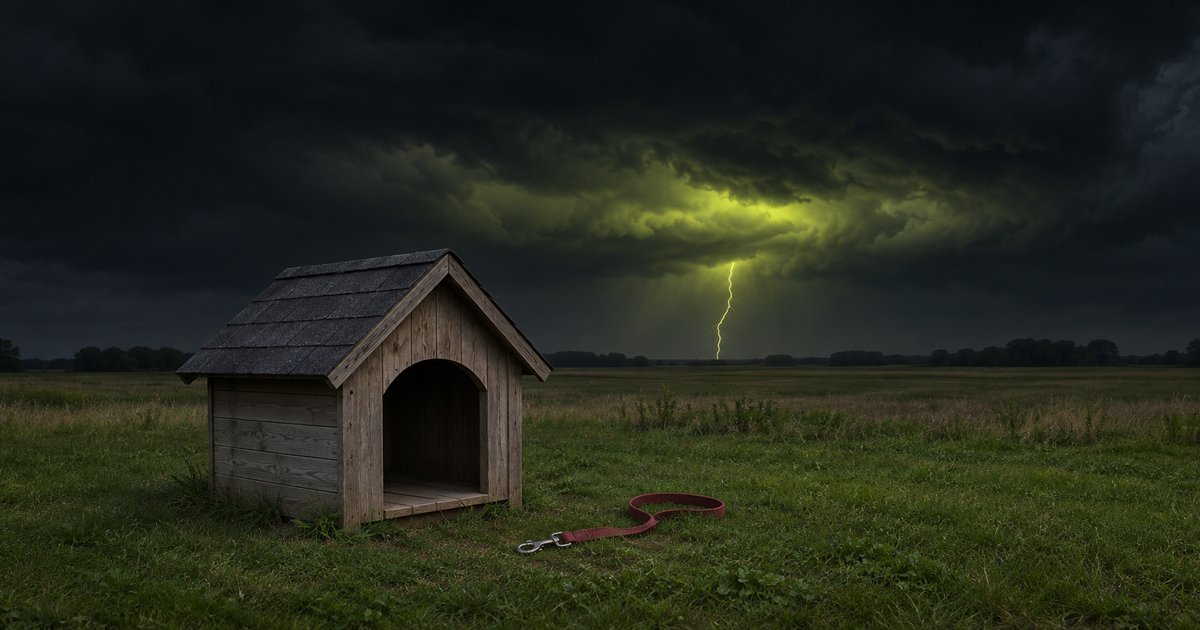
Dogs, cats and other pets belong inside a house or other substantial building when a thunderstorm is in the area. The National Weather Service says a doghouse is not shelter and names dogs chained to trees or on metal runners as particularly vulnerable, so a doghouse, a chain, a tether or a small shed does not stand in for a building.
Pets belong inside a substantial building, and an outdoor setup is not a substitute
The National Weather Service, in its Lightning Indoors guidance (as of November 2026), counts as shelter buildings with electricity and plumbing and metal-topped vehicles with the windows closed. The same page says picnic shelters, dugouts and small buildings without plumbing or electricity do not qualify, and its line for pet owners is short: dog houses are not shelter, and dogs chained to trees or on metal runners are particularly vulnerable to lightning strikes. The Huntsville, Alabama forecast office’s pet brochure makes the same point about tethers. It says tying a pet down outside puts it at high risk from lightning, flooding and flying debris, and it tells owners to bring pets indoors.
Ready.gov’s pet page asks owners to bring pets indoors at the first sign or warning of a storm. The Oregon Department of Agriculture adds two rules: bring pets in well before the storm arrives, and never leave pets or livestock tied up or restrained outside. It also says lightning can kill animals that stand near a fence or a tree that is struck.
| Place | What the source says | Source |
|---|---|---|
| Inside a house or other substantial building | Counts as shelter; pets should get the same cover as people | NWS; Oregon Department of Agriculture |
| Doghouse | Not a shelter | NWS |
| Chained to a tree or on a metal runner | Particularly vulnerable to strikes | NWS |
| Tied down or restrained outside | High risk from lightning, flooding and debris; never leave pets this way | NWS Huntsville; Oregon Department of Agriculture |
| Small shed or rain shelter | Not a shelter | NWS |
| Porch, balcony, open garage or carport | Listed among places for people to stay off during a storm | NWS |
The last row comes from advice written for people: the Lightning Indoors page gives that list to people, not to pets.
Veterinary sources say dogs may be more susceptible than people
The Merck Veterinary Manual’s entry on lightning strike and electrical injury in animals, fully reviewed in July 2025 with an author from the University of California, Davis school of veterinary medicine, says dogs appear to be more susceptible to lightning injury than humans are, and that small dogs are thought to be less susceptible than large ones. One hypothesis it gives is that in four-legged animals current passing between the forelimbs, or between a forelimb and a hindlimb, crosses the heart, while in a standing person the heart is far from the path between the feet. The manual calls the explanation a hypothesis.
The same entry says the most common way lightning injures animals is step potential, which it describes as current spreading on and in the ground away from the strike. That fits what the National Weather Service says about people: ground current causes the most lightning deaths and injuries, and it also kills many farm animals. Because large farm animals have a large body span, the weather service adds, ground current from a nearby strike is often fatal to livestock.
Household pets are struck less often than large animals. The Merck manual says strikes are more likely in large animal species and that chewing electrical cords is the most common cause of electrical injury in small animals, although small animals can be exposed, especially during shared outdoor activities with people. It adds that in most instances of electrocution by lightning, death is instantaneous. PetMD, a pet-health site whose storm article was written by a veterinarian and updated July 8, 2025, says strikes on pets are possible but rare, and usually fatal when they happen.
Indoors, the cautions for people carry over to pets with a few differences
The National Weather Service’s indoor advice lists things people should avoid during a storm: plumbing, so no showers or dishwashing; exterior windows and doors; and concrete floors and walls. It also says lightning enters a structure by a direct strike, through wires or pipes that reach outside, or through the ground. Pet sources carry some of those cautions over. The Oregon Department of Agriculture says to keep pets away from windows during a thunderstorm and not to bathe a pet in one. PetMD says to keep a pet off concrete floors, away from the bathtub and in an interior room without exterior windows and doors, and it calls an interior bedroom the likely best spot.
On one point pet advice pulls in different directions. The ASPCA’s September 2023 advice on frightened pets says that a dog that prefers to hide in a closet or bathroom should be allowed to, and it suggests interior rooms with less noise and fewer flashes of light. PetMD gives a reason to keep a pet out of the bathtub: plumbing can conduct electricity, which matches the weather service’s advice to people to avoid plumbing during a storm. Both pet pages agree on an interior room as the place to start.
Collars are the other difference. A page for pet owners from the Centers for Disease Control and Prevention, last reviewed June 7, 2022, said to take off metal collars, leashes and harnesses and use plastic ones, and it gave a reason that corrects a common belief: metal does not attract electricity, but it conducts it well and can make injuries such as burns worse if the animal is struck. The CDC has since taken that page down; an Internet Archive copy from May 2024 keeps the text. The weather service’s myths page agrees on the first half, saying metal makes no difference to where lightning strikes.
A walk or a yard break during a storm has no protected option
The National Weather Service’s overview of lightning safety says that no outdoor place offers protection when thunderstorms are in the area, and that someone who hears thunder is likely within striking distance of the storm. It names substantial buildings and hard-topped vehicles as the options and says rain shelters, small sheds and open vehicles are not. On a walk, those two options are the whole list.
Not every pet-health page matches that list. PetMD tells owners caught outside with a dog to look for an enclosed structure such as a house, vehicle or shed, and, in a field with nothing else, to crouch as low as possible. The National Weather Service names small sheds as places that do not protect, and on its myths page it says crouching does not lower the risk outdoors. Where the two disagree, the weather service’s guidance is the one to follow.
The better plan is to avoid the situation, and a veterinary source describes how. As of November 2026, Cornell University’s College of Veterinary Medicine advises timing bathroom breaks and outdoor exercise earlier in the day so no one has to go out after a storm or fireworks start, and keeping a dog leashed, even in a fenced yard, if going out cannot be avoided. Coming back out follows the same clock as for people: the weather service says to wait 30 minutes after the last lightning or thunder before going outside.
Cats and other pets get the same advice, with less written about them
Ready.gov and the Oregon Department of Agriculture write “pets” and give one rule for all of them, with no separate lightning rules by species. The Oregon Department of Agriculture’s wording is the broadest: pets should be provided the same cover as humans. PetMD adds a cat-specific risk that has nothing to do with the strike itself, noting that an upset cat may damage the home or run outside, where it can be lost or hurt.
Storm fear matters here because a frightened pet may bolt
The ASPCA’s September 2023 article describes pets that run out of the door or chew or dig through a wall when a storm rolls through, and says pets that bolt can be injured, lost or eat something outside that they should not. As of November 2026, Cornell’s veterinary college lists trembling, panting, pacing, drooling, hiding, digging at doors and escape attempts as signs of fear, and advises owners to keep a dog’s ID collar and microchip information current and to secure the home and yard. A pet that gets out during a storm is outside a building, where the National Weather Service says no place protects anyone.
Both organizations also describe what owners can do. Cornell says punishment must never be used, because it increases distress, and advises staying home with the dog if possible. Both recommend a quiet place for the dog. The ASPCA says storm phobias may worsen with time and that a pet with moderate or severe fear may need help from a veterinarian or veterinary behaviorist. Both organizations mention medication only as something a veterinarian prescribes; Cornell suggests raising it well ahead of a storm and trying any prescribed drug first on a quiet day. Questions about a specific pet, or about any drug, are for that pet’s veterinarian.
What Lightning Tracker adds for a household with pets
Lightning Tracker is an iPhone app that alerts you when a strike is detected inside a radius you set for each place, 10 miles (16 km) by default. For a household with pets, that alert is a prompt to call them in, not a promise of lead time. Detection networks miss some strikes, especially weak ones, and data can arrive late; the app labels delayed or missing data instead of treating it as quiet. Alerts are local notifications, and iPhone settings such as Focus, background refresh and Low Power Mode can change when they arrive, so the iPhone settings that decide when a storm alert arrives are worth checking. It also helps to choose an alert radius that leaves time to bring a dog in from the yard. The app does not replace official warnings or local procedures; it is free on the App Store, with Premium as a subscription.
Not a substitute for official weather warnings.
If you hear thunder, seek shelter even if the app shows no nearby strike.
Sources
- National Weather Service, Lightning Indoors
- National Weather Service, Overview: Lightning Safety
- National Weather Service, Lightning Science: Five Ways Lightning Strikes People
- National Weather Service, Lightning Myths
- National Weather Service Huntsville, Pet Safety brochure
- Centers for Disease Control and Prevention, Lightning Information for Pet Owners (page last reviewed June 7, 2022, since removed from the CDC site; Internet Archive copy of May 10, 2024)
- Ready.gov, Prepare Your Pets for Disasters
- Oregon Department of Agriculture, Caring for Animals during a Thunderstorm
- Merck Veterinary Manual, Lightning Strike and Electrical Injury in Animals, full review July 2025
- PetMD, Thunderstorm and lightning safety for pets, updated July 8, 2025
- ASPCA, Weathering the Storm: How to Help Scared Pets During Storms, September 14, 2023
- Cornell University College of Veterinary Medicine, Fear of fireworks and thunderstorms