 Lightning Tracker
App Store
Home and everyday
Why thunderstorms cut power, and what to prepare before one
November 15, 2026 · 9 min read
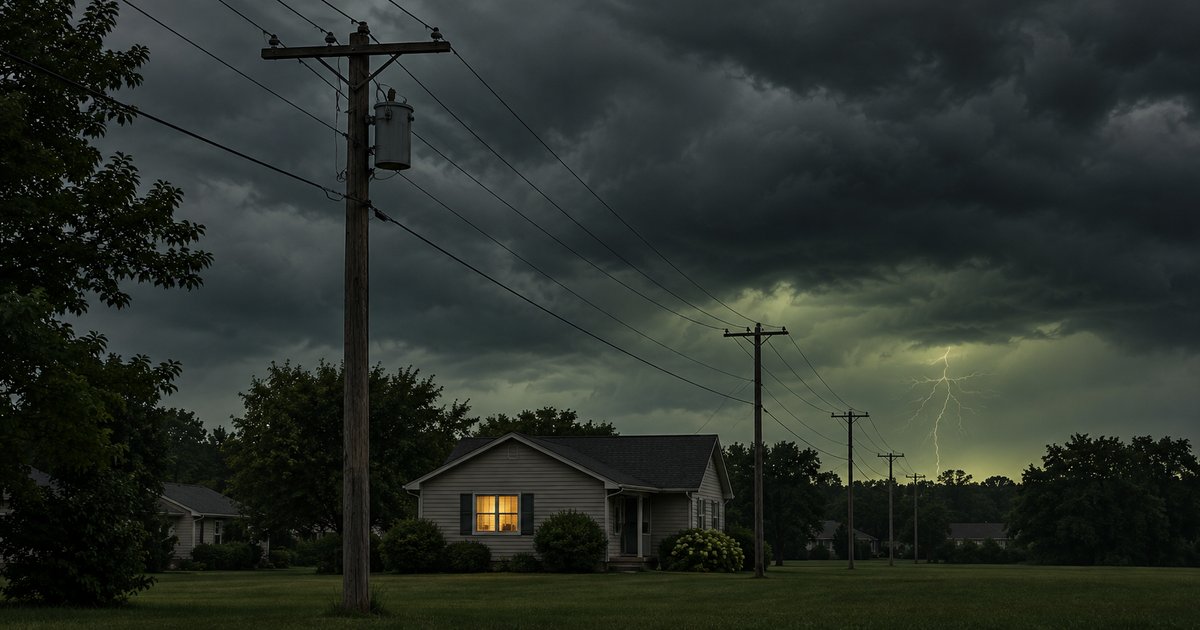
A thunderstorm cuts power when wind, a falling tree or a lightning fault damages or trips part of the grid, and a flicker of the lights is often a protective device testing whether a fault has cleared. Most of what helps is done before the storm: a list of what in your home needs electricity, a plan for food and medicines, and a rule for generators.
Severe weather is the largest recorded cause of U.S. power outages
The U.S. Department of Energy’s 2013 report on grid resilience calls severe weather the single leading cause of power outages in the United States. It says outages from severe weather such as thunderstorms, hurricanes and blizzards made up 58 percent of the outages observed since 2002 and 87 percent of those that affected 50,000 or more customers, using DOE’s Form OE-417 reports. Thunderstorms are one named part of that group, so the percentages do not isolate them.
DOE’s 2015 Quadrennial Energy Review adds where and how. Severe thunderstorms, it says, can cause problems in most regions, particularly the Midwest, Southeast and Mid-Atlantic, while the West sees many outages caused by lightning and wildfires. The review also says distribution outage causes vary with the circuit and the season: one utility may see mostly tree-related outages on one circuit and wind-related outages on the neighboring one, and lightning may be a consistent cause in some months but not in others. Both documents date from 2013 and 2015, so they show a historical pattern, not this year’s count.
Lightning causes faults on power lines when its voltage exceeds what the insulation can take
The IEEE guide to the lightning performance of overhead distribution lines, summarized in a 1999 presentation by the chair of the IEEE working group, opens with the statement that lightning is a major cause of faults on typical distribution lines. The presentation names two routes: a direct stroke to the line, and voltage induced by a stroke nearby. It says direct strokes produce very high overvoltages while insulation is usually capable of handling only 100 to 500 kilovolts, and that induced voltages are usually under 300 kilovolts but cause more trouble on lines with nearby trees, because trees bring strokes closer to the line. The guide covers lines of 69 kilovolts and below.
On overhead distribution lines, the same presentation says, lightning usually causes temporary faults. It cites an estimate that 5 to 10 percent of lightning-caused faults leave permanent damage to equipment, and it adds that a temporary fault can still become a lasting interruption when a one-shot protective device such as a fuse clears it.
DOE’s 2015 review looks at the high-voltage side. Lightning and non-lightning weather causes, it says, are associated with the largest number of recorded transmission outages in North American Electric Reliability Corporation data, but protective devices and other designed-in measures can clear and restore these momentary events quickly. The National Weather Service describes the other end of the line: lightning can reach a building through wires or pipes that extend outside it, and it generates surges that can damage electronic equipment some distance from the strike.
A flicker usually means a protective device tested the line
A recloser is a protective device on the power lines that works a lot like a fuse or a circuit breaker, according to Rappahannock Electric Cooperative (REC) in a March 5, 2026 explainer on power blinks. When something briefly touches a line, such as a tree limb, an animal or storm-related debris, REC says, the recloser can shut the power off for a moment and turn it back on to see whether the problem cleared. If it did, power returns, and that is the blink. If it did not, the recloser may try again, and after a few tries it stays off until crews fix the cause. REC’s point is that without reclosers a brief contact could shut off a larger section for longer. The IEEE presentation gives the same logic from the engineering side: if a breaker or recloser clears a lightning fault, the circuit may be successfully reclosed.
| What you notice | What a source says may be behind it |
|---|---|
| The lights blink and stay on | REC: a recloser opened, tested the line and closed again because the problem had cleared |
| The lights blink once or twice, then the power stays out | REC: the problem persisted, so the recloser stayed off until crews fix the cause |
| The power goes out and stays out after a lightning fault | IEEE: a temporary lightning fault can become a lasting interruption when a one-shot device such as a fuse clears it |
A blink is not always harmless to equipment. REC says power blinks can occasionally interrupt electronics, and it suggests a quality surge protector for computers, TVs and other sensitive devices. The Energy Information Administration counts only non-momentary interruptions in its yearly totals, so a blink does not appear in the hours quoted below.
Wind and falling trees damage lines in severe thunderstorms
The National Weather Service defines a severe thunderstorm as one capable of producing hail an inch or larger or wind gusts over 58 mph, and it says wind that strong can break off large branches or knock over trees. Some severe thunderstorms, it adds, produce winds over 100 mph. For the grid itself, DOE’s 2013 report says placing lines underground removes the distribution system’s susceptibility to wind damage, lightning and vegetation contact, but that underground lines bring extra repair time and much higher costs, with burying overhead wires running between $500,000 and $2 million per mile.
The same DOE report says roughly 90 percent of all outages occur along distribution systems, a figure it attributes to the Edison Electric Institute, and that vegetation management programs can help prevent damage to these lines.
Federal data give outage hours for a year, not for one storm
The Energy Information Administration reported on December 1, 2025 that U.S. electricity customers experienced an average of 11 hours of interruptions in 2024, nearly twice the annual average of the decade before. Major events such as Hurricanes Beryl, Helene and Milton accounted for 80 percent of those hours. Interruptions not triggered by major events, EIA says, routinely average about two hours per year, and the 2024 average was 1.5 interruptions per customer. South Carolina customers had nearly 53 hours that year, while customers in Arizona, South Dakota, North Dakota and Massachusetts averaged under two hours.
Those figures sum every cause over twelve months, and 2024 was dominated by hurricanes, so they do not say how long a power cut after an ordinary thunderstorm lasts. The National Weather Service’s Central Illinois office says in its Severe Weather Preparedness Week page for March 2026 that some storms produce power outages lasting several days, so the restoration estimate your own utility gives for your outage is the better guide.
Before the storm, list what needs electricity and plan for food and medicines
Ready.gov’s power outage page, as of November 2026, starts with an inventory of the items you need that rely on electricity, with a plan for batteries or a portable charger or power bank, flashlights for every household member, and a check of whether your home phone will work in an outage and how long its battery backup lasts. For medical devices and refrigerated medicines it tells readers to talk to a medical provider about a plan, and to find out how long a medication can be stored at higher temperatures. The National Weather Service’s Central Illinois office lists a kit for outages that can last several days, including bottled water, non-perishable food, flashlights and extra batteries, extra clothing and blankets, medications and a first aid kit, and a weather alert or AM/FM radio.
| Item | What the page says |
|---|---|
| Refrigerator, door kept closed | Keeps food cold for about four hours |
| Full freezer, door kept closed | Keeps its temperature for about 48 hours |
| Food that reached 40 °F or higher | Throw away food exposed to 40 °F or higher for two hours or more, or with an unusual odor, color or texture |
| Refrigerated medication after more than a day without power | Discard it unless the drug’s label says otherwise, and ask a doctor or pharmacist for a new supply |
The page also recommends coolers with ice if necessary and a thermometer to monitor temperatures. Ready.gov’s thunderstorm page adds one step that belongs before the storm: cut down or trim trees that may be in danger of falling on your home.
Generators and heat sources create a carbon monoxide risk during outages
The Centers for Disease Control and Prevention’s carbon monoxide page, dated October 26, 2026, describes carbon monoxide as an odorless, colorless gas, and says more than 400 Americans die each year from unintentional poisoning not linked to fires, with more than 100,000 emergency department visits and more than 14,000 hospitalizations. Its generator rules match Ready.gov’s: operate a generator only outside, more than 20 feet from windows, doors and vents, never inside a home or garage even with doors and windows open, and use a battery-powered or battery backup carbon monoxide detector. Ready.gov adds that a wet generator or a device connected to one can cause electric shock, and that a gas stove or oven should never heat a home.
After the storm, downed lines and fallen trees need distance and a report
Ready.gov’s thunderstorm page tells readers to watch for fallen power lines and trees and to report them immediately. Tucson Electric Power’s storm page, a utility’s own advice, says never to touch a downed line and to call 911 if you see one or other damaged equipment. It also says that if a line touches your vehicle you should stay inside until help arrives, because stepping out can make your body the path for electricity to the ground, and that you should never try to remove tree limbs touching downed lines.
Advice about unplugging differs between the storm and the outage
The advice seems to disagree because it was written for two different moments. The National Weather Service’s lightning indoors page says not to unplug equipment during a thunderstorm because you could be struck. Ready.gov’s power outage page says to turn off or disconnect appliances and electronics because power may return with momentary surges or spikes that can cause damage, and its thunderstorm page says that under a thunderstorm warning you should avoid electronic devices connected to an outlet. Tucson Electric Power says it is too late to unplug electronics if the storm is nearby. No page covers an outage that starts while thunder is still audible. Read together, they point to switching things off before the storm arrives; once a storm is overhead, the weather service’s advice is not to unplug.
What Lightning Tracker adds before the lights go out
Lightning Tracker is an iPhone app, available on the App Store, that alerts you when a strike is detected inside a radius you set for each place, 10 miles (16 km) by default, and warns when strikes are coming closer. That alert can be the cue to finish the preparation above, such as charging phones and power banks and finding the flashlights. The alert is tied to detected lightning, not to wind or to a utility outage, so a storm can cost you power without any alert. Detection networks miss some strikes, especially weak ones, and data can arrive late. The app’s alerts are local notifications after the app checks data, and iPhone settings such as Focus, background refresh and Low Power Mode can change when they arrive. The app does not replace official warnings or local procedures.
Not a substitute for official weather warnings.
If you hear thunder, seek shelter even if the app shows no nearby strike.
Sources
- National Weather Service Central Illinois, Severe Weather Preparedness Information
- National Weather Service, Severe Thunderstorm Safety
- National Weather Service, Lightning Safety: Indoors
- Ready.gov (FEMA), Power Outages
- Ready.gov (FEMA), Thunderstorms & Lightning
- Centers for Disease Control and Prevention, Carbon Monoxide (CO) Poisoning Basics
- U.S. Department of Energy, Economic Benefits of Increasing Electric Grid Resilience to Weather Outages, August 2013
- U.S. Department of Energy, Quadrennial Energy Review, Appendix C: Electricity, April 2015
- U.S. Energy Information Administration, Hurricanes in 2024 led to the most hours without power in the United States in 10 years, December 1, 2025
- IEEE Power Engineering Society, Application of the IEEE Guide for Improving the Lightning Performance of Electric Power Overhead Distribution Lines (Std. 1410-1997), April 1999
- Rappahannock Electric Cooperative, Power Blinks Explained: Why a Flicker Often Means the Grid is Working, March 5, 2026
- Tucson Electric Power, During a Storm: Outage & Storm Safety