 Lightning Tracker
App Store
Home and everyday
Can you charge an electric car during a thunderstorm? What the manuals say
November 14, 2026 · 6 min read
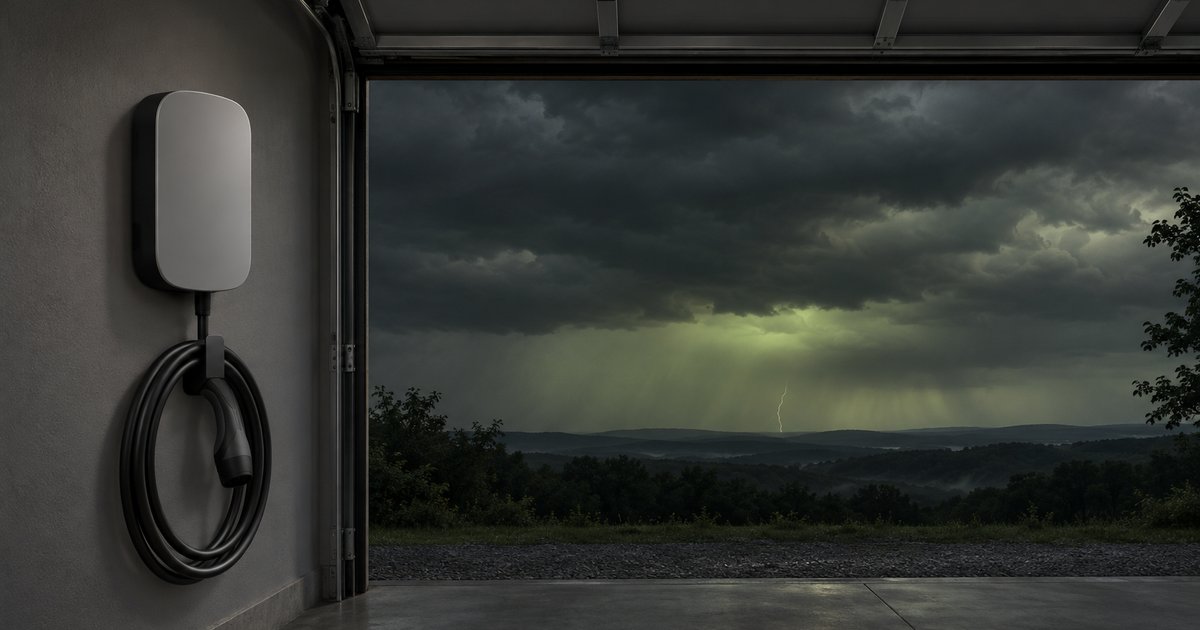
The sources that address the question point to waiting: Kia, Hyundai, Toyota and ChargePoint advise against charging when lightning is a risk, Ford, Tesla and Nissan warn against using or touching charging equipment in an electrical storm, and the National Weather Service says not to touch plugged-in electrical equipment during a thunderstorm. The wording differs by maker, one automaker’s page calls charging in a storm generally fine, and none of the pages says what to do when a storm arrives in the middle of a charge.
Makers and charging networks word the lightning advice differently
Charging companies and automakers that mention lightning do not use the same words, so the table gives each page’s instruction, its date where it has one, and what it covers. All entries were read on November 10 and 11, 2026.
| Source | What it says | What it covers |
|---|---|---|
| ChargePoint, charging network (FAQ updated June 16, 2026) | Charging works in any weather; you may want to avoid charging in a thunderstorm with lightning | Drivers using its stations; no reason given |
| Kia, 2024 U.S. electric vehicle guide | Do not charge when there is lightning or a potential for lightning | The vehicle’s charging; a separate line covers a wet connector |
| Hyundai, online owner’s manual, 2026 edition | Do not charge the vehicle if there is a risk of lightning | The page names no model. A 2024 edition’s charging page says only to be careful when there is lightning |
| Toyota, plug-in hybrid manuals OM47A88U and OM47C17U | Do not charge the vehicle during a lightning storm | The vehicle’s charging; both documents carry the line |
| Nissan, 2025 LEAF online manual (copy on Nissan’s Malta site) | Do not touch the vehicle or the charging equipment when there is lightning, because of electric shock | Touching, not starting or stopping a charge; not a U.S. edition |
| Ford, 2023 Mustang Mach-E manual (U.S. and Canada, edition of September 2022) | Do not use the charging equipment in severe rain, snow or an electrical storm | The section on the Ford Mobile Charger, the portable cord |
| Tesla, Gen 3 Mobile Connector manual (North America, February 9, 2025) | Do not use the connector when you, the vehicle or the connector is exposed to severe rain, snow, an electrical storm or other inclement weather | The portable connector |
| Mazda USA, resource center page | Charging in a thunderstorm is generally fine, though likely not ideal for the driver | Any EV charger; the page’s wording is about a storm, not lightning |
| GARO, wallbox maker in Sweden | Disconnect the cable and stop charging if there is a thunderstorm | General advice on a page about its own wallbox |
Three patterns show up. Kia, Hyundai, Toyota, ChargePoint and GARO address the charge itself: do not charge, or avoid charging, when lightning is a risk. Ford, Tesla and Nissan address the equipment: do not use it or touch it during an electrical storm or lightning. Mazda’s page reads the other way and calls charging in a thunderstorm generally fine. Kia’s wording is the broadest, because it names the potential for lightning and not only lightning that is already happening.
Scope matters when reading the table. Ford’s and Tesla’s warnings sit in the manuals for their portable charging cords, so they do not by themselves describe a wall-mounted charger or a public station. Your own manual, for your own car and your own charger, is the document that applies, and one maker’s rule does not carry over to another.
Rain and lightning are separate rules in the manuals
The U.S. Department of Energy’s Alternative Fuels Data Center says that outdoor installation and use of home charging equipment is fine even if the vehicle is being charged in the rain, provided the equipment is outdoor-rated. That page, read in November 2026, does not mention lightning.
The manuals keep the two hazards apart. Toyota’s documents give steps for charging while it is raining or snowing and, on a separate line of the same warning list, say not to charge during a lightning storm. Kia tells owners not to charge when the connector and plug are wet and, on another line, not to charge when there is lightning. Hyundai’s 2024 charging page has the same two-line structure with softer wording: be careful when the connector is wet, and be careful when there is lightning. A page that says charging in rain is fine therefore does not answer the lightning question, and ChargePoint’s FAQ says so itself by adding “however” after its any-weather sentence.
The National Weather Service says not to touch plugged-in equipment and not to unplug it
The National Weather Service’s lightning-indoors page tells people not to touch electrical equipment such as computers, TVs or cords during a thunderstorm, and, further down the page, says not to unplug equipment, because there is a risk the person could be struck. The page gives the mechanism: once lightning reaches a building, it can travel through the electrical, phone, plumbing and radio and television reception systems.
The page does not name EV chargers. Reading a charging cable as one of the cords in that rule is an interpretation, and it is the reading Nissan’s manual states directly for the vehicle and its charging equipment. Put side by side, the pages leave a gap: the makers say not to charge or touch during lightning, the Weather Service says not to unplug, and no page says what a driver should do when a charge is already running as the storm arrives. The Weather Service’s lightning tips page also says to stay in a substantial building or hard-topped vehicle for at least 30 minutes after the last thunder. No maker page gives a waiting time before charging or handling the cable again, so that is the only timer in these sources, and applying it to a charger is an interpretation too.
A strike on the car or the charger: what the sources describe
The National Weather Service says the outer metal shell of a hard-topped metal vehicle protects the people inside when the windows are closed, and that the vehicle does not always fare as well. Its Lightning and Cars page says damage to the antenna, electrical system, rear windshield and tires is common, and that part of the discharge may reach the electrical system and damage or destroy electronic components, potentially leaving the car inoperable. The page describes ordinary cars. It does not discuss an electric car’s battery or drivetrain, and no maker page says what happens to one in a strike.
For charging equipment, the sources are the makers’ own statements. GARO says its wallbox has built-in surge protection for the charger and the vehicle, and adds that lightning strikes can still cause damage. Tesla’s Gen 3 Wall Connector manual, published January 15, 2020, lists lightning among the external factors that its charging-equipment limited warranty does not cover.
A plug-in surge protector does not appear as a fix in the sources read. Ford’s Mobile Charger section says not to use the charging equipment with an extension cord, surge protector, timer or other adapter, and the Weather Service says typical surge protectors will not protect equipment from a lightning strike.
What the pages leave unanswered
No page gives how often electric cars or chargers are struck during a charge. No maker separates a home wallbox from a public station in its lightning wording. None says why its instruction exists beyond Nissan’s mention of electric shock and GARO’s note that thunderstorms can damage a wallbox and the car.
Deciding before the storm arrives
FPL, a Florida utility, advises EV owners to charge before a storm arrives if conditions allow and to avoid charging during a storm, and its page says to unplug the charging handle from the vehicle before a storm arrives. The page is written around storms with flooding and landfall and does not mention lightning, so it supports timing the charge, not a lightning rule. Read together, the sources point to making the plug decision before the first thunder: the makers say not to charge or touch the equipment once lightning is a risk, and the Weather Service says not to unplug during a thunderstorm. Lightning Tracker, an iPhone app, alerts you when a strike is detected inside a radius you set for each place, 10 miles (16 km) by default, which can be the cue to settle a charge before the storm is overhead.
Not a substitute for official weather warnings.
If you hear thunder, seek shelter even if the app shows no nearby strike.
Sources
- Charging network ChargePoint Can I charge my electric vehicle in any weather? (updated June 16, 2026)
- Kia, Precautions for charging electric vehicle (2024 U.S. electric vehicle guide)
- Hyundai, Safety Precautions for Charging Your Electric Vehicle (2026 online owner’s manual)
- Hyundai, Charging Precautions (2024 online owner’s manual)
- Toyota, plug-in hybrid owner’s manual OM47A88U (PDF)
- Toyota, plug-in hybrid owner’s manual OM47C17U (PDF)
- Nissan, 2025 LEAF owner’s manual, Precautions on charging (copy on Nissan’s Malta site)
- Ford, 2023 Mustang Mach-E Owner’s Manual, U.S. and Canada (PDF)
- Tesla, Gen 3 Mobile Connector Owner’s Manual, North America (PDF, February 9, 2025)
- Tesla, Gen 3 Wall Connector Manual (PDF, January 15, 2020)
- Mazda USA, Can You Charge an Electric Car in the Rain or Snow?
- GARO, Charging your electric car in stormy weather
- FPL, Electric Vehicle Safety (storm preparation)
- U.S. Department of Energy, Alternative Fuels Data Center, Charging Electric Vehicles at Home
- National Weather Service, Lightning Indoors
- National Weather Service, Lightning and Cars
- National Weather Service, Lightning Tips