 Lightning Tracker
App Store
Storm basics
The smell before a storm: ozone and lightning
November 10, 2026 · 6 min read
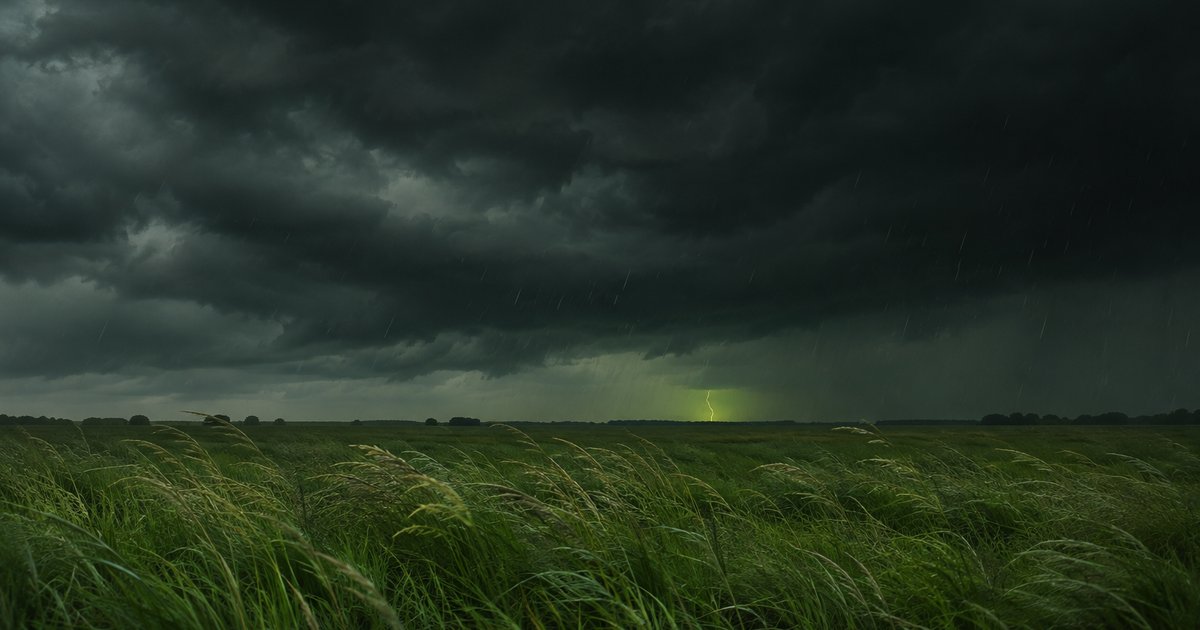
The sharp, fresh smell people notice before a storm is often attributed to ozone, a gas that lightning helps create, according to NOAA's National Severe Storms Laboratory (NSSL), but as of November 2026 none of the sources reviewed for this article shows a smell that reliably comes before a lightning strike. A 2003 PNAS model of U.S. air chemistry points to lightning's ozone being made mostly aloft, and a 2022 study and Scientific American describe ozone reaching the ground on a storm's downdraft without a nearby bolt having made it. CSIRO and Scientific American tie the earthy smell of rain on dry ground to water meeting the ground. Treat a storm smell as a reason to look at the sky and the forecast, not as a warning that will wait for you.
Lightning helps make ozone, mostly high above you
Ozone is a gas made of three oxygen atoms, according to the Environmental Protection Agency (EPA), and the NIOSH Pocket Guide, published by the National Institute for Occupational Safety and Health, describes it as a colorless to blue gas with a very pungent odor. NOAA's National Severe Storms Laboratory (NSSL) says lightning also makes ozone-producing chemicals.
A 2003 study by Zhang, Tie and Bond in the Proceedings of the National Academy of Sciences modeled how lightning and surface sources of nitrogen oxides, gases that feed ozone chemistry, shape the air over the contiguous United States. It found that summer lightning plays a dominant role in controlling nitrogen oxide and ozone concentrations in the middle and upper troposphere. In its July results, lightning changed ozone by 30 percent or more between about 2.5 and 7.5 miles (4 to 12 kilometers) up. The paper also describes ozone forming photochemically, through reactions that involve light, so the chemistry is a chain of steps and not a single event at the instant of a flash.
The study is a model of regional air chemistry and does not discuss smell. Its strongest modeled ozone effect from lightning is aloft; it does not show what a person smells, if anything, near a lightning strike.
How storm ozone could reach your nose before the rain
Scientific American reported in July 2012 that the sharp, fresh aroma of ozone is one of the first odors noticeable as winds pick up and clouds roll in before rain. The magazine wrote that the scent heralds stormy weather because a thunderstorm's downdrafts carry ozone from higher altitudes to nose level. It attributed the lightning chemistry to Louisa Emmons, a tropospheric chemist at the National Center for Atmospheric Research. The downdraft sentence is the article's own, and it gives no lead time.
A 2022 paper in Atmospheric Chemistry and Physics documents one case of ozone arriving this way. On the night of July 31, 2021, surface ozone across the North China Plain reached 80 to 90 parts per billion by volume, 40 to 50 above the monthly mean, and the rise came abruptly, 40 to 50 within 10 minutes. The authors traced it to ozone-rich air from the stratosphere, carried down by the remnants of Typhoon In-fa and then to the surface by the downdrafts of local storms, and they call such an event rarely documented.
That case shows ozone riding a downdraft. It does not show a smell before a strike, and the authors trace the ozone to air from above, not to a bolt. A sharp smell as a storm arrives may therefore be ozone made by earlier lightning, ozone carried down from above, or both, and the nose cannot tell which.
Petrichor is the smell of rain meeting dry ground
Petrichor is the name two scientists at Australia's CSIRO, Isabel (Joy) Bear and Richard Thomas, proposed in a Nature paper of March 7, 1964, titled “Nature of Argillaceous Odour.” CSIRO's account says that by steam distilling rocks exposed to warm, dry conditions they found a yellowish oil, trapped in rocks and soil but released by moisture, responsible for the smell.
Scientific American's 2012 rundown describes falling water displacing odor-carrying molecules from surfaces, particularly dry ones, and carrying them into the air; near plants and trees they may come from the plants, and in cities from concrete and asphalt. It adds a third piece, geosmin, the earthy-musty smell it describes as a by-product of bacteria or blue-green algae.
Accounts disagree on timing. CSIRO describes the oil as released into the air before rain begins to fall, while Scientific American says the rain-related odors come once the rains arrive. All of them start with water meeting ground, which is why petrichor says that rain is arriving or has arrived and says nothing about whether a storm is electrically active.
The burning smell some safety pages list
The Maine Emergency Management Agency lists an abnormal burning smell in the air among signs of an imminent strike, adding that static discharges within the air give off an unusual odor. The same page says such signs come sometimes, but not always, and that there is little, if any, time to take action. It does not name ozone.
When this article was prepared on November 7, 2026, the National Weather Service national lightning pages, the NWS Miami and Marquette office pages and NSSL's lightning basics page did not mention a smell, an odor or ozone as a warning. What causes a smell just before a strike, if anything does, is therefore not answered by the safety sources reviewed.
The three smells side by side
The table sets out what the sources tie each smell to, and when it is reported.
| Smell | What the sources tie it to | When it is reported | As a warning of a strike |
|---|---|---|---|
| Ozone, sharp and fresh | Chemicals made by lightning (NSSL); ozone carried down from higher up by downdrafts (Scientific American, 2022 case study) | As winds pick up and clouds roll in, per Scientific American | No source gives a lead time |
| Petrichor and geosmin, earthy | Oil in rocks and soil (CSIRO); displaced odor molecules and bacterial geosmin (Scientific American) | As rain reaches dry ground; accounts differ on whether just before or with the rain | None; it needs rain, not lightning |
| Burning smell | “Static discharges within the air” (Maine agency page) | Listed among signs of an imminent strike | One state agency page; signs come “sometimes, but not always” |
What to do when the air smells like a storm
The National Weather Service names thunder as its cue: if you hear thunder, even a distant rumble, you are already in danger of becoming a lightning victim. NSSL adds that when the first flash of a storm is cloud-to-ground, it comes without any warning from previous thunder, so a quiet sky is not proof that nothing is coming.
What happens right before lightning strikes nearby? Sometimes there is a warning, and sometimes there is none. A Maine Emergency Management Agency page, whose answers it says were provided by the National Weather Service (undated), lists hair standing on end, a snapping or crackling sound, a tingling feeling and an abnormal burning smell. It says any of these means lightning is about to strike you or somewhere very near you, with little, if any, time to act. So do not wait for a sign: if you hear thunder, the same page says to get into a substantial building immediately or, if none is available, a hard-topped metal vehicle with the windows rolled up.
If a storm smell makes you look up, and the clouds are building or the forecast calls for thunderstorms, move toward shelter now instead of waiting for a second sign. Where to shelter from lightning explains what counts as a substantial building or hard-topped vehicle, flash to bang shows how to turn thunder into a distance, and why wait 30 minutes covers how long to stay inside. A smell can start the check; it should not end it.
What a map can add that a nose cannot
The Lightning Tracker iPhone app shows recent detected strikes on a live map, with the distance and direction to the nearest one and how many minutes ago it was, and it alerts you when a strike is detected inside a radius you set for each place, 10 miles (16 km) by default. Detection networks miss some strikes and data can arrive late, and the app marks a delay or a gap instead of counting it as calm; how lightning is detected explains why. The app does not replace official warnings or local procedures.
Not a substitute for official weather warnings.
If you hear thunder, seek shelter even if the app shows no nearby strike.
Sources
- NOAA National Severe Storms Laboratory, Severe Weather 101: Lightning FAQ
- Zhang, Tie and Bond, Impacts of anthropogenic and natural NOx sources over the U.S. on tropospheric chemistry, Proceedings of the National Academy of Sciences, 2003
- U.S. Environmental Protection Agency, Ground-level Ozone Basics
- NIOSH, NIOSH Pocket Guide to Chemical Hazards: Ozone
- Daisy Yuhas, Storm Scents: It's True, You Can Smell Oncoming Summer Rain, Scientific American, July 18, 2012
- Chen et al., Transport of substantial stratospheric ozone to the surface by a dying typhoon and shallow convection, Atmospheric Chemistry and Physics, June 24, 2022
- CSIRO, The smell of rain: how our scientists invented a new word (March 31, 2015)
- Maine Emergency Management Agency, Lightning Safety
- National Weather Service, Understanding Lightning Science