 Lightning Tracker
App Store
Storm basics
Heat lightning: lightning too far away to hear
November 12, 2026 · 6 min read
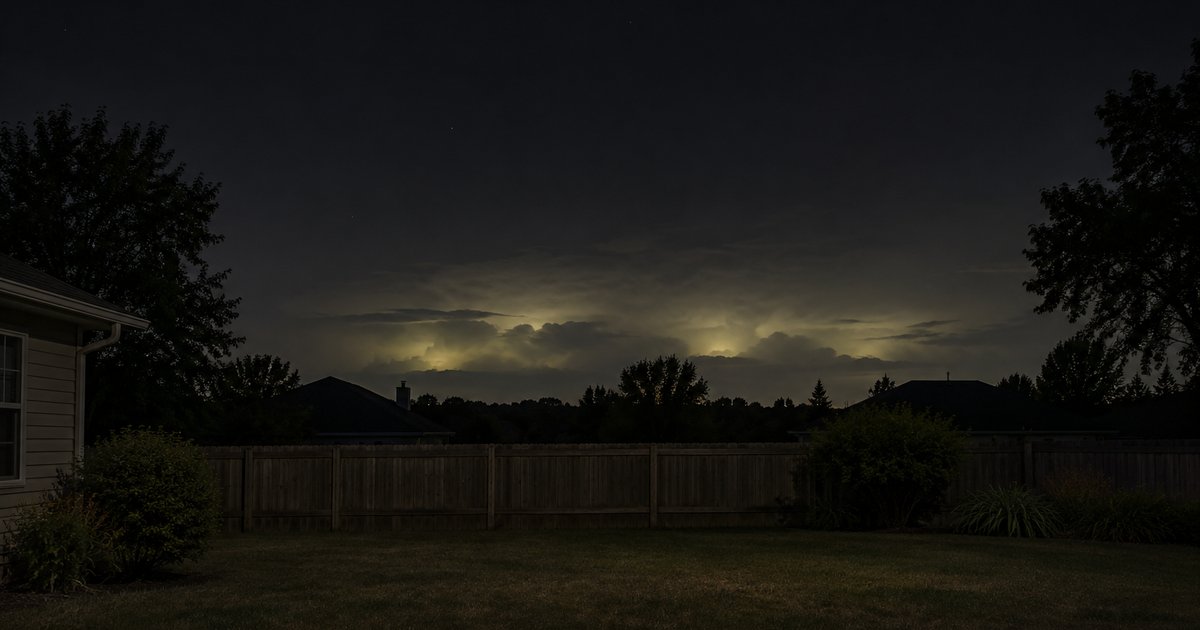
Heat lightning is ordinary lightning from a thunderstorm too far away for its thunder to reach you. The National Weather Service says it is not a separate type of lightning, only the light of a distant storm. The silent flashes are not a reason to relax: storms move, and the National Weather Service says lightning can strike 10 to 15 miles from its storm, about where thunder stops being audible.
Compared with nearby lightning, heat lightning has no different electrical cause: NOAA's National Severe Storms Laboratory says it is no different from regular lightning. What changes is what reaches you from a distant storm: you can see its light, but the thunder is too far away to hear.
What the name actually covers
The National Weather Service uses “heat lightning” for lightning from a distant thunderstorm that is just too far away for an observer to see the cloud-to-ground flash or hear its thunder, and it points out that many people wrongly treat the term as a specific type of lightning. The NOAA National Severe Storms Laboratory (NSSL) defines it slightly more broadly: any lightning, inside a cloud or to the ground, or the glow it causes, that is too far away for thunder to be heard. NSSL adds that the nickname exists because the effect is noticed most often in summer. The name describes when people see it, not what causes it.
So the long-running argument over whether heat lightning “exists” is mostly about wording. The flashes are real lightning. What does not exist is a separate, heat-driven kind of lightning.
Why you see a glow instead of a bolt
At a distance, the lightning flash itself is often hidden. The National Weather Service says mountains, hills, trees or the curvature of the Earth can block the view of the actual flash, so what you notice is a faint flash of light reflected off higher-level clouds. NSSL describes a related effect for flashes inside a cloud, which light up the whole cloud like a sheet, and notes that distant lightning may look reddish, as sunsets do, because blue light is scattered.
That is why the typical report is a flicker along the horizon or inside a cloud bank, with no branching bolt in sight.
Why the thunder never arrives
Can lightning happen without thunder? The National Severe Storms Laboratory says a lightning flash produces thunder, but you may see the flash without hearing it when the storm is too far away. Can thunder happen without lightning? No: NSSL says thunder starts as a shock wave when the lightning channel rapidly heats the air. As the sound travels, it becomes stretched and muted. NOAA's JetStream education pages say that when air temperature falls with height, which is the usual situation, thunder normally has an audible range of up to 10 miles (16 km). The National Weather Service gives the same figure of about 10 miles from a flash. Past that, the light still reaches you and the sound does not.
Ten miles is a typical value, not a wall. JetStream explains that when air warms with height, an inversion, sound bends back toward the ground and can add to what you hear. So the cutoff shifts with the air layers on a given night, and the same distant storm can sound quieter or louder from one evening to the next. For the counting method that turns a delay into a distance, see flash to bang.
How far away the storm is
Distance is what separates heat lightning from the lightning you hear, but the sources describe it at three different scales, so here they are side by side.
| Distance | What you are likely to notice | What the sources say |
|---|---|---|
| Within about 10 miles (16 km) of a flash | Thunder is normally audible. | The National Weather Service says that if you hear thunder, you are likely within striking distance of the storm. |
| About 10 to 15 miles (16 to 24 km) from the storm | Thunder usually fades out, while flashes can still be seen. | The National Weather Service says “bolts from the blue” can strike 10 to 15 miles from the thunderstorm. |
| Farther, roughly 30 to 100 miles (48 to 160 km) | Faint flashes or glowing clouds with no thunder at all. | Only secondary sources give a range; no National Weather Service or NOAA page we reviewed does. |
The thunder figure is measured from the flash and the bolt-from-the-blue figure from the storm, so the rows overlap rather than line up. They still show the point: the stretch from about 10 to 15 miles is where thunder goes quiet while strikes remain possible.
How far the flashes can be seen is the least certain number here. As of November 2026, Wikipedia says the most intense storms can be seen up to 100 miles away over flat ground or water, with 30 to 50 miles more common because of terrain, trees and low clouds. The Farmers' Almanac says 50 to 100 miles on a clear night. Treat both as loose estimates: the storm's height, terrain and low clouds all change the answer.
Silent flashes are not an all-clear
A storm far enough away to be silent stays out of reach only as long as it stays away, and storms move. The National Weather Service describes the threat as rising as a thunderstorm approaches and peaking when it is overhead, so flashes that you can only see belong to an earlier stage of that curve, not to a different kind of storm. Lightning also does not stay under the rain: the National Weather Service says it often strikes more than three miles from the center of the storm.
A reasonable reading is that flashes growing brighter, more frequent or higher in the sky point to a storm coming closer, though no source gives a threshold. The one signal the National Weather Service does put a line on is sound. Thunder you can hear means you are likely within striking distance, and from that moment the advice is to go indoors and to wait 30 minutes after the last lightning or thunder. Where to shelter and why the wait restarts cover the details.
Counting does not help much while the sky is silent. At about five seconds per mile, ten miles is roughly 50 seconds, so a flash with no thunder after a minute was likely beyond that. Without a bang, though, the count never ends, so it cannot place the storm. It only says the storm is out of earshot.
Other flickers that are not heat lightning
Two nearby terms cause confusion. NSSL defines dry lightning as lightning that occurs without rain nearby, so that term is about rain, not about distance. A dry-lightning storm can be overhead with thunder you can hear. The other is the sprite, a red, brief flash high above a thunderstorm that NSSL says reaches up to 60 miles from the cloud top, is visible only at night and is rarely seen with the human eye. Because sprites are so seldom seen without sensitive cameras, the flicker most people watch from a porch is ordinary lightning.
Finding the storm behind the flashes
A lightning map can show what the horizon only hints at. Lightning Tracker is an iPhone app that shows recently detected strikes on a live map, with the distance and direction to the nearest one and how many minutes ago it was detected. Its alerts fire when a strike is detected inside a radius you set for each place, which defaults to 10 miles (16 km), roughly the range of thunder, and it also warns when strikes noticeably approach. A storm that flickers beyond your radius can be on the map, but the radius alert waits for strikes inside it. The article on choosing an alert radius explains how to size it for your place.
The map has limits, and heat lightning shows why they matter. Detection networks miss some strikes, especially weak ones, and data can arrive late, which the app labels instead of treating as quiet. If you can see flashes while the map shows nothing, trust your eyes: an empty map is an observation, not proof, as how lightning is detected explains. The app does not replace official warnings.
A short routine for a night of silent flashes
- Note the pattern. Brighter, more frequent or higher flashes suggest the storm is nearer.
- Listen between flashes. The first thunder you hear is the National Weather Service's cue to go indoors.
- Check a map or official warnings. Detected strikes and warnings cover storms your horizon hides.
- Keep the wait. After the last lightning or thunder, wait 30 minutes before going back out.
Not a substitute for official weather warnings.
If you hear thunder, seek shelter even if the app shows no nearby strike.
Sources
- National Weather Service, Heat Lightning
- NOAA National Severe Storms Laboratory, Severe Weather 101: Lightning Types
- NOAA National Severe Storms Laboratory, Severe Weather 101: Lightning FAQ
- NOAA JetStream, The Sound of Thunder
- National Weather Service, Understanding Lightning: Thunder
- National Weather Service, Lightning Myths
- National Weather Service, Lightning Safety Overview
- Wikipedia, Heat lightning, secondary source, read November 2026
- Farmers' Almanac, What Makes Heat Lightning? (And Is It Really Lightning?), updated July 27, 2026, secondary source