 Lightning Tracker
App Store
Storm basics
How far away can you see lightning?
November 18, 2026 · 4 min read
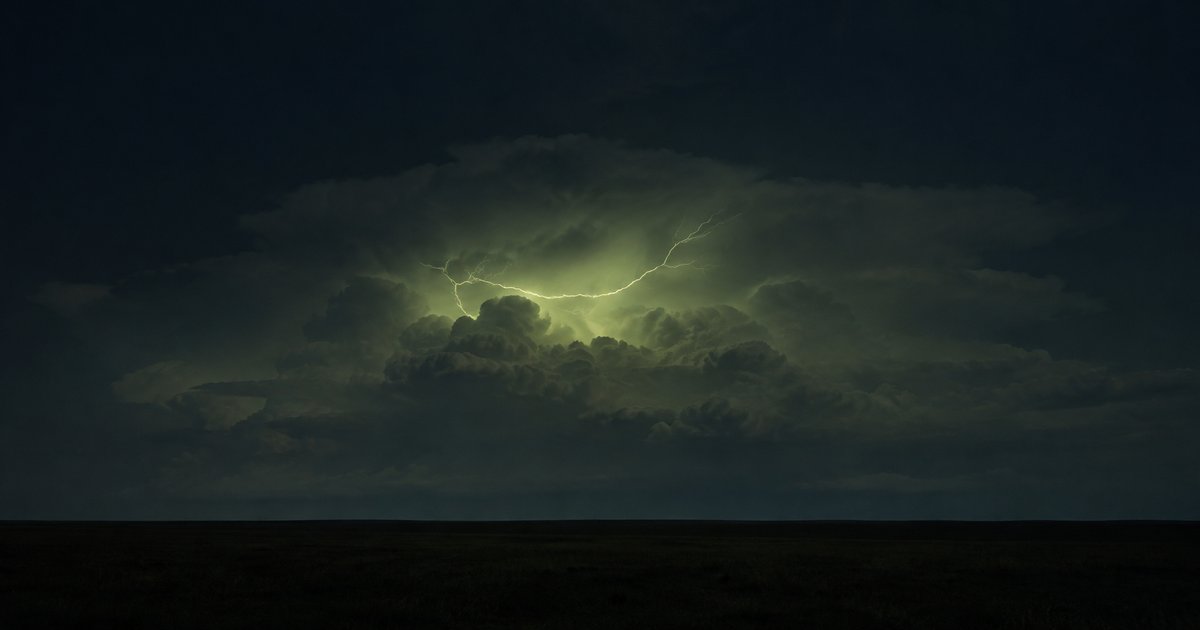
You can see lightning from a storm more than 10 miles (16 km) away in clear air, especially at night, according to National Weather Service guidance. That is an observation, not a maximum visibility distance or a boundary beyond which a storm cannot strike.
The 10-mile figure is an observation, not a maximum
The National Weather Service (NWS) says lightning can be seen from storms more than 10 miles (16 km) away in clear air, especially at night, if nothing blocks the view of the thunderstorm. That wording gives a condition under which a distant flash is visible. It does not set an outer edge for what the human eye can see. A flash seen on the horizon therefore cannot be assigned a distance merely from the fact that you saw it.
The same NWS guidance names the time of day, weather and obstructions such as trees and mountains as variables. A dark sky makes a flash easier to notice; a blocked view can hide the storm even when it is closer.
A glow without a visible bolt can still come from a thunderstorm
The NWS describes heat lightning as light from a thunderstorm too far away for an observer to see the actual cloud-to-ground flash or hear its thunder. The name does not describe lightning generated by hot weather. It describes what the observer can perceive from a distant storm. A glow on the horizon can therefore be light from a thunderstorm, even if no distinct jagged channel appears.
Light reaches the observer essentially at once, while sound weakens and is affected by its path through the air. The NWS thunder explainer says thunder can be heard for only about 10 miles (16 km) from a flash. A visible flash without sound cannot be turned into a measured distance to the strike.
Thunder is a useful clue, but silence is not a ruler
Environment and Climate Change Canada’s December 2017 explainer says thunder can be heard from about 5 to 12 miles (8 to 20 km), depending on atmospheric conditions. It describes how temperature layers bend sound, and how water and cloud conditions change what a listener hears. The NWS sports guidance adds that traffic, wind and precipitation can reduce the distance from which thunder is audible.
When a matching thunderclap is heard, the NWS gives the flash-to-bang count: divide the number of seconds between flash and thunder by five for an approximate distance in miles to that lightning. NOAA NESDIS repeated the same five-seconds-per-mile method in its August 2025 learning activity. The calculation estimates a flash’s distance; it does not say how far the next flash may reach from the storm. Count only after reaching shelter, as the NWS thunder page instructs.
When no thunder follows, there is no interval to calculate. Background noise or the way sound travels can explain silence, and a distant storm can also explain it. Conversely, a storm can be hidden by terrain or weather, so the absence of a visible flash does not establish an absence of lightning nearby.
Visual distance does not define the striking area
The NWS sports guidance says a significant lightning threat generally extends about 6 to 10 miles (10 to 16 km) outward from the base of a thunderstorm cloud. That is a statement about where lightning can reach, not how far away the cloud can be seen. It asks activity organizers to account for the time people need to reach protection and to monitor forecasts, radar and detection. A visible flash, however far away it seems, cannot serve as a strike-radius boundary, and a flash hidden by trees does not show that the storm is far away.
The NWS says there is no protected place outdoors while a thunderstorm is in the area. It identifies a substantial building, or a hard-topped metal vehicle with closed windows if a building is unavailable, as places that provide protection. That is the practical answer when you hear thunder or a storm approaches; a building or hard-topped vehicle matters more than estimating a visible flash’s range.
For organized outdoor activities, the NWS sports page advises stopping when lightning is seen, thunder is heard, or skies look threatening, with enough time for everyone to get indoors. A visible flash may be from far beyond the striking area, but the observation by itself does not reveal whether the storm is moving closer or whether another flash will reach farther.
A lightning map measures detected events, not visual reach
Lightning Tracker is an iPhone app that shows recent detected strikes on a live map, including distance and direction to the nearest one and how many minutes ago it was detected; alerts use a radius chosen for each place, with 10 miles (16 km) as the default. Lightning detection networks can miss some strikes or report them late, so the app does not replace official weather warnings or local procedures.
Not a substitute for official weather warnings.
If you hear thunder, seek shelter even if the app shows no nearby strike.
Sources
- National Weather Service, Lightning Safety and Outdoor Sports Activities
- National Weather Service, Heat Lightning
- National Weather Service, Understanding Lightning: Thunder
- NOAA NESDIS, How Far Away Is Lightning?
- Environment and Climate Change Canada, How thunder sounds