 Lightning Tracker
App Store
Storm basics
What causes thunder, and why does it rumble?
November 12, 2026 · 8 min read
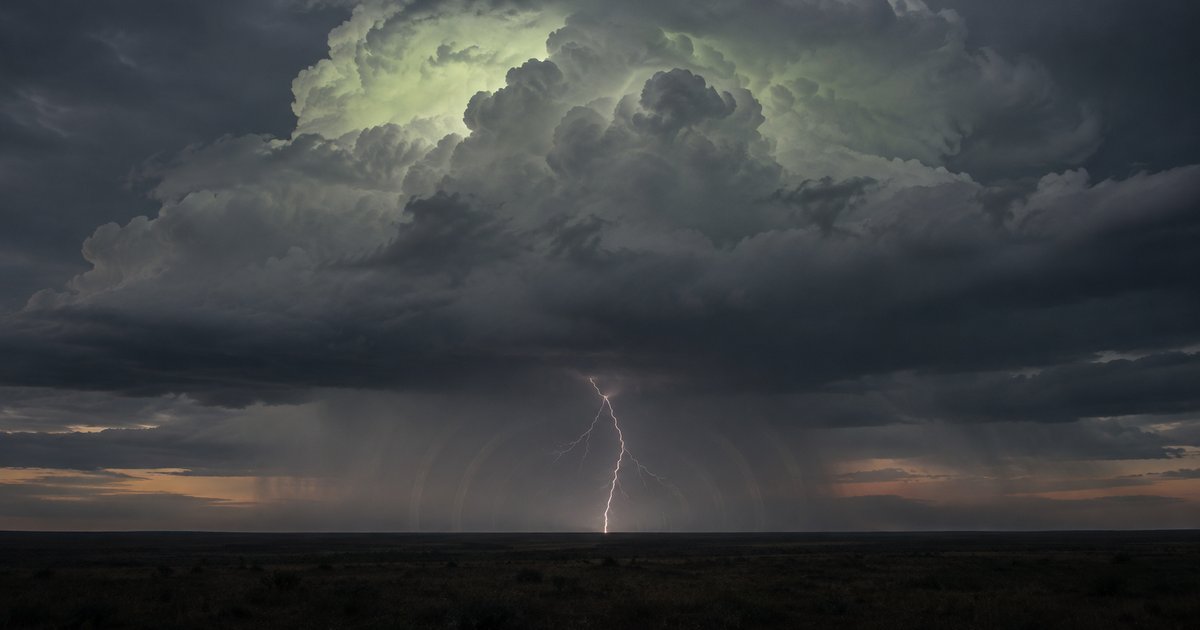
Thunder is the sound of lightning heating the air along its channel so fast that the air expands as a shock wave, which turns into an ordinary sound wave after the first 10 yards or so, according to NOAA's National Severe Storms Laboratory. It rumbles because the channel is long and its sound reaches you in pieces, and how far it carries, about 10 miles in the National Weather Service's usual figure, depends on the air and the noise around you.
Lightning makes thunder by heating the air in its channel faster than the air can move
The NOAA National Severe Storms Laboratory (NSSL) says the energy of a lightning flash heats the air in the channel to above 50,000 °F in only a few millionths of a second. That air has no time to expand, so it is suddenly at very high pressure, and it then pushes outward into the surrounding air and compresses it. NSSL describes the result as a disturbance that spreads in all directions: a shock wave for the first 10 yards, then an ordinary sound wave, which is thunder.
The National Weather Service (NWS) gives the same sequence. Its thunder page says the discharge heats the air rapidly and makes it expand, and that right after the flash the air cools and contracts quickly. In the NWS account, that rapid expansion and contraction creates the sound wave we hear. NOAA's JetStream school calls the first step explosive expansion, air pushing so fast that it compresses the air ahead of it into a shock wave like a sonic boom, and puts the temperature at 54,000 °F (30,000 °C). Those pages give two figures for how hot the channel gets, and neither changes the mechanism.
Recordings of real thunder support the heating explanation. In 2017, Lacroix and colleagues in the Journal of the Acoustical Society of America analyzed several thousand acoustic and electromagnetic signals recorded in southern France in autumn 2012. They report that the low-frequency part of the sound, 1 to 40 hertz, shows no clear difference between the return stroke and discharges inside the cloud, and that this is compatible with thermal expansion from sudden heating of the air in the channel. A 2018 paper from the same group, covering 27 flashes, found that thunder infrasound comes dominantly from return strokes and that the sound spectra of flashes that stay inside the cloud and flashes that reach the ground are similar, though stronger for ground flashes.
NSSL answers the reader's other common question directly: it is not possible to have thunder without lightning.
Thunder rumbles because a lightning channel is long and its sound reaches you in pieces
A lightning channel makes sound along its whole length, and the NWS explains that a discharge that strikes one spot on the ground still travels many miles through the air. The NWS says a listener first hears the thunder from the part of the channel nearest to them, then the sound from parts farther and farther away. NSSL adds that every point along the channel produces its own shock wave and sound wave, so what we hear as thunder is an accumulation of many sound waves.
NOAA JetStream describes what happens to each of those waves on the way. As they spread away from the path of the bolt, the shock waves are distorted, stretched and elongated, and the sound is more muted. Waves from different points that reach the ear at the same moment add together and make the sound stronger. The combination of millions of shock waves, JetStream says, gives thunder its continuous booming or rumbling sound.
Frequency changes the character of the sound, and NSSL gives the sequence for a close strike. Higher frequencies are absorbed by the air more quickly than low ones, so the closest channels give a tearing sound, channels a little farther give a sharp click or loud crack a few seconds later, and several tens of seconds later the thunder from the most distant part of the flash has faded to a low rumble.
| Step | Where the sound comes from | What it sounds like |
|---|---|---|
| First | The closest channels | A tearing sound, which contains high frequencies |
| A few seconds later | Channels a little farther away | A sharp click or loud crack |
| Several tens of seconds later | The most distant part of the flash | A quiet, low-frequency rumble |
The NWS says a loud boom is created by the main lightning channel as it reaches the ground, and that a sharp crack or click means the channel passed nearby, while a rumble means the lightning was at least several miles away.
The shape of the channel matters too. The 2017 study built a model inspired by an earlier theory by Few and found that the crooked geometry of the channel explains at least part of the low-frequency content of the thunder spectrum. Sources do not all give the same explanation for the rumble: NOAA's NESDIS school page says an initial crack is followed by rumbles as the column of air continues to vibrate, while the NWS, NSSL and JetStream describe sound arriving from different parts of the channel at different times. The research above is consistent with the second description, which this article follows.
Thunder can be heard from 10 miles to 25 miles away, depending on the source and the air
Agency pages give different audible ranges, and none of the ones opened for this article reconciles them. The table lists each figure as the source words it, as of November 2026.
| Source | What it says |
|---|---|
| NWS, Understanding Lightning: Thunder | Thunder can be heard for only about 10 miles from the strike. |
| NWS Melbourne, What is Lightning? | Typically up to 10 miles (16 km). Less during heavy rain and wind; beyond 10 miles on cool, calm, quiet nights when a storm is many miles away. |
| NWS, outdoor sports guidance | About 10 miles if there is no background noise; traffic, wind and precipitation may limit it to less. |
| NOAA JetStream | Normally up to 10 miles (16 km) when air temperature falls with height. |
| NSSL, Lightning Basics | Up to 25 miles from the discharge. |
Read together, the sources point to 10 miles as a typical figure under ordinary conditions, with the range shrinking in rain, wind and noise and stretching on a quiet night. NSSL's 25 miles is the highest figure, and its page does not say under what conditions.
Layers of air change what you hear. JetStream explains that sound travels faster in warm air than in cool air, and that temperature normally falls with height. When it instead rises with height, called an inversion, sound waves bend back toward the ground, which can add sound and make thunder louder. JetStream says this is more common in winter, when storms form in warm air above a cooler air mass near the ground. If the lightning stays above the inversion, most of its sound stays up there too, but sound from cloud-to-ground strikes can remain below it, giving thunder a much louder impact. A thunderclap that seems unusually loud can therefore reflect how close the strike was, or the layers of air that night; the sources do not give a way to tell which.
Lightning can be seen with no thunder heard when the sound fades or is drowned out before it reaches you
NSSL says you can see lightning and not hear the thunder because it was too far away, and notes that this is sometimes called heat lightning because it occurs most often in the summer. The flash is lightning like any other; light reaches you far faster than sound does, and the sound has the whole distance in which to fade.
The NWS says traffic, wind and precipitation can cut the distance at which thunder is heard, so a storm inside the usual range can still be silent to a listener in noise. The same guidance says a significant lightning threat generally extends outward from the base of a thunderstorm cloud about 6 to 10 miles. Silence therefore says something about sound, and not much about where the storm is.
A flash-to-bang count measures the distance to the nearest part of the channel, and the sources ask for caution
The NWS says thunder takes about 5 seconds to travel a mile, so the seconds between flash and thunder divided by 5 give the distance in miles: 5 seconds is about 1 mile and 15 seconds about 3 miles. Because the first sound comes from the nearest part of the channel, the number you get is the distance to that part, not to the center of the storm.
Three conditions bend the estimate. The NWS Melbourne page says heavy rain and wind make thunder audible over a shorter distance, so a long count or no thunder at all can come from the conditions as much as the storm. JetStream says sound moves faster in warm air than in cool air, so 5 seconds per mile is not a fixed number. And the NWS says the ability to see lightning varies with the time of day, the weather and obstructions such as trees and mountains, so terrain can hide the flash you are timing. The sources opened for this article give no terrain correction for the sound itself. Treat counting from flash to bang as a rough estimate, not a measurement.
Thunder you can hear means you are within striking distance of the storm
The NWS thunder page says the sound of thunder should serve as a warning to anyone outside that they are within striking distance of the storm. Its outdoor guidance adds that people should wait 30 minutes after the last thunder before resuming outdoor activities, because electrical charges can linger in clouds after a storm seems to have passed. The sound is the signal, and the count is extra information.
Lightning Tracker, an iPhone app on the App Store, shows the distance and direction to the nearest recently detected strike and how many minutes ago it happened, and it does not replace official warnings.
Not a substitute for official weather warnings.
If you hear thunder, seek shelter even if the app shows no nearby strike.
Sources
- NOAA National Severe Storms Laboratory, Severe Weather 101: Lightning Basics
- NOAA National Severe Storms Laboratory, Severe Weather 101: Lightning FAQ
- National Weather Service, Understanding Lightning: Thunder
- National Weather Service Melbourne, What is Lightning?
- National Weather Service, Lightning Safety and Outdoor Sports Activities
- NOAA JetStream, The Sound of Thunder
- NOAA NESDIS, What Causes Lightning and Thunder?
- Lacroix et al., Acoustic/Infrasonic analysis and modeling of thunder from a long-term recording in Southern France, Journal of the Acoustical Society of America, 2017
- Lacroix et al., On the origin of thunder: Reconstruction of lightning flashes, statistical analysis, and modeling, Journal of the Acoustical Society of America, 2018