 Lightning Tracker
App Store
Storm basics
How far away can thunder be heard?
November 19, 2026 · 4 min read
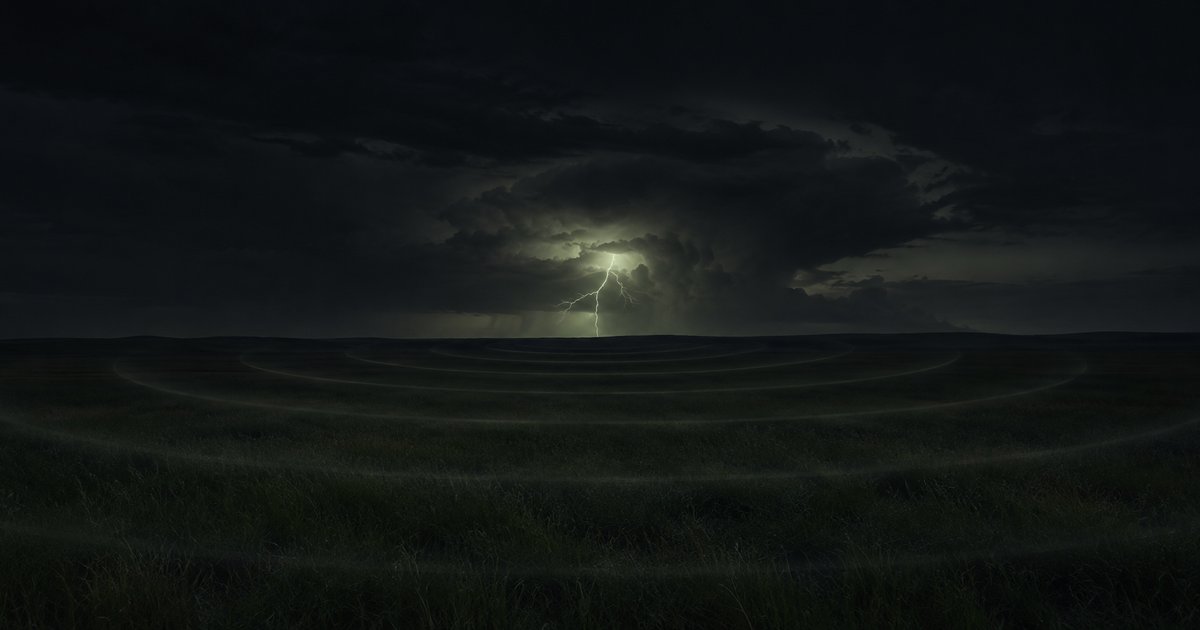
Thunder is usually heard about 10 miles (16 km) from a lightning flash when background noise is low, according to the National Weather Service’s undated outdoor sports guidance. Traffic, wind and rain can shorten that range; the NWS Melbourne office says a cool, calm, quiet night can carry thunder beyond 10 miles. Hearing it signals a storm close enough to require shelter, while silence is not a distance test.
What “about 10 miles” means in the NWS guidance
The NWS thunder explanation gives about 10 miles as the distance at which thunder can be heard from a lightning strike. Its outdoor sports guidance supplies the condition that matters: thunder can usually be heard about that far provided there is no background noise. Traffic, wind and precipitation can reduce the hearing distance. A person in heavy rain might miss thunder from a flash closer than the usual figure.
The NWS Melbourne office calls 10 miles (16 km) typical. It explicitly says heavy rain and wind shorten that distance, while thunder can carry beyond 10 miles on cool, calm and quiet nights. The distance is between the listener and the sound-producing flash, not automatically the distance to the center of a storm cloud.
The NWS tells organizers of outdoor sports to consider sight of lightning, sound of thunder and threatening skies. It says the ability to see lightning depends on time of day, weather, trees and mountains. A storm can develop overhead, and some produce lightning just as they enter an area. Relying on whether a particular flash was audible would therefore leave gaps even before the uncertainty of sound travel is considered.
Why agencies give somewhat different ranges
The World Meteorological Organization's 2017 International Cloud Atlas says thunder is usually not heard when the discharge is more than about 12 miles (20 km) away. It also says thunder may be inaudible at appreciably shorter distances because sound waves refract in the lower atmosphere. Canada's federal meteorological page similarly describes audibility at distances from about 5 miles (8 km) to about 12 miles (20 km), depending on atmospheric conditions.
| Source | Stated distance | Condition or qualification |
|---|---|---|
| NWS outdoor sports | Usually about 10 miles | No background noise; traffic, wind or precipitation shorten it |
| NWS Melbourne | Typically up to 10 miles | Beyond 10 miles on some cool, calm, quiet nights |
| WMO Cloud Atlas | Usually not heard beyond about 12 miles (20 km) | Sometimes inaudible at shorter distances |
| Australia's Bureau of Meteorology | Usually about 9 miles (15 km); sometimes about 16 miles (25 km) | Longest figure is for optimum conditions, such as a still night |
Australia's Bureau of Meteorology gave its figures in a June 2018 explainer. The values also use rounded conversions: 15 km is about 9 miles and 25 km is about 16 miles.
Sound can disappear before the storm does
Environment and Climate Change Canada says higher sound frequencies are absorbed more readily as thunder travels. The air's temperature structure can bend sound upward, away from a listener on the ground, or downward toward the surface. The agency contrasts a hot summer day, when waves tend to bend up, with a cooler surface at night, when they can bend down. These paths help explain why the same distance does not produce the same sound on every day.
Background noise supplies another limit. The NWS names traffic, wind and precipitation. Near breaking surf, the problem can be particularly noticeable; the site's beach lightning guidance covers the setting where waves obscure thunder. The WMO notes that thunder sometimes fails to be audible at much shorter distances.
The NWS calls a distant visible flash without audible thunder heat lightning. The agency says it is ordinary lightning from a distant thunderstorm, not a special kind of discharge caused by heat. Look at the weather and available lightning information as well as what you can hear.
Hearing thunder changes the outdoor decision
The NWS thunder page says the sound should warn anyone outside that they are within striking distance of the storm and should move to shelter immediately. Its outdoor sports guidance says the significant lightning threat generally extends about 6 to 10 miles outward from the thunderstorm cloud base. The advice does not ask a person to wait for a louder clap or to estimate the exact distance first.
The NWS says a delay of about five seconds between a flash and its thunder corresponds to one mile of sound travel. That is the basis of the flash-to-bang count, which is a rough estimate for a flash you can both see and hear. It cannot measure a flash whose thunder never reaches you. The NWS says to seek shelter as soon as thunder is heard.
The NWS identifies substantial buildings and hard-topped metal vehicles as protective places during a thunderstorm. A gazebo, tent or open field does not serve the same purpose; choose a building or hard-topped vehicle and wait until the agency's return guidance is met. The NWS outdoor sports page says to wait at least 30 minutes after the last thunder before resuming outdoor activity.
Lightning Tracker, an iPhone app, shows recently detected strikes with the distance and direction to the nearest one and lets you set a radius for alerts at each place; the default is 10 miles (16 km). Detection networks can miss strikes and data may be delayed, so setting an alert radius helps you plan a route to shelter but does not replace official warnings.
Not a substitute for official weather warnings.
If you hear thunder, seek shelter even if the app shows no nearby strike.
Sources
- National Weather Service, Lightning Safety and Outdoor Sports Activities
- National Weather Service, Understanding Lightning: Thunder
- National Weather Service Melbourne, What is Lightning?
- World Meteorological Organization, International Cloud Atlas: Thunder
- Environment and Climate Change Canada, How thunder sounds
- Bureau of Meteorology, Explainer: what is thunder?
- National Weather Service, Heat Lightning