 Lightning Tracker
App Store
Storm basics
How fast is lightning? The leader, return stroke and light are different speeds
November 14, 2026 · 9 min read
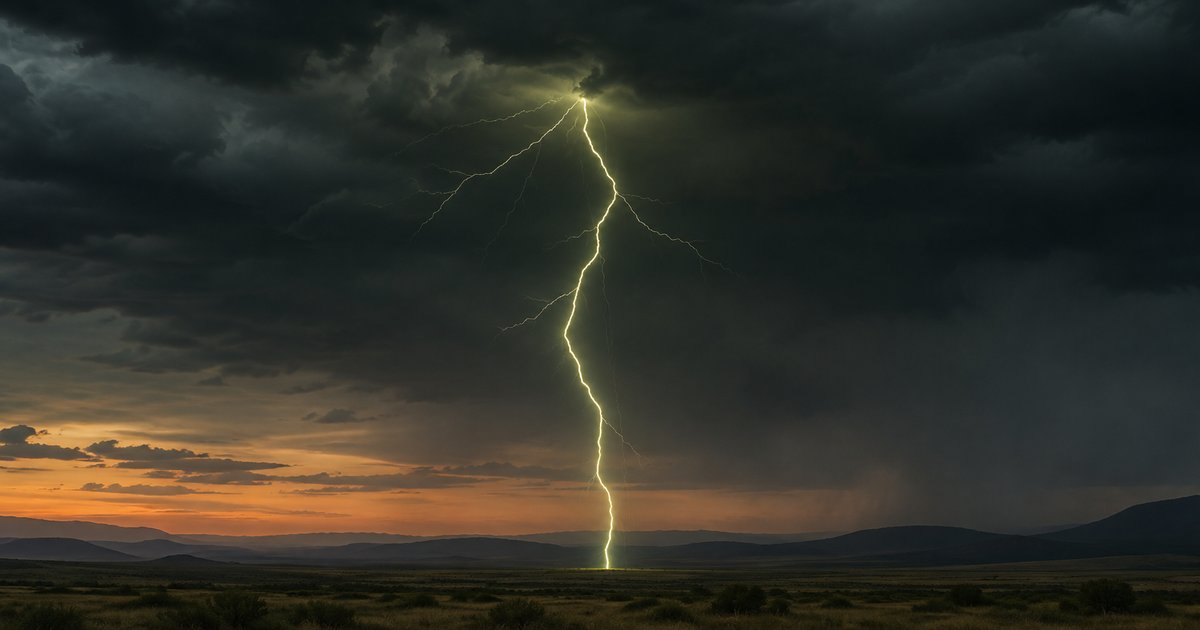
Lightning has no single speed. The National Weather Service puts the downward stepped leader at about 200,000 miles per hour and the bright return stroke at about 200 million mph, NASA gives light as 186,000 miles per second (about 670 million mph), and thunder travels at about 760 mph. Each figure belongs to a different part of the flash, and measurements of single flashes spread well beyond the round numbers.
A lightning flash is a sequence, and each step moves at its own speed
The National Weather Service describes a typical cloud-to-ground flash as a negatively charged stepped leader that grows downward in quick steps, each typically about 50 meters (150 feet) long, and branches as it looks for a connection with the ground. When a branch comes within about 50 meters of the ground or of an object on it, the leader meets an upward streamer, and that connection opens the path for the rapid discharge seen as a bright flash. The bright surge is the return stroke, which the NWS says moves upward through the leader channel. A leader starts when the charge differences that collisions between ice and hail build in the cloud become too great, the NWS explains in its overview, and the insulating air breaks down.
Two more points from the NWS matter for speed. The stepped leader and the return stroke together take just a fraction of a second, and although both give off visible light, they happen so quickly that the human eye cannot tell them apart; only high-speed cameras follow the leader toward the ground. The National Severe Storms Laboratory (NSSL) says the return stroke part happens in a few thousandths of a second. The figures in this article come from studies and pages about cloud-to-ground lightning. The NWS overview names a second main kind, lightning between charges inside the cloud.
The headline speeds run from 760 mph to 670 million mph
The table below sets the usual figure for each part of a flash beside its source, as of November 2026. The NWS pages quoted here give no speed for the dart leader, so that row comes from a research paper, and the metric values are converted here, not copied.
| What moves | Speed | In metric units | Source |
|---|---|---|---|
| Stepped leader | About 200,000 mph | About 89 km/s | National Weather Service |
| Dart leader | About 1.8 to 37 million mph in three flashes | About 820 to 16,670 km/s | Stolzenburg et al., 2013 |
| Return stroke | About 200 million mph | About 89,000 km/s | National Weather Service |
| Light from the flash | 186,000 miles per second, about 670 million mph | About 300,000 km/s | NASA Glenn Research Center |
| Thunder | About 760 mph at sea level on a standard day | About 340 m/s | NASA Glenn Research Center |
NSSL says light travels through the air roughly a million times faster than sound, which fits the last two rows. The sections below take each row in turn and say where the sources disagree.
The stepped leader moves at about 200,000 mph, and measured flashes run faster
The NWS says stepped leaders generally travel at about 200,000 miles per hour, although speeds vary considerably, and that the leader would move much faster if it did not pause between steps. Measurements of single flashes give higher numbers. Stolzenburg and colleagues, in a 2013 paper in the Journal of Geophysical Research, used high-speed video of three natural negative ground flashes. Before a leader joined an earlier channel, they report average two-dimensional speeds of 1.6 to 2.7 × 10⁵ meters per second, and for the other 12 strokes of the same flashes, stepped leader averages of 1.7 to 3.0 × 10⁵. That is about 360,000 to 670,000 mph in our conversion, above the NWS round figure. An encyclopedia entry at Britannica gives an average of about 1.5 × 10⁵ meters per second, about 340,000 mph.
Even the step is not agreed. The NWS gives steps of about 50 meters, while a 2007 answer from the University of Illinois physics outreach program, Physics Van, gives about 30 meters, about a microsecond for each step and a pause of about 50 microseconds between steps. The sources agree on the main point: the leader is the slow part, about a thousand times slower than the return stroke by the NWS figures.
The dart leader follows an old channel at millions of meters per second
NOAA JetStream explains that after a return stroke ends there is a pause of about 20 to 50 milliseconds, and that if enough charge remains in the cloud, another leader can run down the channel the first one made. This second kind is called a dart leader. Because it uses a channel that already exists, JetStream says, it normally does not branch, and dart leaders give lightning its flickering look.
The 2013 paper by Stolzenburg and colleagues is the source for speed. In the three cases where a stepped leader changed into a dart leader, the average speed after the change was 3.4 to 7.8 × 10⁶ meters per second, against 1.6 to 2.7 × 10⁵ before it. Dart leader averages in the other strokes of those flashes ranged from 0.82 to 16.67 × 10⁶ meters per second, about 1.8 to 37 million mph in our conversion. The authors call the stepped-to-dart change apparently rare in optical data, about 1% of subsequent strokes. Three flashes are a small sample, and the NWS gives no dart leader figure to compare with, so the range shows how much the speed varies more than it fixes a typical value.
The return stroke travels at roughly a third of the speed of light, with wide scatter
The NWS says the highly visible return stroke moves upward through the leader channel at about 200 million miles per hour. Against NASA's 186,000 miles per second, about 670 million mph, that is about 30% of the speed of light by our arithmetic. Measurements spread around it. In 1982, Idone and Orville reported two-dimensional speeds for 63 strokes, recorded with a high-speed streak camera in Florida in 1977 and 1978 and in New Mexico in 1979. The mean near the ground was 1.1 × 10⁸ meters per second, about 246 million mph, with the distribution peaking near 9 × 10⁷, about 200 million mph and in line with the NWS. Individual strokes ranged from 2.9 × 10⁷ to 2.4 × 10⁸ meters per second, about 65 to 537 million mph.
Place and height change the result. Idone and Orville found mean first-stroke speeds of 6.6 × 10⁷ meters per second in Florida and 1.5 × 10⁸ in New Mexico, and in 16 of their 17 best-recorded events the speed fell as the stroke climbed, often by 25% or more in the upper channel. Wang and colleagues recorded rocket-triggered lightning at Camp Blanding, Florida, and in 1999 reported 1.3 and 1.5 × 10⁸ meters per second in the bottom 60 meters or so of the channel, with the return strokes slowing over the bottom 400 meters. In 1987, Idone and co-authors measured a return stroke that lowered positive charge to the ground at between 0.93 and 1.0 × 10⁸ meters per second, depending on the optical system. Idone, Orville and colleagues cautioned in 1984 that triggered-lightning results need caveats when applied to natural lightning.
| Study or source | What was measured | Result | In mph (converted here) |
|---|---|---|---|
| NWS | Stepped leader; return stroke | About 200,000 mph; about 200 million mph | Same |
| Stolzenburg et al., 2013 | Stepped leaders, three flashes | 1.6 to 3.0 × 10⁵ m/s | About 360,000 to 670,000 |
| Britannica | Stepped leader, average | About 1.5 × 10⁵ m/s | About 340,000 |
| Idone and Orville, 1982 | 63 return strokes, near the ground | Mean 1.1 × 10⁸ m/s; range 2.9 × 10⁷ to 2.4 × 10⁸ m/s | About 246 million; 65 to 537 million |
| Wang et al., 1999 | Two triggered return strokes, bottom 60 m | 1.3 and 1.5 × 10⁸ m/s | About 291 million and 336 million |
One research group argues that the measured speeds understate the true one. A 2026 paper by Cooray and colleagues in Electric Power Systems Research treats the return stroke as a current pulse on the leader channel and makes a case that its speed equals the speed of light. In their account the slower speeds from experiments come from the rapid dispersion of the current as it travels along the channel. Its abstract frames this as an argument, and it acknowledges that the measurements show a speed below light.
Light from the flash arrives at once, and thunder takes about five seconds per mile
NASA's Glenn Research Center, on a page last updated May 13, 2021, gives the speed of light as a constant 186,000 miles per second, so we see a flash the instant it happens. Thunder, the center says, travels at the speed of sound, which depends on the temperature of the day and is about 760 mph, or 1,100 feet per second, at sea level on a standard day. The NWS says thunder takes about 5 seconds to travel a mile, and NSSL gives about one fifth of a mile per second, or one third of a kilometer per second. That gap is why counting the seconds from flash to bang works: divide by five for miles, or by three for kilometers, as NSSL puts it.
Thunder starts as a heating effect. The NWS says the lightning discharge heats the air rapidly and makes it expand, that air in the channel may reach 50,000 °F, and that the expansion and the quick cooling and contraction that follow create the sound wave we hear as thunder. The NWS adds that you hear first the thunder from the part of the channel nearest you, then the thunder from parts farther away.
Lightning against a bullet, and the fastest thing on Earth
The U.S. Department of Justice's National Institute of Justice (NIJ) sets, in its July 2008 body armor standard, a test velocity of 847 meters per second (2,780 feet per second) for the 7.62 mm rifle bullet used against Type III armor, about 1,900 mph, and 373 meters per second (1,225 feet per second) for a 9 mm test bullet, about 830 mph. Those are test figures, not the speed of every bullet. Against the rifle figure, the NWS leader speed of 200,000 mph is about 100 times faster, and the NWS return stroke speed of 200 million mph is more than 100,000 times faster, by our arithmetic. Thunder, at 760 mph, is slower than both test bullets.
By the figures above, the lightning discharge is not the fastest thing on Earth. The NWS return stroke speed is about 30% of the speed of light, while CERN says the Large Hadron Collider pushes protons or ions to near the speed of light, with its two beams traveling at close to that speed. The light of the flash itself, at 186,000 miles per second, moves faster than the discharge that makes it.
The speeds explain the delay before thunder, and nothing in the flash gives a warning
The National Weather Service says people who hear thunder are likely within striking distance of the storm, and that thunder can normally be heard about 10 miles from a strike. A sequence that takes a fraction of a second cannot be watched and acted on, in our reading of the NWS pages above, so the NWS advice rests on the sky and on thunder: get inside when the sky looks threatening or thunder is heard, and wait 30 minutes after the last lightning or thunder before going back outside. Lightning Tracker, an iPhone app on the App Store, shows the distance and direction to the nearest recently detected strike and how many minutes ago it happened, and it does not replace official warnings.
Not a substitute for official weather warnings.
If you hear thunder, seek shelter even if the app shows no nearby strike.
Sources
- National Weather Service, Understanding Lightning: Negative Flash
- National Weather Service, Understanding Lightning: Initiation of a Stepped Leader
- National Weather Service, Understanding Lightning Science
- National Weather Service, Understanding Lightning: Thunder
- National Weather Service, Lightning Safety Overview
- NOAA JetStream, JetStream Max: The Lightning Process, Keeping in Step
- NOAA National Severe Storms Laboratory, Severe Weather 101: Lightning Basics
- NOAA National Severe Storms Laboratory, Severe Weather 101: Lightning FAQ
- NASA Glenn Research Center, Lightning Strike
- Stolzenburg et al., Stepped-to-dart leaders preceding lightning return strokes, Journal of Geophysical Research: Atmospheres, 2013
- Idone and Orville, Lightning return stroke velocities in the Thunderstorm Research International Program (TRIP), Journal of Geophysical Research, 1982
- Wang et al., Observed leader and return-stroke propagation characteristics in the bottom 400 m of a rocket-triggered lightning channel, Journal of Geophysical Research: Atmospheres, 1999
- Idone et al., The propagation speed of a positive lightning return stroke, Geophysical Research Letters, 1987 (NASA Technical Reports Server)
- Idone et al., Correlated observations of three triggered lightning flashes, Journal of Geophysical Research, 1984 (NASA Technical Reports Server)
- Cooray et al., Known properties of the lightning leader channels point towards a return stroke moving with the speed of light, Electric Power Systems Research, 2026
- University of Illinois Urbana-Champaign, Physics Van, The Speed of Lightning, 2007
- Encyclopaedia Britannica, How Fast is Lightning?
- U.S. Department of Justice, National Institute of Justice, Ballistic Resistance of Body Armor, NIJ Standard-0101.06, July 2008
- CERN, Facts and figures about the LHC