 Lightning Tracker
App Store
Storm basics
How wide and long is a lightning bolt?
November 14, 2026 · 8 min read
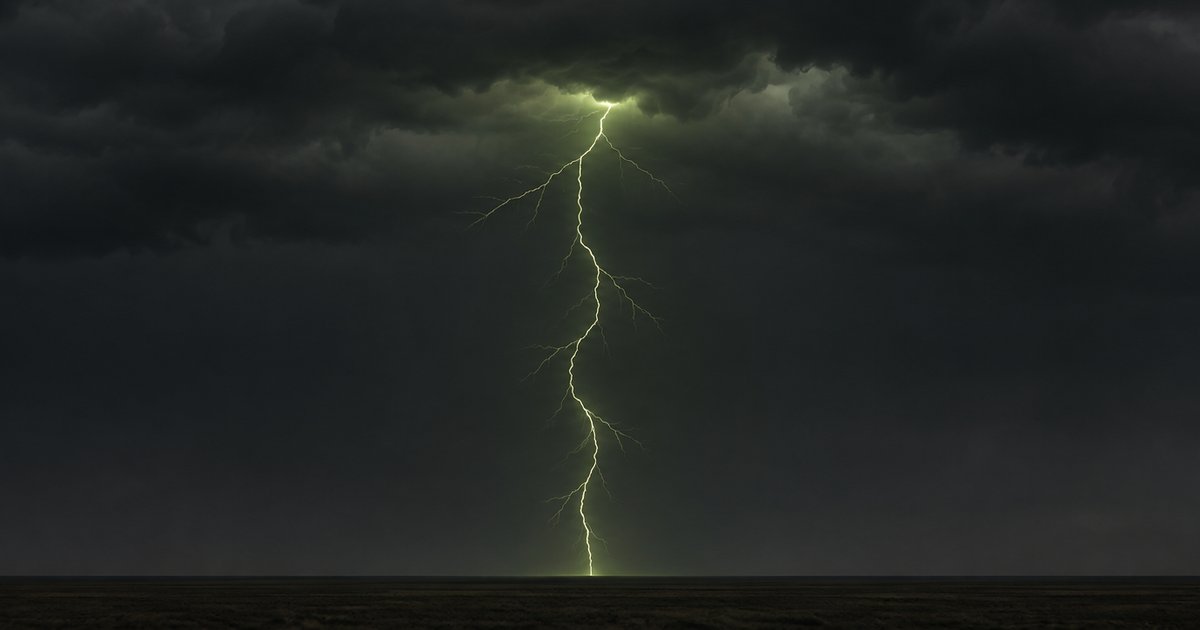
Most reference pages put the channel of an ordinary lightning bolt at about 1 inch (2.5 cm) across and a cloud-to-ground bolt at a few miles long, but those are estimates. The National Weather Service office in Melbourne, Florida, lists a diameter of about 1 inch and an average cloud-to-ground length of 2 to 10 miles (3 to 16 km), while a 2019 study of six strokes found a current-carrying core about 0.5 to 0.8 inch wide inside a glowing channel about 4 to 6 inches wide.
Agency and reference pages put the lightning channel at about an inch wide
The National Weather Service (NWS) forecast office in Melbourne, Florida, lists the estimated diameter of a lightning channel as about 1 inch (2.5 cm) in a list of lightning facts that gives no citation beside the figure. The 2013 National Athletic Trainers' Association position statement on lightning safety, published in the Journal of Athletic Training, gives the same value: approximately 1 inch (2.5 cm). An archived February 2013 copy of the NOAA National Severe Storms Laboratory (NSSL) lightning FAQ gives a wider span, one to two inches (2.5 to 5 cm).
Tom Skilling, answering a viewer on the WGN-TV Chicago weather blog on May 27, 2021, put the figure lower still. He wrote that the main current-carrying part of a discharge is not even half an inch (1.3 cm) across and that the return stroke, the intense pulse that returns to the cloud from the ground, may grow to between half a centimeter and a centimeter. The table sets these statements next to a measurement study from the next section.
| Source | Width given | What it describes |
|---|---|---|
| NWS Melbourne, FL (undated page) | About 1 inch (2.5 cm) | Estimated diameter of a channel |
| Athletic trainers' position statement, 2013 | About 1 inch (2.5 cm) | The lightning channel |
| NSSL FAQ, archived February 2013 | 1 to 2 inches (2.5 to 5 cm) | Actual diameter of a channel |
| WGN-TV weather blog, May 2021 | Under half an inch (1.3 cm); return stroke about 0.2 to 0.4 inch (0.5 to 1 cm) | Current-carrying part; return stroke |
| An et al., 2019 (six return strokes) | Core about 0.5 to 0.8 inch (1.3 to 2 cm); glowing channel about 4 to 6 inches (10 to 16 cm) | Core current channel; luminous channel |
The last row's inches are this article's conversion of published radii, doubled to give a diameter. The first four rows range from a fraction of an inch to two inches, and none of those pages describes a measurement behind its figure.
Measurements find a core under an inch wide inside a wider glow
Researchers cannot lay a ruler against a bolt, so they infer its width from spectra, pictures and physics. Tingting An and colleagues reported in the journal Physics of Plasmas in 2019 that they combined the spectra of six return strokes with synchronized electric-field records and optical pictures. Their estimate of the core current channel was a radius of 0.66 to 1.01 cm, and of the luminous channel a radius of 5.03 to 7.96 cm. The abstract also puts the core at 27,300 to 30,300 K and the luminous channel at 3,300 to 5,800 K, which this article converts to roughly 49,000 to 54,000 °F and 5,500 to 10,000 °F. The core is the hot part of the channel; the glow around it is cooler and several times wider.
Read against that study, the agencies' "about 1 inch" matches the order of the core, not the glow, but this is a reading of the sources, not a statement any of them makes. The study covers six strokes from one research effort, so it shows a range for those strokes and not a width every bolt shares.
A 2026 review by Guorong Liu, Sulin Jiang and Wei Wang in AIP Advances describes the traditional model the same way: a high-temperature, high-conductivity core that carries the current, wrapped in a corona sheath, a layer of charge around the channel. Its abstract says high-speed imaging and spectroscopy have in recent years let researchers see the core of natural lightning directly, and that how the core forms and changes during a discharge remains unsolved.
A photograph records the glow, which is wider than the core
In the same WGN-TV reply, Tom Skilling adds that the return stroke puts out most of the light people see, and a photograph records light, not current. A different measurement shows how wide the glow can look. In 1998 a Japanese group reported results from a high-speed line-scanning camera, with only a few examples from natural lightning, in the Journal of Geophysical Research. It found that the luminous region of a return stroke channel may expand quickly, reach a maximum diameter of several tens of meters (roughly 100 feet or more) about 100 microseconds after the stroke begins, and then shrink.
That is far wider than the 2019 estimate of a luminous channel several inches across, and the two abstracts do not reconcile them. They measure different things: one maps temperature across the channel, the other records how optical intensity varies across it. The sound reading is that "width" depends on what is counted: the narrow current-carrying core, the hot glowing channel, or the faint light spread around it. A core about an inch wide can therefore look far wider in a photograph.
An ordinary cloud-to-ground bolt is a few miles long, and sources differ on how many
The NWS Melbourne page says the length of an average cloud-to-ground channel can range from 2 to 10 miles (3 to 16 km). The athletic trainers' 2013 statement says the lightning channel averages 3 to 5 miles (4.83 to 8.05 km) long. Both give lengths of the channel itself, which is not a straight line: NSSL's archived FAQ describes a stepped leader that zigzags downward in segments of roughly 50 yards (46 m), so a channel is longer than the distance from its top to its base.
Flashes that stay inside the cloud are measured differently. A 2021 presentation by Nicolau Pineda, Rafał Iwański and Antti Mäkelä to a EUMETSAT lightning-imager working group analyzed one year of in-cloud flashes mapped by radio detectors in Poland and Catalonia. Its summary lists a spatial extension, given as maximum length, of 10 to 20 km (6 to 12 miles), with a median of 14.1 km (8.8 miles) in the Polish network and 11.5 km (7.1 miles) in the Catalan one. The authors define a flash's size from an ellipse fitted to the mapped points, and they note that the two networks are set up differently. The figures describe in-cloud flashes, one of the two main types of lightning, while the NWS and athletic-trainer figures describe flashes that reach the ground.
| Source | What was measured | Length given |
|---|---|---|
| NWS Melbourne, FL (undated page) | Average cloud-to-ground channel | 2 to 10 miles (3 to 16 km) |
| Athletic trainers' position statement, 2013 | Lightning channel, on average | 3 to 5 miles (4.83 to 8.05 km) |
| EUMETSAT working-group presentation, October 2021 | In-cloud flashes, radio detection networks, one year | Maximum length 10 to 20 km (6 to 12 miles); median 14.1 and 11.5 km (8.8 and 7.1 miles) |
| WMO, July 31, 2025 | Longest flash on its extremes record | 829 km (515 miles), with a margin of error of 8 km (5 miles) |
The last row is a record, not an ordinary value. The World Meteorological Organization announced on July 31, 2025, that a flash in October 2017 ran from eastern Texas to near Kansas City. Its release says the flash was not identified in the original 2017 analysis and was found by re-examining the storm, one of the first where NOAA's GOES-16 satellite documented megaflashes from orbit. The release says the record measures flash extent as a maximum great-circle distance, the same method used for the previous record, so it is a reach across the map and not the length of the channel's path.
Lightning can strike miles beyond the rain under the storm
Reach from the storm is the size that bears on what people do. The NWS Melbourne page says lightning often strikes outside the rain area to as much as 10 miles (16 km), with even greater distances in exceptional situations. NOAA's JetStream weather school says almost all lightning occurs within 10 miles of its parent thunderstorm but can strike much farther, and that detection equipment has confirmed bolts almost 50 miles (80 km) away. A second JetStream page says many positive strikes, which start near the edge of the cloud or in its anvil, can occur more than 25 miles (40 km) from precipitation.
| Source | Distance | Context |
|---|---|---|
| NWS Melbourne, FL | As much as 10 miles (16 km), more in exceptional cases | Outside the rain area |
| NOAA JetStream FAQ | Almost all within 10 miles; almost 50 miles (80 km) confirmed | From the parent thunderstorm |
| NOAA JetStream, positive lightning | More than 25 miles (40 km) | From precipitation, for many positive strikes |
| NSSL FAQ, bolt from the blue | Several miles; one case about 10 miles (16 km) | Strike under a cloudless sky |
NSSL describes a bolt from the blue as a flash that leaves the side of the storm, travels a long way through clear air and then angles down to the ground. NSSL documents flashes that traveled several miles from the cloud, and a bicyclist struck under a cloudless sky was probably hit by a bolt from a storm about 10 miles (16 km) away, obscured by mountains. The NWS Melbourne page lists the belief that dry weather keeps lightning away among its lightning myths and answers it with the 10-mile distance.
The size of a bolt does not change the rule that thunder means go indoors
The NWS says that if you hear thunder, even a distant rumble, you are already in danger of becoming a lightning victim. The Melbourne office's rule is to go indoors at the first thunder and stay there for 30 minutes after the last clap. Whether a channel is an inch wide, a flash several miles long or a strike 10 miles from the rain, the rule is the same, and counting the seconds from flash to bang estimates the distance without changing it. Lightning Tracker, an iPhone app, shows recently detected strikes on a live map with the distance and direction to the nearest one and how many minutes ago it happened.
Not a substitute for official weather warnings.
If you hear thunder, seek shelter even if the app shows no nearby strike.
Sources
- National Weather Service Melbourne, FL, Lightning Rules
- Walsh et al., Journal of Athletic Training, March–April 2013, National Athletic Trainers' Association Position Statement: Lightning Safety for Athletics and Recreation
- NOAA National Severe Storms Laboratory, Severe Weather 101: Lightning FAQ (Internet Archive copy of February 21, 2013)
- NOAA National Severe Storms Laboratory, Severe Weather 101: Lightning FAQ (as of November 2026)
- WGN-TV Chicago, Tom Skilling, What is the width of a lightning bolt? (May 27, 2021)
- An et al., Physics of Plasmas 26, January 2019, The radius and temperature distribution along radial direction of lightning plasma channel (abstract)
- Liu, Jiang and Wang, AIP Advances 16, September 2026, Research status, opportunities, and challenges of the radial structure of lightning channel (abstract)
- Takagi et al., Journal of Geophysical Research: Atmospheres 103, June 1998, Expansion of the luminous region of the lightning return stroke channel (abstract)
- Pineda, Iwański and Mäkelä, EUMETSAT MTG Lightning Imager Mission Advisory Group meeting, October 2021, IC Flash size calculations from LLS VHF measurements at mid-latitudes (PDF)
- World Meteorological Organization, WMO certifies megaflash lightning record in USA (July 31, 2025)
- NOAA JetStream, Lightning: Frequently Asked Questions
- NOAA JetStream, The Positive and Negative Side of Lightning
- National Weather Service, Understanding Lightning Science