 Lightning Tracker
App Store
Storm basics
Why lightning zigzags, branches and runs sideways
November 14, 2026 · 8 min read
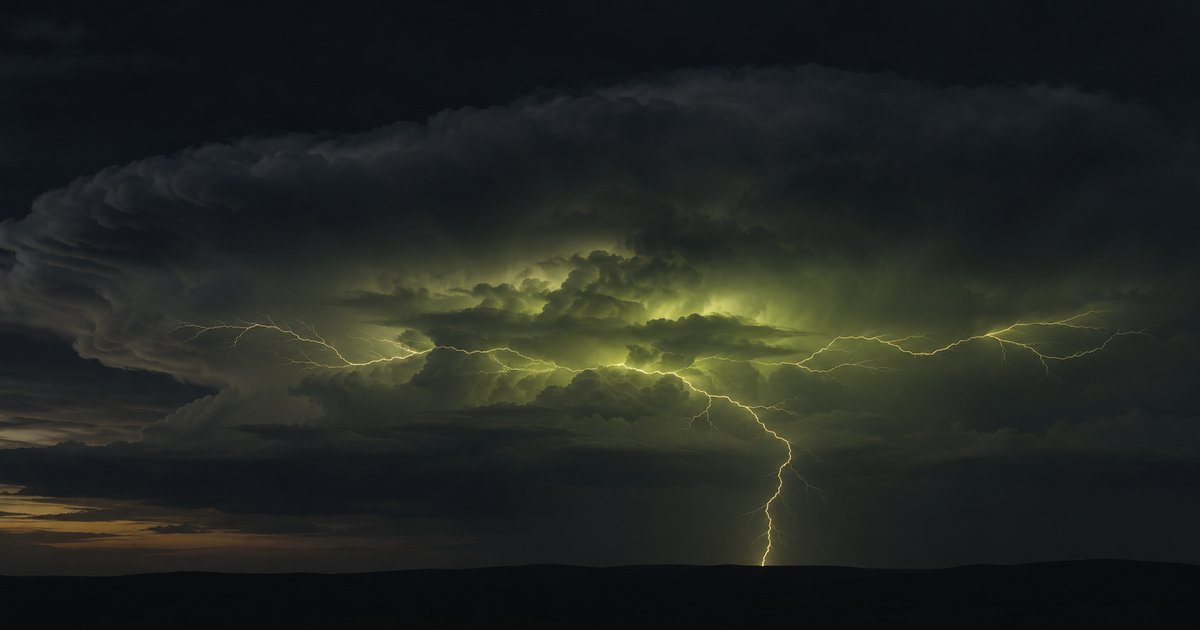
Lightning zigzags because the stepped leader that starts a cloud-to-ground flash advances in short jumps and senses only the charge right around its tip, so each jump can point a little differently. It branches when several jumps start from one tip, and sideways flashes are most often seen in the layered charge of a storm’s stratiform regions and anvil. Researchers still disagree about what sets the direction of each jump.
A stepped leader builds the zigzag one short jump at a time
A stepped leader is the first channel of a cloud-to-ground flash, laid down after charge builds up inside the storm. The National Weather Service (NWS) says it starts moving down when the insulating capacity of the air breaks down, and that as it leaves the cloud its tip senses only charges within about 50 meters (165 feet). The leader therefore surges ahead in segments of about that length, steered by the air immediately around the tip and not by the ground far below. Each surge gives off a small flash that high-speed cameras can detect, and the NWS says the path from cloud to ground can come out very jagged and indirect.
The NWS rules out the usual folk explanation: because the leader moves blindly toward the ground, it does not take the path of least resistance. The National Severe Storms Laboratory (NSSL) describes the same behavior as a channel of negative charge that zigzags downward in roughly 50-yard segments in a forked pattern, invisible to the human eye. NOAA’s JetStream pages, last updated in April 2023, give the typical step as about 160 feet (50 meters) long and 1 microsecond in duration, with a pause of about 50 microseconds between steps.
The crooked line in a photograph is the route the leader had already laid down. The NWS says the leader establishes the conductive channel the discharge will take, and JetStream says the return stroke that follows carries more than 99% of a bolt’s luminosity and is what we see as lightning.
Researchers disagree about what sets the direction of each step
Researchers have offered different explanations of what shapes a leader’s path, and the two research papers below each describe the underlying mechanism as unclear or unresolved. The table sets four explanations side by side, with the kind of evidence each one rests on.
| Source | What it offers | What it rests on |
|---|---|---|
| NWS, lightning science pages (undated) | The tip senses only nearby charge, so the path is jagged, not the path of least resistance | Agency education page |
| William Valine, Scientific American (answer first published July 7, 2003) | Steps tend to reach toward regions of higher conductivity in the air, and those regions are randomly spread | An atmospheric scientist’s answer to a reader’s question |
| Jiang and colleagues, Scientific Reports (June 2017) | Clusters of “space leaders” form ahead of the tip, and their irregular angles are the origin of the crooked path | Camera recordings of two negative flashes at 180,000 frames per second |
| Lowke and Szili, Journal of Physics D (December 2022) | Metastable oxygen that builds up during the dark pause between steps explains the stepping | Calculations for the first 7 microseconds of a modeled discharge |
The two research papers are not the same kind of evidence. Jiang and colleagues recorded two real flashes and measured 96 steps, with a geometric-mean step length of 4.4 meters (about 14 feet) and a range of 1.3 to 8.6 meters (about 4 to 28 feet). That is far shorter than the 50-meter steps NOAA gives as typical, and neither source reconciles the two figures. Their paper reports that clusters of space leaders formed in parallel ahead of the channel tip during individual steps, and that the irregular angles between those space leaders and the leader’s advancing direction are the origin of the crooked path. Its introduction says the physical mechanism of branching and zigzagging in lightning still remains unclear.
Lowke and Szili, in the Journal of Physics D: Applied Physics (published online in December 2022), start from an unresolved issue: an explanation for lightning proceeding to the ground by luminous steps separated by dark times of many microseconds. Their abstract proposes that singlet delta metastable oxygen molecules, produced in corona pulses, accumulate during that dark time and explain both the stepping and the long, conducting but dark column behind each step. It describes the support as calculations of the densities of electrons, ions and metastable molecules for a discharge started by a 50 cm (20-inch) sphere of charged hail particles. A calculation for a chosen starting condition is a proposal, not a recording of a storm, and the abstract does not say whether the same mechanism also decides which way each step points.
A branched flash is a leader that split, and most branches die out
The NWS says a stepped leader generally branches outward as it seeks a connection to the ground, and that depending on the electric field around it, individual branches may become more or less prominent. JetStream says the leader usually branches in many directions as it approaches the ground and that, inside the cloud, the channel branches in a tree-like shape. Jiang and colleagues attribute the branching to several space leaders connecting to the same channel tip at almost the same time, or one after another when some resume after an interruption.
The same 2017 paper found that stacking the frames of each recording revealed many tiny branches, far more than any single frame shows. It reports that most of them do not travel far from the main channel and fade out shortly after they form.
Many flashes reach the ground by more than one branch. The NWS lightning myths page says many cloud-to-ground flashes have forked or multiple attachment points to earth, and that tests in the United States and Japan found this in at least half of negative flashes and more than 70% of positive flashes. The word “forked” is not used consistently: JetStream applies it to a different case, where a later dart leader takes a different path to the ground and the lightning appears to dance from one spot to another.
Sideways flashes are most common where a storm’s charge sits in flat layers
Most lightning starts inside a thunderstorm and travels through the cloud, NSSL says, with roughly 5 to 10 times as many flashes that stay in the cloud as flashes that reach the ground. NSSL lists several names for flashes that stay in or around the cloud: sheet lightning for an in-cloud flash that lights the cloud as a sheet, cloud-to-air flashes whose visible channels extend into the air around the storm, and spider lightning, long horizontally traveling flashes often seen on the underside of stratiform clouds and often linked to positive cloud-to-ground flashes. The NWS glossary adds the slang term anvil crawler: a discharge within the anvil of a thunderstorm with one or more channels that appear to crawl along the anvil’s underside, typically during the storm’s weakening or dissipating stage or during an active mesoscale convective system.
A 2020 study in the Journal of Geophysical Research: Atmospheres by Michael Peterson, Scott Rudlosky and Daile Zhang used data from space-based lightning imagers to look at how flashes appear from orbit. It reports that flashes that propagate horizontally are most often seen in electrified stratiform regions, where extensive layered charge structures promote lateral development. Its introduction offers a possible reason as a hypothesis: layered charge in anvil and stratiform clouds may act as conduits for horizontal propagation. “May” is the study’s word, and the NWS glossary entry for anvil crawlers describes what they look like without giving a mechanism.
The ground contact of a flash can also sit far from where it began. Valine’s 2003 answer in Scientific American says the point where the channel contacts the ground may be displaced a considerable distance horizontally from the point inside the cloud where it began.
Bolts from the blue and positive flashes can strike far from the rain
NSSL defines a bolt from the blue as a cloud-to-ground flash that starts inside a cloud, goes out the side of the storm, travels horizontally away from the cloud and then goes to ground, so it can land where the sky above is blue. NSSL says that even a storm 6 miles away can be dangerous for that reason, and the NWS says bolts from the blue can strike 10 to 15 miles from the thunderstorm.
Positive flashes can also start away from the rain. The NWS says about 10% of flashes are positive and that their leaders usually start in the upper positive region of the cloud. The ground is normally shielded from that charge by negative charge in the middle of the storm, but when upper-level winds are stronger than lower-level winds and the storm tilts, or when the anvil spreads out ahead of or behind the updraft, the ground is no longer shielded. The NWS says positive flashes can precede the main part of the storm and the rain area by 5 to 10 miles or more, and that many people are caught by surprise.
The NWS Paducah, Kentucky, office’s printed guide describes two positive types separately. It describes a bolt from the blue as a positive bolt that starts in the updraft, typically two-thirds of the way up, and travels horizontally for many miles before striking the ground, and anvil lightning as a positive bolt that develops in the anvil and travels generally straight down. NSSL’s definition of a bolt from the blue does not mention polarity, so the agencies’ wording differs.
A crooked or sideways flash does not change the shelter rule
The shape of a flash says nothing about where the next one will land. JetStream says that forecasting when and where lightning will strike is not yet possible and most likely never will be, and the NWS says that if you hear thunder you are likely within striking distance of the storm. It asks people to wait 30 minutes after the last lightning or thunder before going back outside, whatever the flashes looked like.
Lightning Tracker, an iPhone app, shows recently detected strikes on a live map; a dot on any lightning map marks where a strike was detected, not how its channel bent, and the NWS notes that many detectors cannot acquire accurate information about multiple ground attachments.
Not a substitute for official weather warnings.
If you hear thunder, seek shelter even if the app shows no nearby strike.
Sources
- National Weather Service, Understanding Lightning: Initiation of a Stepped Leader
- National Weather Service, Understanding Lightning: Types of Flashes
- National Weather Service, Understanding Lightning: Positive Flash
- National Weather Service, Lightning Myths
- National Weather Service, Glossary: Anvil Crawler
- National Weather Service, Overview: Lightning Safety
- National Weather Service Paducah, KY, Lightning reference guide (PDF)
- NOAA National Severe Storms Laboratory, Severe Weather 101: Lightning Types
- NOAA JetStream, JetStream Max: The Lightning Process: Keeping in Step (last updated April 2023)
- NOAA JetStream, How Lightning is Created (last updated April 2023)
- Jiang, Qie and colleagues, Channel branching and zigzagging in negative cloud-to-ground lightning, Scientific Reports 7, 3457, June 2017 (open access)
- Lowke and Szili, Toward a theory of ‘stepped-leaders’ in lightning, Journal of Physics D: Applied Physics 56(4), December 2022 (abstract)
- Peterson, Rudlosky and Zhang, Changes to the Appearance of Optical Lightning Flashes Observed From Space According to Thunderstorm Organization and Structure, Journal of Geophysical Research: Atmospheres 125(4), 2020 (open-access copy in PubMed Central)
- William C. Valine, Why are lightning bolts jagged instead of straight?, Scientific American, answer first published July 7, 2003