 Lightning Tracker
App Store
Storm basics
Dry lightning: strikes from storms with little or no rain
November 16, 2026 · 7 min read
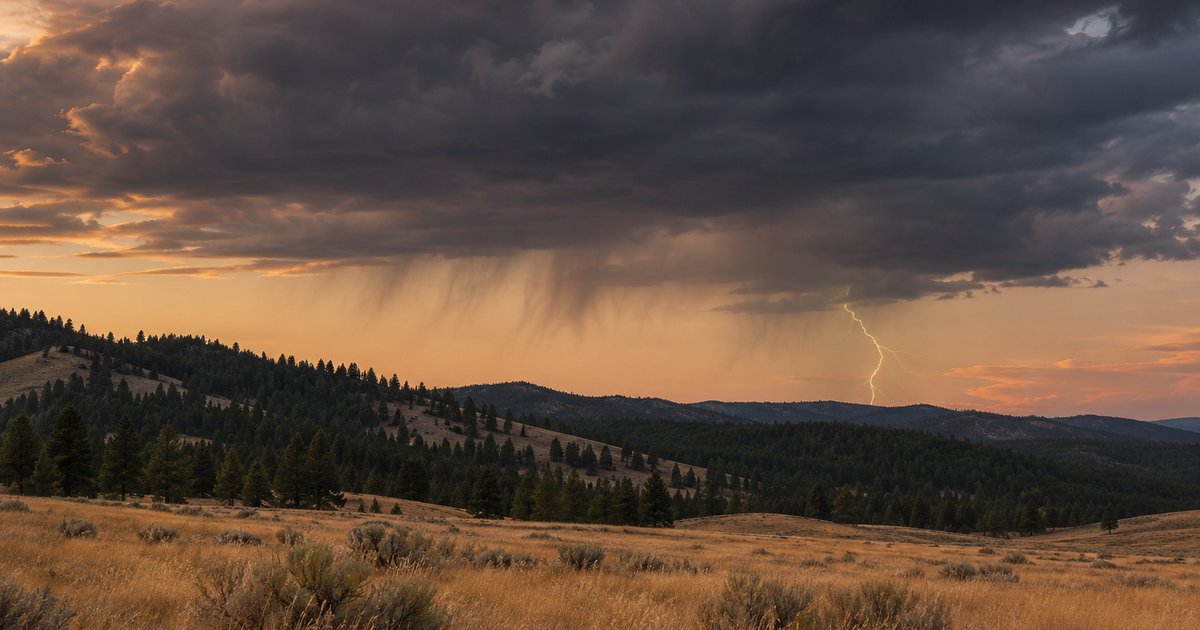
Dry lightning is lightning from a thunderstorm that drops little or no rain on the ground below it. It matters in two ways: a strike can ignite dry vegetation with no rain to put the fire out, and the lack of rain on you says nothing about whether the next strike can reach you.
Dry lightning is lightning from a storm whose rain stays in the air
The National Weather Service glossary defines a dry thunderstorm as, generally, a high-based thunderstorm in which lightning is observed but little if any precipitation reaches the ground. It adds that most of the rain evaporates into relatively dry air beneath the storm cell, and that the storm may also be called “dry lightning.” The National Severe Storms Laboratory puts the lightning side of it in one line: lightning that occurs without rain nearby. The label describes the weather around the strike, not a separate kind of flash.
In the strictest sense, the Albuquerque forecast office explains, rain leaves the cloud base but evaporates somewhere between the base and the ground, which meteorologists call virga. Storms that produce no measurable rain at all are rare, according to the same office. Most “dry” storms drop a little rain, and whether that rain counts is a matter of definition.
No rain where you stand does not by itself make a thunderstorm a dry thunderstorm: the NWS Albuquerque office says lightning can land outside the area that receives wetting rain. If you hear thunder without feeling rain, follow the NWS thunder rule and go inside; the absence of rain does not measure your distance from lightning.
Agencies draw the line between dry and wet at different rainfall amounts
No single rainfall number defines a dry thunderstorm. The National Weather Service office in Albuquerque describes dry versus wet in fire weather as a rolling scale that depends on the surface fuel bed and the weather that came before. After a long hot, dry spell, more rain is needed to moisten the fuel, and under a closed forest canopy more rain is needed to reach the ground. By the firefighting definition, a storm can produce measurable rain and still count as dry, because the rain is not enough to moisten the fuel bed. The same office adds that lightning can strike outside the small area that gets wetting rain, so a storm with a rainy core is not dry everywhere.
| Source | What counts as dry |
|---|---|
| NWS glossary | Little if any precipitation reaches the ground; no amount given |
| NWS Albuquerque | In most closed-canopy forests of New Mexico, rainfall under a tenth of an inch |
| NWS Grand Junction, Red Flag criteria | Less than 0.10 inch of rain |
| U.S. Forest Service, Missoula Fire Sciences Laboratory | 0.10 inch or less nearby; 0.25 inch or less east of the Mississippi River |
| NWS Storm Prediction Center, fire weather outlooks | 0.10 inch or less with the cloud-to-ground strikes; 0.50 inch or less in the Pacific Northwest and Northern Rockies |
For scale, 0.10 inch is about 2.5 millimeters. The thresholds are set around whether fuel gets wet, not around the storm, so the same storm can be dry in one agency’s terms and wet in another’s.
Dry lightning starts wildfires because the rain does not wet the fuel
The U.S. Forest Service Missoula Fire Sciences Laboratory says storms with dry lightning occur frequently in the western United States in the summer months and are the most common source of natural wildland fire ignitions. The Albuquerque office states the mechanism: the drier the thunderstorm, combined with dry vegetation, the more efficient it is at igniting fires with cloud-to-ground lightning.
The National Interagency Fire Center’s tables for 2025 count 8,294 lightning-caused wildland fires out of 77,850 in total, about 11%. Those lightning fires burned 2,857,141 of the year’s 5,131,474 acres, about 56%. The tables sort fires by cause and do not separate dry lightning from lightning with rain, so they show how much lightning matters to wildfire, not how much of it was dry.
Not every strike is equally likely to start a fire. The National Severe Storms Laboratory says positive lightning, the less common polarity, often has a stronger peak current and a longer flash duration than the usual negative kind, and that the longer-lasting current is thought to make ignition more likely. The Storm Prediction Center adds that fuels are paramount in fire weather: without receptive fuels, the chance of a significant fire weather threat is rather low.
A fire does not always show itself right away. Researchers call the time between the lightning and the moment a fire is detected the holdover time. A 2023 paper in Earth System Science Data, which assembled holdover data from earlier studies, notes that lightning-ignited wildfires can smolder or go undetected for several hours, days or even weeks before being reported. A fire can therefore appear well after the storm that started it has moved on.
Forecasters and fire managers flag dry thunderstorms separately
The National Severe Storms Laboratory notes that the Storm Prediction Center, part of the National Weather Service, routinely issues forecasts for dry lightning because this kind is more likely to cause forest fires. The center’s fire weather outlooks include two categories built around dry thunderstorms: ISODRYT, an elevated risk, and SCTDRYT, a critical risk. The product description sets the minimum criteria for the critical category at cloud-to-ground lightning covering 40% or more of an area with rainfall of 0.10 inch or less, and for the elevated category at 10% to 39% coverage. The center verifies outlooks against meteorological conditions, such as whether dry thunderstorms occurred, and not against whether fires started.
Locally, the Grand Junction forecast office lists widely scattered or more dry thunderstorms, 15% or more coverage, as a primary Red Flag criterion. It explains that a Red Flag Warning is issued to advise user agencies of occurring or imminent red flag conditions, generally within the next 12 to 24 hours. This article checked the criteria of one local office; other offices publish their own. These products are written for agencies: the Storm Prediction Center says its fire weather outlook is designed for use in the National Weather Service and other federal, state and local government agencies.
Dry storms can also bring damaging wind and blowing dust
The National Weather Service storm spotter guide describes dry downbursts as damaging winds with little if any rainfall, where sometimes all that is visible is evaporating precipitation or dust kicked up from the ground. Evaporation cools the air under the cloud, the cooler air is denser, and gravity pulls it toward the surface; gusty winds occur in the area of the virga. Wind is a separate hazard from the lightning, and a dry storm can bring both.
A storm without rain is still a reason to go inside
Rain is a poor warning sign for lightning. The National Weather Service says lightning often strikes more than three miles from the center of a thunderstorm, far outside the rain or the storm cloud, and that “bolts from the blue” can strike 10 to 15 miles from the storm. Ten lightning myths covers this one and nine others. The National Severe Storms Laboratory describes a helmeted bicyclist struck on a day with a cloudless sky; the bolt probably came from a thunderstorm about 16 km (roughly ten miles) away, hidden by mountains. Readers who use smell as a storm cue can compare ozone, petrichor and last-moment odors in the smell before a storm.
The National Weather Service’s lightning safety overview also names rain as a cue that people misuse. Some people wait until the thunderstorm is overhead and it starts to rain, it says, and many go back outside after waiting only for the rain to become lighter or end. In a dry thunderstorm that cue may never come, so it cannot be what tells you to move. The overview’s own rule is simpler: if you hear thunder, you are likely within striking distance of the storm, and you wait 30 minutes after the last lightning or thunder before going back outside. Why wait 30 minutes explains why that clock restarts, and where to shelter covers where to spend it.
Heat lightning describes distance, while dry lightning describes rainfall
The National Weather Service defines heat lightning as the light from a distant thunderstorm just too far away for you to see the actual cloud-to-ground flash or hear the thunder, and notes that thunder can only be heard for about 10 miles from a flash. The two terms answer different questions: heat lightning is about how far the storm is, dry lightning is about how much rain reaches the ground beneath it. A dry thunderstorm can be close enough to hear. To judge distance from a flash you can see, flash to bang shows the counting method.
What Lightning Tracker shows when the sky is dry
Lightning Tracker is an iPhone app that shows recently detected strikes on a live map, with the distance and direction to the nearest one and how many minutes ago it was detected. It alerts you when a strike is detected inside a radius you set for each place, 10 miles (16 km) by default, so the trigger is a detected strike, not rain at your location. How to choose an alert radius covers the trade-offs, and how lightning is detected explains the sensors behind the dots. Detection networks miss some strikes, especially weak ones, and data can arrive late; the app labels delayed or missing data instead of treating it as quiet. It does not replace official warnings or local procedures. Fire weather outlooks and Red Flag Warnings come from the National Weather Service.
Not a substitute for official weather warnings.
If you hear thunder, seek shelter even if the app shows no nearby strike.
Sources
- National Weather Service, Glossary: Dry Thunderstorm
- National Weather Service Albuquerque, Fire Weather Topics: “Dry” Thunderstorms
- National Weather Service Grand Junction, The Red Flag Program
- NOAA Storm Prediction Center, SPC Products: Fire Weather Outlooks
- National Weather Service, Weather Spotter’s Field Guide: Downbursts
- National Weather Service, Overview: Lightning Safety
- National Weather Service, Lightning Myths
- National Weather Service, Heat Lightning
- NOAA National Severe Storms Laboratory, Severe Weather 101: Lightning FAQ
- U.S. Forest Service Missoula Fire Sciences Laboratory, Dry Lightning Strikes
- National Interagency Fire Center, Lightning-caused wildfires
- National Interagency Fire Center, Wildfires and Acres
- Moris et al., A global database on holdover time of lightning-ignited wildfires, Earth System Science Data, March 2023