 Lightning Tracker
App Store
Storm basics
Lightning holdover fires: can a fire start days after the strike?
November 19, 2026 · 9 min read
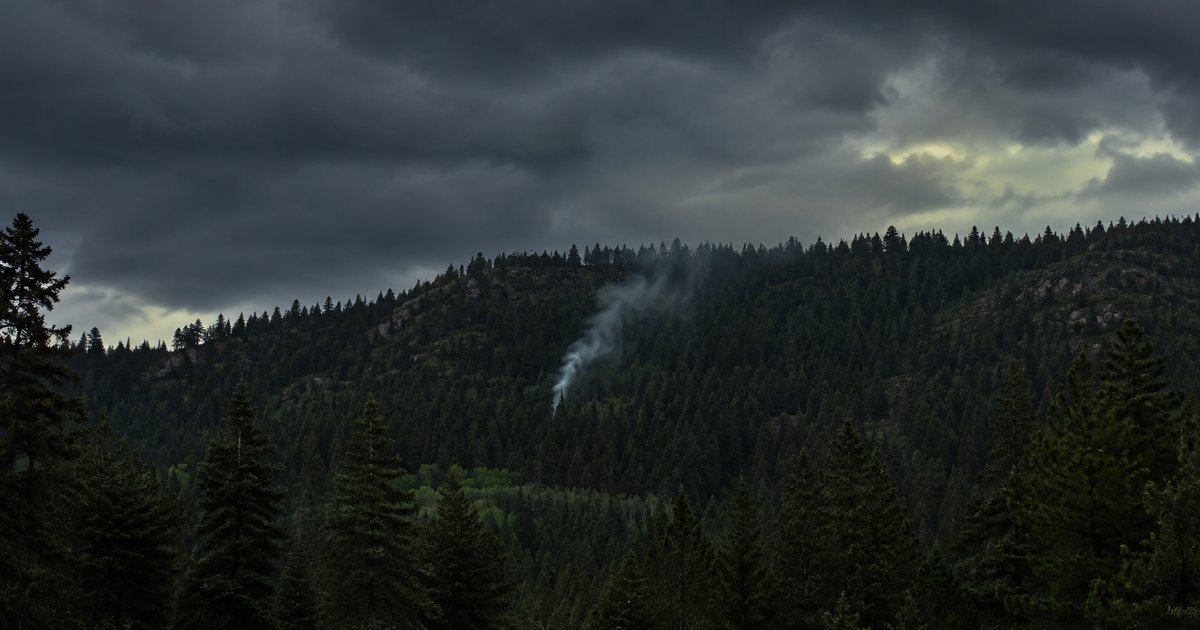
Yes: a lightning strike can leave heat smoldering in duff, roots or a standing dead tree, and the fire can go unreported for days or even weeks before it flares up. Researchers call these holdover fires. Most lightning fires in the studies below were reported within a day, but a study of more than 68,000 U.S. fire reports from 1995 to 2020 found that nearly one-third were holdovers, with a day or more between the lightning and the report.
A holdover fire is a lightning ignition that smolders unseen before anyone reports it
The North Carolina Forest Service describes lightning holdover fires as wildfires that can remain dormant, like a sleeper, typically smoldering underground without showing flames. The agency says the heat spreads through fuels such as standing dead snags, woody debris, root systems, true organic soils or deep duff, and that a holdover can mean days, even weeks of dormancy. It defines duff as the layer of decomposing organic material above the mineral soil and just beneath the loose litter of twigs, needles and leaves. Because duff is tightly packed and holds less oxygen than surface litter, it typically smolders instead of flaming, and when it dries out it can burn underground, slowly spreading without flames for days, even weeks.
Moris and colleagues, in a March 2023 paper in Earth System Science Data, split a lightning fire’s life into ignition, survival and arrival. They report that the organic soil around the base of trees hit by lightning is a commonly reported ignition point, and that the survival phase, the smoldering one, does not occur in every fire: depending on fuel dryness and weather, an ignition may spread almost at once as a surface fire or survive as a smoldering fire in the organic soils. The authors write that the rain and weather that come with thunderstorms are usually assumed to work against flaming combustion, so a fire may smolder in litter, duff or humus until it goes out or conditions turn more favorable, for example when surface fine fuels dry out or strong winds arrive.
Nobody sees the smoldering, so the delay is measured from its two ends. The same authors say the existence and duration of the smoldering phase are usually unknown, so holdover time is conventionally defined as the time between the lightning that ignited the fire and the time the fire is detected.
Studies find most lightning fires reported within a day, and a sizable minority later
Three research datasets answer how long the delay runs, and they measure different things, so they are listed side by side and not combined.
| Study | Fires studied | What it found |
|---|---|---|
| Moris et al., Earth System Science Data, March 2023 | 42 distributions from 29 studies; more than 152,375 fires in 13 countries, 1921 to 2020 | In 30 of the 42 distributions, more than half of the fires were reported in under 24 hours; medians ranged from 1.4 to 53.6 hours (about 2.2 days) |
| Schultz et al., Fire, April 2019 | 905 lightning-ignited fires of at least 988 acres (4 km²) in the contiguous U.S., 2012 to 2015 | 52% to 60% were reported the same day as the closest flash, depending on the search method; a 12-day holdover in New Mexico was examined |
| Schultz et al., Journal of Applied Meteorology and Climatology, April 2024 | More than 68,000 lightning-ignited fire reports in the contiguous U.S., 1995 to 2020 | Nearly one-third were holdovers, meaning a day or more passed between the lightning and the report |
The 2024 paper adds that fires reported less than a day after the lightning statistically burned more acreage, so in that dataset the fires reported within a day were the ones that burned more. The 2019 paper found that most of the holdover events it saw were in the western contiguous United States, with the highest density in north-central Idaho.
The longest delays are the least certain. Moris and colleagues say the time intervals in their database run from 1 minute to 87 days, but the maximum holdover times are strongly shaped by the cutoffs each original study applied, so they are not a good indicator of the longest delays that occur. The sources therefore support “days, even weeks” as what can happen, and none of them gives a typical or maximum number of weeks.
Alaska fire managers were still looking for holdover fires after the June 2026 storms
Moris and colleagues found that the first 24 hours were the most frequent interval in most daily distributions, with four exceptions built from fire remote sensing data in boreal regions, where the interval from 24 to 48 hours was the most frequent. They add that the longer holdover times seen in boreal regions are typically explained by climate, weather, vegetation and soil, though differences in methods may confound the comparison.
Alaska’s fire updates show what that looks like in practice. The U.S. Wildland Fire Service said on June 30, 2026 that fire managers were still monitoring for holdover fires, and that one small holdover fire had been identified late the previous day, likely ignited by lightning several days earlier. The same update described the Henshaw Fire, a holdover smoldering in spruce and hardwoods and burning deep into the duff in places, estimated at 2 acres, to which six smokejumpers were sent. On July 1, 2026 the service reported another holdover fire from the previous week’s lightning storms, in the upper Koyukuk River Basin about 20 miles (32 km) northwest of Allakaket, and said managers would keep monitoring as temperatures warm, vegetation dries and winds increase.
Holdovers also change how a season is counted. An August 29, 2025 article from the same service, about the surge of fires in mid-June 2025, counted 176 new fires between June 15 and June 29, 162 of them lightning-caused, and added that the figure does not include holdover fires that emerged later.
Fire agencies pair strike data with rain and fuel information, then patrol
The BC Wildfire Service’s Predictive Services page, checked November 12, 2026, says it uses Environment and Climate Change Canada’s lightning detection network, a feed with the location, time, amperage and polarity of each strike, and compares it with radar and weather stations to see whether rain fell nearby. It says it typically investigates positively charged strikes with no accompanying precipitation, which it says typically have the highest amperage and likelihood of sparking new fires. The National Weather Service glossary describes a dry thunderstorm as generally a high-based storm in which lightning is observed but little if any precipitation reaches the ground, and says it may also be called dry lightning.
After a storm moves through, the BC service says, it conducts air or ground patrols along known lightning pathways, timed for when smoke or heat from a strike is likely to be found. Ground patrols focus on smoke plumes and can be done by staff from areas with good visibility; air patrols look for plumes and may use thermal imaging to locate heat signatures in the forest. The same page lists handheld devices, aircraft, satellites and drones as sources of thermal imaging.
In the United States, the Forest Service’s Missoula Fire Sciences Laboratory says a scientist there produces maps that help land managers identify potential lightning ignitions and where dry lightning has occurred immediately after storms pass, and that both maps are created daily to help managers identify areas with a high likelihood of new lightning-caused wildland fire ignitions.
Investigators attribute a fire to lightning with ground evidence, and the strike record is only part of it
The National Wildfire Coordinating Group’s guide for fire investigators, in its March 2025 edition, lists what can point to lightning: a recent electrical storm in the area (hours, days or weeks), indicators of holdovers, scarring on trees or snags, precipitated sap, needle showers, blowholes at the base of a tree, fulgurites and splintered wood. It says a lightning-caused fire may smolder undetected for several days, weeks or months before it becomes a sustained flaming front, and tells the investigator to look for fuels that can hold a smoldering fire for an extended period. The guide’s “months” goes beyond the “days, even weeks” of the state and research sources above, and none of them gives a typical delay.
The guide’s steps include obtaining and reviewing lightning detection maps and data, extended to 30 days or more if weather or fuel conditions warrant, and using multiple sources because the accuracy of detection maps and data can vary with sensor locations. Its worked example of ruling lightning out describes a search of lightning databases that showed no strikes near the fire’s area in the previous two weeks, no witnesses who saw lightning activity and no physical evidence of a strike in the ignition area.
The guide classifies a fire as undetermined when no remaining hypothesis rises to probable, which it defines as more likely true than not, greater than 50 percent. It also notes that some agencies do not require an origin and cause investigation for natural fires, and that it is not uncommon for an arsonist to use the presence of lightning in an area as cover.
The matching studies show the same limits. In the 2019 study of 905 fires, the search methods found a flash within 14 days before the report for 81% to 88% of the fires, so 12% to 19% had none. For the method the authors found most promising, the closest flash to the fire’s start point had a median distance of about 0.5 mile (0.83 km), with a 95th percentile of about 3.6 miles (5.86 km). Moris and colleagues list the sources of mismatch: wildfire data problems such as misclassification and low detection effort, lightning data problems such as low detection efficiency and location accuracy in lightning networks, and the matching method itself. Read together, these sources point to this: a strike time and place near a fire is one piece of evidence, and none of them treats a strike record alone as proof of a cause.
A strike also does not decide whether it becomes a fire. Hessilt and colleagues, in a 2022 paper in Environmental Research Letters, studied Alaska and the Northwest Territories from 2001 to 2018 and found that short-term fuel drying associated with fire weather was the main driver of lightning ignition efficiency, the likelihood that a strike starts a fire. A live lightning map plots detected strikes, and these sources give no way to tell from the dots which strikes will start fires.
Hikers and residents can take three points from the agency sources
The first point is that smoke can appear after the storm has gone. The North Carolina Forest Service says dry, warm or windy conditions can wake holdovers and bring ground fire to the surface, and cites two lightning-induced fires in North Carolina’s Coastal Plain, Evans Road in 2008 and Pains Bay in 2011, that ignited during prolonged drought, burned for weeks and consumed more than 40,000 acres each. The BC Wildfire Service describes a similar pattern: heat can simmer underground for days or weeks, then flare up as fuels dry and the weather heats up.
The second point is that rain does not rule it out. The BC service says a strike may cause ignition in moist conditions without immediately growing into a fire.
The third is who to call. Alaska’s fire information site says to report a fire in Alaska by calling 911 or the Alaska Interagency Coordination Center at 1-800-237-3633. No agency page cited here gives a date after which a struck area stops being a concern, and none gives rules for hikers about checking for smolders. The lightning danger during the storm itself has a rule: the National Weather Service says to wait 30 minutes after the last lightning or thunder before going back outside.
What Lightning Tracker shows near a storm that may leave a holdover
Lightning Tracker is an iPhone app that shows recently detected strikes on a live map, with the distance and direction to the nearest one and how many minutes ago it was detected. The free version keeps 30 minutes of strike history, and a longer history is part of Premium. Detection networks miss some strikes, especially weak ones, so the map is a record of what was detected and not of every strike or of any fire. The app does not replace official warnings or local procedures.
Not a substitute for official weather warnings.
If you hear thunder, seek shelter even if the app shows no nearby strike.
Sources
- North Carolina Forest Service, Lightning-induced Wildfires
- Moris et al., A global database on holdover time of lightning-ignited wildfires, Earth System Science Data, March 2023
- Schultz et al., Spatial, Temporal and Electrical Characteristics of Lightning in Reported Lightning-Initiated Wildfire Events, Fire, April 2019
- Schultz et al., Assessing Flash Characteristics in Lightning-Initiated Wildfire Events between 1995 and 2020 within the Contiguous United States, Journal of Applied Meteorology and Climatology, April 2024
- Hessilt et al., Future increases in lightning ignition efficiency and wildfire occurrence expected from drier fuels in boreal forest ecosystems of western North America, Environmental Research Letters, April 2022
- U.S. Wildland Fire Service (Alaska), Low fire activity on U.S. Wildland Fire Service Incidents, June 30, 2026
- U.S. Wildland Fire Service (Alaska), Drying Conditions May Reveal Additional Holdover Fires, July 1, 2026
- U.S. Wildland Fire Service (Alaska), What triggered the wildfire surge across Interior Alaska around solstice?, August 29, 2025
- BC Wildfire Service, Predictive Services, checked November 12, 2026
- National Weather Service, Glossary: Dry Thunderstorm
- U.S. Forest Service Missoula Fire Sciences Laboratory, Dry Lightning Strikes
- National Wildfire Coordinating Group, Guide to Wildland Fire Origin and Cause Determination, PMS 412, March 2025
- National Weather Service, Overview: Lightning Safety