 Lightning Tracker
App Store
Storm basics
Hot lightning vs. cold lightning: what continuing current means
November 19, 2026 · 8 min read
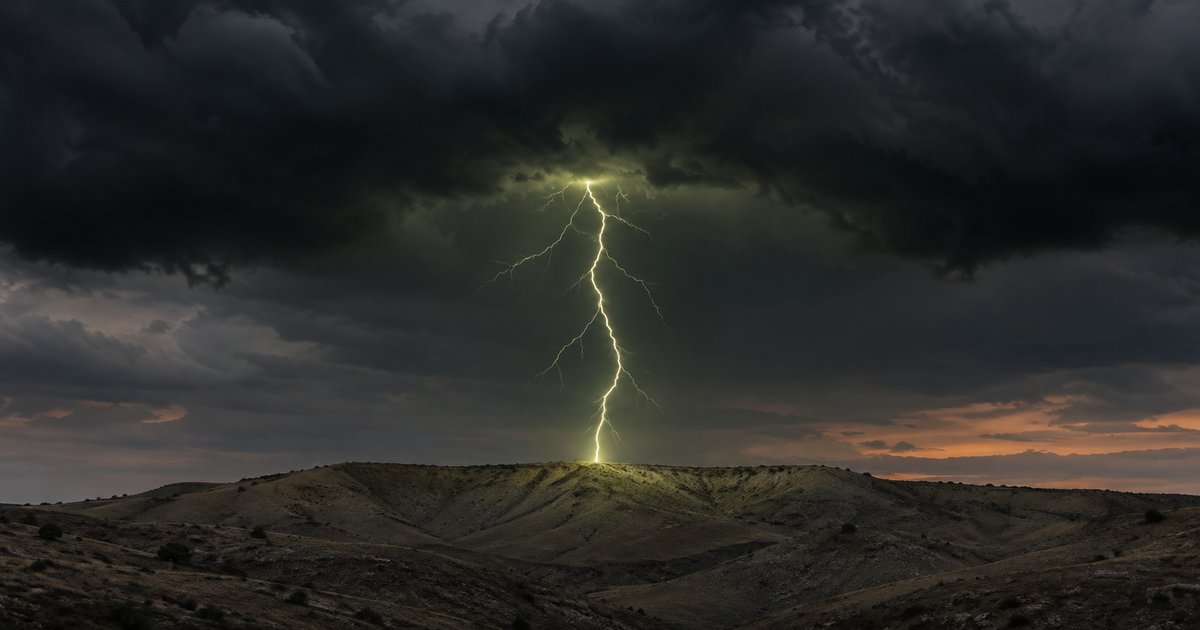
Hot lightning is the National Weather Service’s informal name for a flash that contains continuing current, meaning charge that flows through the channel for a longer time instead of only in short return strokes; flashes with only return strokes are called “cold lightning.” The names compare how long current flows, and so how likely a flash is to start a fire, not how hot the channel gets, because both kinds of channel are extremely hot.
The National Weather Service defines hot lightning by how long current flows
The National Weather Service (NWS) explains on its “Understanding Lightning” page that most flashes are combinations of leaders and return strokes, but some contain continuing current. In those flashes the charge does not move only in one or more separate return strokes; it flows continuously over a longer period through the lightning channel. The National Severe Storms Laboratory (NSSL) describes a return stroke as the bright current surge that travels back toward the cloud at about 60,000 miles per second once a leader from the cloud and a streamer from the ground connect.
To an observer, the NWS says, a flash with continuing current looks like a continuously lit channel instead of a flicker, with brightness that varies with the amount of charge moving. Flashes with both return strokes and continuing current are also common: they flicker, and they also hold steady light for short periods.
The NWS ties the names to heat and fire. In a typical return stroke, it says, electricity flows for only a short period and does not generate the heat required to ignite a fire, while in continuing current electricity flows over a much longer period and generates considerably more heat. Flashes with continuing current are therefore more likely to start fires. The NWS says they are sometimes referred to as hot lightning, while flashes containing only return strokes are referred to as “cold lightning.” The words “sometimes referred to” mark these as informal names, and the research papers opened for this article use the terms continuing current and long continuing current instead.
Both kinds of lightning channel are extremely hot, so the labels compare how long the heat lasts
Cold lightning is not cool. The NWS says the air in a lightning channel may reach as high as 50,000 °F (about 27,800 °C), five times hotter than the surface of the Sun, and the NSSL says the energy of a return stroke heats the channel air to above 50,000 °F in only a few millionths of a second. Both statements describe the discharge itself, so a flash with only return strokes is included in them.
Sources give different peak temperatures for lightning, and measuring them is hard. The NSSL gives a range of 18,000 to 60,000 °F for the surrounding air. In a January 2026 paper in Scientific Reports, Wemhoner and colleagues used a near-infrared photometer array to measure 23 return strokes and reported an average peak temperature of about 62,000 °F (34,800 K). They also note that the peer-reviewed literature on the temperature of lightning’s sub-processes is scant.
The same paper bears directly on the labels. Its authors followed one return stroke that was followed by continuing current and report that the channel sustained about 35,500 °F (20,000 K) for at least 10 milliseconds, cooling slowly at about 2,700 °F (1,500 K) per millisecond. They conclude that a return stroke with continuing current cools down slowly, and they say the cooling rates they report are two orders of magnitude slower than those an earlier study reported for strokes with no reported continuing current. That is one flash recorded about 2.6 miles (4.2 km) from the instrument and compared across two studies, so it fits the pattern the names suggest but does not prove a general rule.
Researchers draw the line for a long continuing current at different durations
The NWS page gives no number for “a much longer period,” and the papers below use their own cutoffs. A millisecond (ms) is a thousandth of a second, so 10 ms is one hundredth of a second.
| Paper | Published | Duration it uses or reports | In seconds |
|---|---|---|---|
| Pérez-Invernón, Huntrieser and Moris, Fire | July 2022 | Labels long-continuing-current lightning as longer than 18 ms | 0.018 |
| Pérez-Invernón and colleagues, Journal of Geophysical Research: Atmospheres | October 2023 | Counts continuing current lasting more than 10 ms in satellite data for summer 2018 | 0.01 |
| Same 2023 paper | October 2023 | A video-recorded, fire-igniting flash in the Swiss Alps: long continuing current of about 400 ms, optical signal of 2 to 4 seconds | 0.4 |
| Pérez-Invernón and colleagues, Journal of Geophysical Research: Atmospheres | August 2025 | Continuing currents lasting more than 10 ms | 0.01 |
| Wemhoner and colleagues, Scientific Reports | January 2026 | One four-stroke flash: 55 ms of continuing current after the first return stroke, 300 ms across the whole flash | 0.055 and 0.3 |
The cutoffs differ by almost a factor of two (10 ms against 18 ms), and the cases measured in these papers run from 55 ms to about 400 ms, so “long” has no single number in these sources.
Fire researchers tie ignition to how long continuing current lasts, and fuel still matters
In a September 1989 report, Don Latham and Joyce Schlieter of the U.S. Forest Service’s Intermountain Research Station described laboratory tests in which an electric arc that simulated continuing current was driven through 1,666 beds of wildland fuel. They found that ignition probabilities depended on the duration of the arc only, with current flow and arc diameter having no detectable effect, and that the most important variable associated with the discharge was its duration. The fuel mattered as well: for duff from short-needled conifers, the probability depended almost entirely on the depth of the fuel bed.
Studies of storm data point the same direction without settling it. A 2022 paper in Fire says long continuing current lightning is proposed as the main precursor of lightning-ignited wildfires, and that its long-lasting phase is the part more likely to ignite vegetation. A 2023 paper found that, despite data uncertainties, a flash with continuing current lasting more than 10 ms was more likely to ignite a fire than cloud-to-ground lightning in general across the contiguous United States in summer 2018, while its authors wrote that simultaneous optical and radio detections confirming the role of continuing currents are rare. A 2025 paper found that the ignition efficiency of fire-igniting strokes with continuing current is slightly higher than that of strokes without it, and that strokes with continuing currents lasting more than 10 ms may have a higher potential to start wildfires when conditions for the fire’s initial spread are less favorable.
Fuel sets the other half of the odds. The Storm Prediction Center says that in fire weather the element of fuels is paramount and that, without receptive fuels, the likelihood of a significant fire weather threat is rather low. Read together, the sources point to this: a flash with continuing current raises the chance that a fire starts, and it does not make a fire certain. The wider question of how lightning starts wildfires is covered in lightning-caused wildfires.
Positive flashes more often carry continuing current, but the sources split on whether polarity matters for fire
A positive flash is the less common kind of cloud-to-ground lightning: the NSSL says a downward positive leader followed by an upward return stroke lowers positive charge to earth. Positive cloud-to-ground flashes typically have only a single return stroke, the NSSL says, and they are more likely than negative ones to have a sustained current flow. Natural Resources Canada, on a page modified June 30, 2025, lists the share of flashes containing a long continuing current as 20% for typical negative flashes and 80% for positive ones. Latham and Schlieter wrote in 1989 that almost all positive discharges have a continuing current and only about one in five negative discharges do, so the share for positive flashes depends on the data behind it.
The NSSL adds that the longer-duration current of positive lightning is thought to make it more likely to ignite fires. The 2025 paper described above reached a narrower conclusion: its results suggest that the polarity of the strokes does not significantly influence the likelihood of a fire. Because a negative flash can also carry continuing current, about one in five by the Canadian table, hot lightning is not a synonym for positive lightning.
The labels hot lightning and cold lightning are easy to misread in three more ways
- Heat lightning is a different idea. The NWS says the term is commonly used for lightning from a distant thunderstorm just too far away for you to see the actual cloud-to-ground flash or hear the thunder. It describes distance, while hot lightning describes the current inside a flash.
- Dry lightning is a different idea. The NSSL defines it as lightning that occurs without rain nearby, and the U.S. Forest Service’s Missoula Fire Sciences Laboratory puts the line at 0.10 inch (about 2.5 mm) of rain or less nearby, or 0.25 inch (about 6 mm) east of the Mississippi River. Rain is the test there, not current duration. The 2022 paper studied Arizona, New Mexico and Florida: it found that lightning-ignited wildfires there tend to occur during dry thunderstorms, that long continuing current lightning tends to occur in thunderstorms with high relative humidity and ice content, and that the conditions favoring one are not necessarily those favoring the other.
- Thunder is not a clue to the kind. The NWS explains thunder as the sound of the discharge heating the air rapidly, after which the air cools and contracts quickly. None of the sources opened for this article says that hot and cold lightning sound different.
Identifying continuing current in strike data takes extra measurements
Latham and Schlieter wrote in 1989 that the lightning location systems of the time did not measure the duration of continuing current and did not even identify the discharges that have it. The 2023 and 2025 papers instead worked with continuing currents detected from space: the Geostationary Lightning Mapper, an instrument on weather satellites, records the optical emissions of lightning that reach space, and the 2023 authors also analyzed an extremely low frequency radio signal for one confirmed fire-igniting flash in the Swiss Alps. Read together, the sources point to this: a detected strike on a map marks where and when a flash was found, and telling a flash with a long continuing current from one without it takes extra optical or radio measurements.
The National Weather Service’s thunder rule applies to every flash, hot or cold
The NWS lightning safety overview says that if you hear thunder you are likely within striking distance of the storm, and that you should wait 30 minutes after the last lightning or thunder before going back outside. The NWS continuing-current page treats these flashes as a fire concern, and none of the sources opened for this article sets a different safety rule for hot or cold lightning.
Lightning Tracker is an iPhone app that shows recently detected strikes on a live map, with the distance and direction to the nearest one and how many minutes ago it was detected; it does not replace official warnings or local procedures.
Not a substitute for official weather warnings.
If you hear thunder, seek shelter even if the app shows no nearby strike.
Sources
- National Weather Service, Understanding Lightning: Continuing Current/Hot Lightning
- National Weather Service, Understanding Lightning: Thunder
- National Weather Service, Overview: Lightning Safety
- National Weather Service, Heat Lightning
- NOAA National Severe Storms Laboratory, Severe Weather 101: Lightning FAQ
- NOAA National Severe Storms Laboratory, Severe Weather 101: Lightning Types
- NOAA National Severe Storms Laboratory, Severe Weather 101: Lightning Detection
- NOAA Storm Prediction Center, SPC Products: Fire Weather Outlooks
- U.S. Forest Service Missoula Fire Sciences Laboratory, Dry Lightning Strikes
- Natural Resources Canada, Lightning: more information (page modified June 30, 2025)
- Latham and Schlieter, U.S. Forest Service Intermountain Research Station, Ignition Probabilities of Wildland Fuels Based on Simulated Lightning Discharges, Research Paper INT-411, September 1989
- Pérez-Invernón, Huntrieser and Moris, Meteorological Conditions Associated with Lightning Ignited Fires and Long-Continuing-Current Lightning in Arizona, New Mexico and Florida, Fire, July 2022
- Pérez-Invernón et al., On the Role of Continuing Currents in Lightning-Induced Fire Ignition, Journal of Geophysical Research: Atmospheres, October 2023
- Pérez-Invernón et al., Assessing the Influence of Fire Weather and Continuing Currents Detected From Space in Lightning-Induced Fire Ignition, Journal of Geophysical Research: Atmospheres, August 2025
- Wemhoner et al., Atomic oxygen photometric temperature of lightning and its sub-processes with SOPAPILLA, Scientific Reports, January 2026