 Lightning Tracker
App Store
Storm basics
Thunderstorms at night: why they happen and how to wake up for one
November 18, 2026 · 7 min read
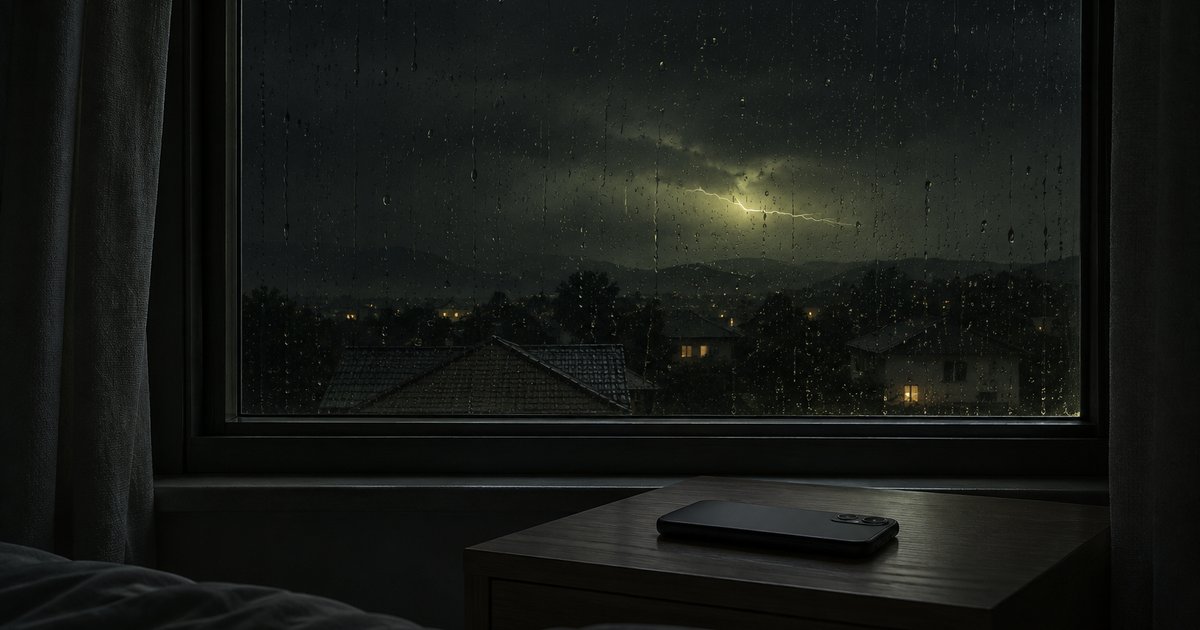
Over most land, thunderstorms are not most likely at night: NASA's Global Precipitation Measurement mission says they are most likely in the afternoon or evening. The exception is the Southern Great Plains, where the NSF National Center for Atmospheric Research says summer thunderstorms are most common after sunset. Either way, a storm that arrives at 2 a.m. finds you asleep, so the practical question is what will wake you in time.
Over most land, the peak is still the late afternoon
NASA's Global Precipitation Measurement mission says thunderstorms over land are most likely at the warmest, most humid part of the day, which is usually the afternoon or evening, and that over the ocean they are most likely in the early hours before dawn. R. L. Holle's 2013 paper for the American Meteorological Society, which used lightning-detection data for 2006 through 2010, shows the same shape on land: the most common time of peak lightning was between 2 p.m. and 6 p.m. local mean time, and the national minimum fell between 8 and 10 a.m.
A storm still going at 10 p.m. can be the afternoon's storm rather than a separate night one. The National Weather Service says a thunderstorm that has developed continues to generate boundaries that can trigger additional storms, so one round of storms can hand off to the next after dark.
The Great Plains run on a night schedule
NASA's Earth Observatory (October 7, 2020, page updated January 31, 2026) says the Great Plains routinely have nighttime thunderstorms in summer, unlike anywhere else in the country. A NASA climate scientist quoted there says the region gets half of its summer rainfall at night, and the article adds that these large systems account for more than 40 percent of annual rainfall in some areas. The NSF National Center for Atmospheric Research (NCAR) says thunderstorms across the Southern Great Plains are most common after sunset in summer.
The peak also travels. Holle found an evening maximum that began on the High Plains, east of the Rocky Mountains, and moved eastward through the night, with nighttime maxima as late as 2 to 4 a.m. in some Upper Midwest locations. A storm that begins near the mountains at dusk can reach a town farther east in the small hours.
What feeds a storm after the sun is gone
The National Weather Service glossary defines the low-level jet as a belt of strong southerly wind in the boundary layer, the air nearest the ground, and says it is common over the Plains states at night during the warm season. NASA's Earth Observatory describes the mechanism: after sunset the air at the ground cools, warm and moist air settles on top of that cool layer, and the winds just above are no longer slowed by friction from the land. They speed up to as much as 80 miles per hour (130 km/h) within 1,600 feet (500 meters) of the ground and carry warm, moist air toward the storms.
NCAR's Plains Elevated Convection at Night (PECAN) field project, held June 1 to July 15, 2015, studied nights when the largest store of storm energy sat above a cool, stable layer at the surface. NCAR says much of the resulting rain falls from mesoscale convective systems, that the intensity of the nocturnal ones is correlated with the jet, and that accurate prediction of this kind of elevated storm remains an elusive goal. In plain terms, a forecast can say a night is favorable for storms more reliably than it can say where the storms will form.
A night storm can last well past the 30-minute rule of thumb
The NOAA National Severe Storms Laboratory defines a mesoscale convective system as a collection of thunderstorms that act as a system, and says one can spread across an entire state and last more than 12 hours. A system keeps making new storms, so lightning can arrive in waves through the night. The National Weather Service advice is to wait 30 minutes after the last lightning or thunder before going back outside, and the count starts over with each new flash, as why wait 30 minutes explains. The quiet minutes between waves are part of the storm, not the end of it.
What darkness changes about seeing and hearing a storm
The NOAA National Severe Storms Laboratory says it is possible to see lightning and not hear the thunder because the storm was too far away. The National Weather Service describes the faint flash an observer sees from such a storm as light reflected off higher-level clouds, and says thunder can only be heard for about 10 miles from a flash. At night those reflected flashes stand out against a dark sky, which is why a storm beyond the horizon can look like silent flickering; flash to bang shows how to turn the gap between flash and thunder into a distance.
Both of those cues need you awake. Asleep, you see no flash and may hear no thunder, and the National Weather Service notes that "bolts from the blue" can strike 10 to 15 miles from the thunderstorm, about where thunder fades. So for a night storm the warning has to come from a device, not from your senses.
Does a house shelter you while you sleep?
The National Weather Service lists buildings with electricity and plumbing as lightning shelter. It says lightning can enter a building through a direct strike, through wires or pipes that extend outside, or through the ground, and then travel through the electrical, phone and plumbing systems. Its indoor advice follows those paths: stay away from exterior windows and doors, do not touch electrical equipment such as computers, TVs or cords, avoid plumbing, and do not lie on concrete floors or lean against concrete walls. Set up a NOAA Weather Radio or another warning channel before bed so you can respond if a warning wakes you.
Ways to be woken up
The National Weather Service office in La Crosse, Wisconsin, asks how you receive severe weather alerts in the middle of the night and answers with NOAA Weather Radio: specially designed radios sound an alarm when a hazardous emergency exists, and the office calls them smoke alarms for severe weather. NOAA Weather Radio broadcasts official warnings, watches and forecasts around the clock, and it needs a special receiver or scanner.
On an iPhone, the Sleep Focus is the obstacle and the exit at once. Apple's Human Interface Guidelines say a Focus filters notifications during a period reserved for an activity such as sleeping, and that people choose which apps can break through. The notification level decides what gets past a Focus:
| Apple's notification level | Breaks through a Focus | Overrides the Ring/Silent switch |
|---|---|---|
| Passive | No | No |
| Active (the default) | No | No |
| Time Sensitive | Yes | No |
| Critical | Yes | Yes |
Apple's guidelines say Critical notifications are extremely rare, typically come from government agencies or health and home apps, and require an entitlement, so for most apps the most urgent level available is Time Sensitive. Two things follow from the table. The Focus has to allow Time Sensitive notifications or the app, and a phone left with its side switch on silent may stay quiet because Time Sensitive does not override that switch. Apple also says the first time a Time Sensitive notification arrives, the system gives people a way to turn it off, so it is worth confirming it is still on.
Lightning Tracker, an iPhone app, alerts when a strike is detected inside a radius you set for each place, 10 miles (16 km) by default, and again when strikes get noticeably closer. Its approach alerts ask for Time Sensitive delivery, and iOS settings such as Focus, Background App Refresh and Low Power Mode affect whether they arrive. The app also has limits: detection networks miss some strikes, especially weak ones, data can arrive late, and in the background iOS decides when the app may check. It does not replace official warnings. A larger radius can give more minutes between the first alert and a strike overhead, a trade-off how to choose an alert radius walks through.
A bedtime check for a night with storms in the forecast
- Open your sleep Focus. Under Settings › Focus, allow Time Sensitive notifications or add the app. iPhone storm alert settings lists the menus.
- Look at the side switch. Time Sensitive does not override the Ring/Silent switch, so test the phone the way you will leave it.
- Plug the phone in. Low Power Mode affects alert delivery, so check that it is off.
- Pick the radius for sleeping. Choose the distance that gives your household time to reach shelter from bed.
- Keep a second channel. A NOAA Weather Radio needs its own special receiver, not a phone.
When an alert wakes you, move to a substantial building or a hard-topped car, as where to shelter from lightning describes, and treat the last flash as the start of the 30-minute wait, not as the all-clear. The app begins that wait after the last strike it detects inside your radius and restarts it with each new one; when it ends, it reports what it observed and asks you to judge conditions yourself rather than announcing that the storm is over.
Not a substitute for official weather warnings.
If you hear thunder, seek shelter even if the app shows no nearby strike.
Sources
- NASA Global Precipitation Measurement mission, Is there a specific time of day that a thunderstorm is most likely to occur?
- R. L. Holle, American Meteorological Society, Diurnal Variations of NLDN Cloud-to-Ground Lightning in the United States (conference paper, 2013)
- National Weather Service, Understanding Lightning: Thunderstorm Development
- NASA Earth Observatory, Thunderstorms Rumble over the Great Plains (October 7, 2020)
- NSF NCAR Earth Observing Laboratory, PECAN: Plains Elevated Convection at Night
- National Weather Service, Glossary: Low Level Jet
- NOAA National Severe Storms Laboratory, Severe Weather 101: Thunderstorm Types
- NOAA National Severe Storms Laboratory, Severe Weather 101: Lightning FAQ
- National Weather Service, Lightning Indoors
- National Weather Service, Lightning Safety Overview
- National Weather Service, Heat Lightning
- National Weather Service, Lightning Myths
- National Weather Service La Crosse, NOAA Weather Radio Awareness Day (2015)
- National Weather Service, NOAA Weather Radio All Hazards
- Apple, Human Interface Guidelines: Managing notifications