 Lightning Tracker
App Store
Places and activities
Winnipeg thunderstorms and lightning: season and where to check
November 18, 2026 · 7 min read
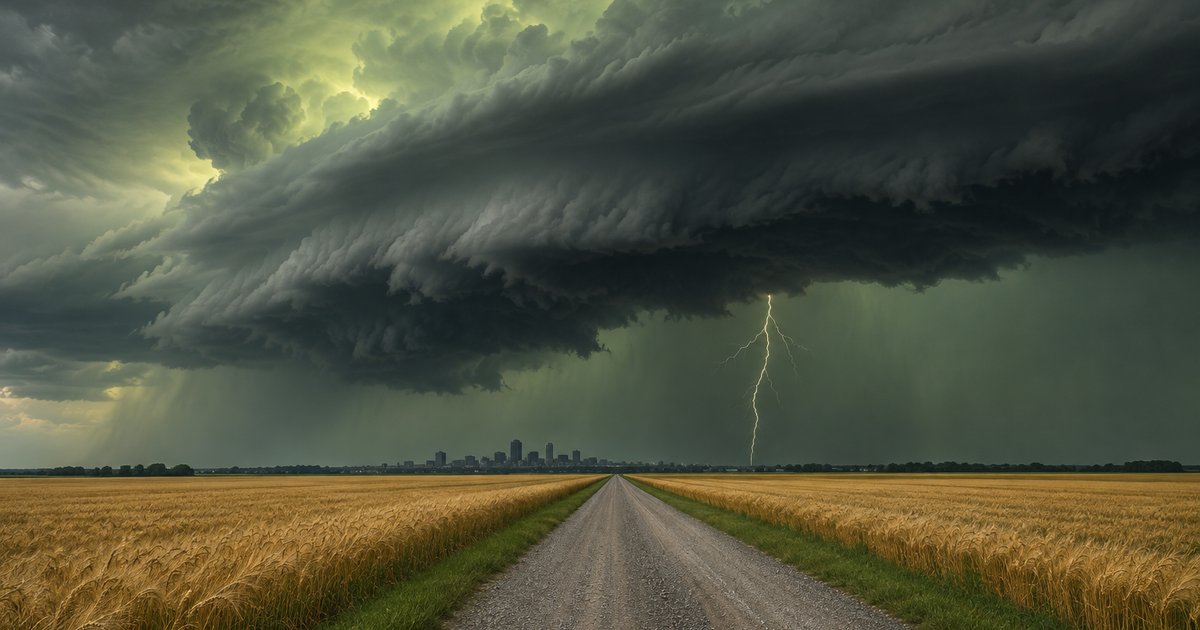
Winnipeg has lightning on about 32 days a year: Environment and Climate Change Canada (ECCC) counted 37,194 cloud-to-ground flashes within 25 kilometers of the city center from 1999 to 2018 and an average of 32.1 lightning days a year. The average lightning season in southern Manitoba runs from April 1 to October 1, and about 40 percent of its lightning falls between 10:30 p.m. and 10:30 a.m. ECCC’s weather alerts and Lightning Map are the official checks; thunder is the signal to go indoors whatever either shows.
How much lightning does Winnipeg get?
ECCC’s “Lightning activity in Canadian cities” table counts cloud-to-ground flashes within 25 kilometers of each city’s center over 1999 to 2018, and gives the average number of days a year on which lightning would be expected within that radius. Every city gets the same radius and the same 20 years, so the rows compare directly. Winnipeg’s 37,194 flashes average about 1,860 a year.
| City | Flashes within 25 km | Lightning days a year | Years | Source |
|---|---|---|---|---|
| Winnipeg, MB | 37,194 | 32.1 | 1999–2018 | ECCC city table |
| Regina, SK | 32,853 | 30.1 | 1999–2018 | ECCC city table |
| Saskatoon, SK | 22,340 | 27.0 | 1999–2018 | ECCC city table |
| Calgary, AB | 25,268 | 38.2 | 1999–2018 | ECCC city table |
| Edmonton, AB | 32,811 | 36.9 | 1999–2018 | ECCC city table |
| Toronto, ON | 56,139 | 40.5 | 1999–2018 | ECCC city table |
| Windsor, ON | 109,776 | 50.1 | 1999–2018 | ECCC city table |
Flashes and lightning days measure different things. ECCC notes that one city can have more strikes than another and still have the same number of lightning days, because storms differ in strength and duration. Calgary shows the split: 38.2 lightning days a year, more than Winnipeg’s 32.1, but 25,268 flashes against Winnipeg’s 37,194. In ECCC’s table, 28 cities have more flashes than Winnipeg and 41 have more lightning days. Windsor, Ontario, which ECCC names as Canada’s city with the most lightning days, has about three times Winnipeg’s flashes.
Inside Manitoba, ECCC’s table lists 12 cities, and Winnipeg is fourth of 12 on both measures. Brandon (42,228), Portage la Prairie (39,383) and Steinbach (39,107) have more flashes; Portage la Prairie (34.8), Steinbach (34.5) and Brandon (32.8) have more lightning days. ECCC’s hotspot map describes southern Saskatchewan and southern Manitoba as an area of relatively high lightning activity that appears to be an extension of the active Great Plains area of the United States (see where lightning strikes most in the US). These are 1999–2018 averages for a 25-kilometer circle, not a forecast for any storm.
When is Winnipeg’s thunderstorm season?
ECCC’s average lightning season in southern Manitoba starts on April 1 and ends on October 1, with small areas starting as early as March 20 and ending as late as November 1. The agency’s maps divide the province into regions rather than naming cities, so the dates below are regional ones. Winnipeg lies about 100 kilometers north of the Minnesota border, according to The Canadian Encyclopedia, in the south of the province.
| Season marker | ECCC region | Average date, 1999–2018 |
|---|---|---|
| Season starts | Manitoba – South | April 1 |
| Season starts, small areas | Manitoba – South, small areas | March 20 |
| Season ends | Manitoba | October 1 |
| Season ends, small areas | Manitoba, small areas | October 20 |
| Season ends, southern small areas | Manitoba – South, small areas | November 1 |
ECCC publishes no month-by-month table for Winnipeg alone. Its 1999–2018 monthly averages for all of Canada put July first, with about 900,000 cloud-to-ground flashes, followed by August (580,000) and June (480,000). The Province of Manitoba says hot or muggy days and warm nights indicate that thunderstorms may be forming.
What time of day do Winnipeg thunderstorms come?
ECCC says the most frequent time for lightning across most of Canada is between 1 p.m. and 6 p.m. local time, the pattern behind afternoon thunderstorms. The southern prairies differ. ECCC reports that nocturnal lightning can account for almost half of all lightning in the southern halves of Saskatchewan and Manitoba, and its 1999–2018 map gives these shares for lightning between 10:30 p.m. and 10:30 a.m. local time.
| ECCC region | Share of lightning between 10:30 p.m. and 10:30 a.m. |
|---|---|
| Manitoba – South | 40 percent |
| Manitoba – South, small areas | 50 percent |
| Manitoba – Central, small areas | 55 percent |
| Manitoba – North | 25 percent |
In southern Manitoba, then, about four strikes in ten fall overnight or in the morning, and six in ten between 10:30 a.m. and 10:30 p.m. Why the Plains keep a night schedule is covered in thunderstorms at night.
What do a severe thunderstorm watch and warning mean in Winnipeg?
ECCC issues three types of weather alerts: warnings, advisories and watches. It says a watch tells you to get ready to protect yourself from potential severe weather, is issued when conditions are favorable for the development of severe weather, and may be upgraded to a warning when certainty increases. A warning tells you to act now: severe weather is either happening or will happen, and some of it, tornadoes for example, can occur with less than 30 minutes’ notice. The National Weather Service’s definitions of the same two words are set out in severe thunderstorm watch vs. warning.
ECCC colors each alert yellow, orange or red as the risk grows, and says yellow alerts are the most common. On its Weather Information map, solid colors and solid outlines mark warnings and advisories, and transparent colors with dotted outlines mark watches. Severe thunderstorm and tornado warnings are drawn as a shape around the area forecasters expect to be affected, while watches use fixed alert zones, so a watch and a warning often appear over the same place at the same time. ECCC uses the Alert Ready system, which reaches phones, television and radio, only for tornado warnings and for severe thunderstorm warnings with wind gusts of 130 km/h or greater or baseball-sized or larger hail (7 cm).
ECCC’s Impact Guide for thunderstorms describes the effects of hail, wind and rain, and adds a note that lightning can occur with any thunderstorm. ECCC calls lightning the most common danger associated with thunderstorms and says to find shelter as soon as you see lightning or hear thunder, without waiting for an alert.
Where can you check Winnipeg lightning and alerts?
| Official service | What it shows | What to keep in mind |
|---|---|---|
| ECCC Weather Information map | Alerts, radar and lightning as layers; a table of active alerts | Select an alert-colored area to open its text, and read the full alert. |
| ECCC Lightning Map layer | Brown circles for detected ground strikes; a larger circle means more strikes at that spot | It is not a forecast, and in-cloud lightning does not appear. |
| WeatherCAN app | Forecasts and alert notifications | Notifications depend on your settings. |
| ECCC Thunderstorm Outlook | An early heads-up that a thunderstorm is likely to develop, up to 36 hours ahead | An outlook is not an alert and does not guarantee a storm. |
ECCC says the Lightning Map updates every minute. When the layer looks empty, ECCC lists reasons that do not mean the sky is quiet: no lightning in the last hour, a map that has not yet updated, in-cloud or cloud-to-cloud lightning, or a strike the network did not detect. If you see lightning or hear thunder, ECCC says to get to shelter quickly regardless. Strike age and coverage gaps apply to any live lightning map; ECCC notes, for example, that lightning can show before the radar image updates.
The layer replaced a product with another name: ECCC’s lightning pages say the Canadian Lightning Danger Map has moved to Canada.ca/weather, where the Lightning layer shows current strikes. The Province of Manitoba adds that ECCC issues watches, advisories and warnings through radio and television stations and through Weatheradio, a nationwide radio network that broadcasts weather information 24 hours a day. ECCC’s tools show detected ground strikes; apps and third-party maps are covered under checking lightning near you.
What do Manitoba and the City of Winnipeg say about lightning?
The Province of Manitoba’s severe-weather page says thunderstorms are common on the prairies and often bring hail, lightning, high winds, heavy rain and occasionally tornadoes. It recommends waiting 30 minutes after the last lightning strike in a severe storm before going outside again. ECCC counts the 30 minutes from the last sound of thunder (why wait 30 minutes).
The City of Winnipeg’s page on wading pools says a pool may be closed throughout the day if the weather turns to thundershowers during the day, or if lightning or thunder are present.
On June 9, 2026, ECCC warned, as CP24 quoted it, that its meteorologists were “tracking a severe thunderstorm that is possibly producing a tornado” and named West Winnipeg among the places in its path. By midday on June 10 the City of Winnipeg had received nearly 1,000 service requests after the storm, and it asked residents to call 911 for emergencies and 311 for non-emergencies such as downed trees.
How do Regina and Saskatoon compare?
On ECCC’s city table, Regina averages 30.1 lightning days a year with 32,853 flashes, and Saskatoon 27.0 days with 22,340 flashes. Winnipeg’s flash count is about 13 percent above Regina’s and about two-thirds above Saskatoon’s. ECCC’s province-wide average lightning season in Saskatchewan runs from May 10 to October 1, so it starts later than southern Manitoba’s April 1. The nocturnal share is 35 percent in southern Saskatchewan, against 40 percent in southern Manitoba. ECCC’s alerts and Lightning Map cover all of Canada, so the checks above apply in both cities.
What should you do when thunder starts?
ECCC names two kinds of shelter: an enclosed building with plumbing and wiring, or an all-metal vehicle. It says to stay there for at least 30 minutes after the last sound of thunder. Neither a missing alert nor an empty map changes that rule.
Lightning Tracker is an iPhone app that works in Winnipeg as elsewhere. It shows recent detected strikes on a live map, with the distance and direction to the nearest one and how many minutes ago it was. It does not replace official warnings.
Not a substitute for official weather warnings.
If you hear thunder, seek shelter even if the app shows no nearby strike.
Sources
- Environment and Climate Change Canada, Lightning activity in Canadian cities
- Environment and Climate Change Canada, Maps and statistics: lightning in Canada
- Environment and Climate Change Canada, Map of Canada’s lightning hotspots
- Environment and Climate Change Canada, Weather Alerts
- Environment and Climate Change Canada, Colour-coded weather alerts
- Environment and Climate Change Canada, Weather Impact Guides
- Environment and Climate Change Canada, Severe thunderstorms and tornadoes
- Environment and Climate Change Canada, How to use the Weather Information map
- Environment and Climate Change Canada, Lightning Map
- Environment and Climate Change Canada, Lightning
- Province of Manitoba, Severe Weather: Thunderstorms
- Province of Manitoba, Severe Weather: Look for the signs
- Province of Manitoba, Severe Weather: Listen for the warnings
- City of Winnipeg, Wading pools
- City of Winnipeg, Mayor thanks City crews, urges caution following major storm
- CP24, Manitoba weather: Tornado warnings issued
- The Canadian Encyclopedia, Winnipeg