 Lightning Tracker
App Store
Places and activities
Lightning in Ontario: seasons, warnings and what to do
November 19, 2026 · 5 min read
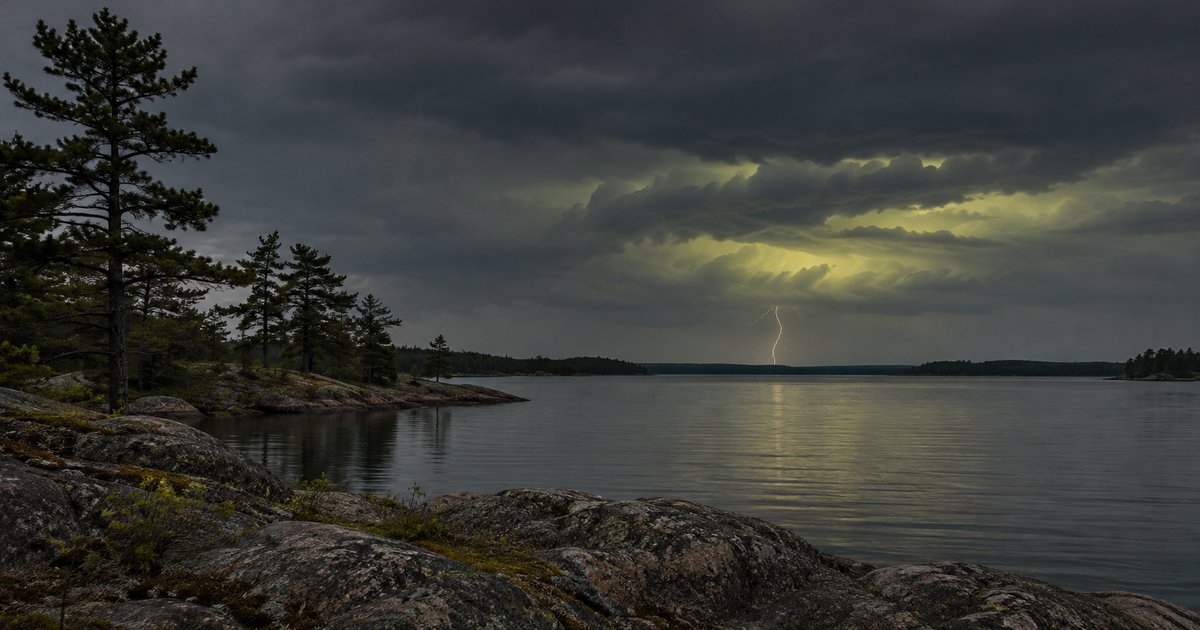
Ontario thunderstorms are common from late April to early October, Ontario Parks said in July 2023, but the province’s lightning is not spread evenly: ECCC’s 1999–2018 maps place a major hotspot between Lakes Huron and Erie. Check ECCC’s official warnings and observed-strike layer for your location, then go into an enclosed building or metal-topped vehicle at the first thunder and stay inside for at least 30 minutes after the last rumble, as Ontario’s May 2026 guidance says.
Ontario’s storm season spans spring through fall
Ontario Parks wrote in July 2023 that thunderstorms are common throughout the province from late April to early October. That is a planning season, not a calendar boundary that prevents a storm outside it. For a park trip, Ontario Parks says to check the forecast for the park itself before leaving home, rather than relying on the forecast for your hometown. It advises staying home from a backcountry trip when warnings for thunderstorms, strong wind or flooding are posted.
Environment and Climate Change Canada (ECCC) maps for 1999–2018 show that the Ontario pattern is uneven. In its eastern Canada average-flash-density table, southwestern Ontario between the Great Lakes has 2.1 flashes per square kilometre per year (about 5.4 per square mile), against 0.5 per square kilometre (about 1.3 per square mile) for western, northern and central Ontario as a broad group. Small areas between the lakes reach 3.0 or more per square kilometre (about 7.8 or more per square mile) in that table. These are historical area averages, not a way to judge a particular campsite or a storm today.
Southwestern Ontario has a distinct lightning hotspot
ECCC identifies southwestern Ontario as one of Canada’s highest lightning-density areas. Its hotspot page places part of that concentration in a lake-breeze convergence zone between Lakes Huron and Erie, where air moving inland from the lakes meets air over land. It also identifies a second hotspot from the southern tip of Georgian Bay toward southeast of Barrie. The agency’s 1999–2018 southern Ontario map shows the greatest single-year density, a different measure from the multi-year average. Mixing those two maps would make a hotspot look like a typical year.
Ontario Parks’ province-wide season and ECCC’s regional density maps answer different questions. The park guidance tells a visitor when thunderstorms are common enough to plan around. The ECCC map shows where detected flashes accumulated over past years. Neither number tells you whether a particular park has a storm approaching now; use the official forecast and alerts for that decision.
Check ECCC alerts and the lightning layer for different purposes
ECCC’s August 2026 Weather Alerts guide calls a watch a prompt to get ready when conditions favour severe weather. A warning calls for action because severe weather is happening or expected. The guide says to read the full alert text for its timing, place, likely impacts and actions. Its yellow, orange and red colours express impact level; colour alone is not a count of lightning strikes.
In August 2026, ECCC introduced targeted polygons for severe thunderstorm and tornado warnings on its Weather Information map. Severe thunderstorm watches still use broader predetermined alert zones. Open the full warning for the place you are in, especially when a polygon crosses only part of a familiar region. ECCC’s Weather Information map and WeatherCAN are the official paths to Ontario forecasts and alerts.
The separate ECCC Lightning Map layer shows detected ground strikes as brown circles and updates every minute. It displays observations, not a forecast. ECCC says an empty layer may omit in-cloud lightning, reflect a missed detection or await an update. A rumble of thunder is reason to seek shelter even with no circle on the screen. Checking lightning near you begins with that audible sign, then uses maps as additional information.
Ontario’s shelter guidance begins at the first thunder
The Government of Ontario’s thunderstorm guidance, updated May 2026, says to enter an enclosed building or metal-topped vehicle when thunder is heard. Its outdoor list says to avoid water, high ground, isolated trees, power lines and picnic shelters. The province says to remain inside for at least 30 minutes after the last rumble of thunder. Restart that wait if thunder returns. Enclosed buildings and vehicles need to be identified before a walk or event, while there is time to reach one.
Ontario also warns people indoors to stay away from windows and to avoid showers, baths and running water during the storm because lightning can enter plumbing. Those steps matter after you have already reached shelter; they are not reasons to delay going inside. The same provincial page notes that thunderstorms may bring hail, damaging wind and tornadoes, so read any official warning for hazards beyond lightning.
In a provincial park, choose the retreat before the trip
Ontario Parks’ July 2023 campground guidance tells tent and tent-trailer campers to use a hard-topped vehicle when a thunderstorm arrives, with the windows up. It specifically rules out a picnic shelter or vault privy as lightning shelter. A tent does not change the decision just because it is pitched under trees. Camping in a thunderstorm involves leaving the campsite for the vehicle or an enclosed building early enough to reach it.
Ontario Parks tells swimmers to get out of the water when they see lightning or hear thunder, and tells paddlers and boaters to make their way to shore when severe weather hits. Its backcountry advice recognizes that a building or vehicle may be far away; that is why the park recommends a group plan and a forecast check for the specific park before setting out. The park guide says to continue lightning precautions for 30 minutes after the last flash or thunder.
Ontario Parks’ general visitor page, read in November 2026, also tells visitors to check alerts for the park they plan to visit. Park alerts concern local access and conditions, while ECCC provides weather forecasts and warnings. A visitor should check both before departure and listen for thunder on site.
Official Ontario quick links
- ECCC Weather Information map: forecast and weather alerts for the place you select.
- ECCC Lightning Map guide: where to turn on the observation layer and how to interpret an empty display.
- Ontario thunderstorm guidance: provincial shelter and indoor steps.
- Ontario Parks visitor guidance: park-specific alert route and trip planning.
Lightning Tracker is an English-language iPhone app that works in Ontario and elsewhere; it can alert you when it detects a strike inside a radius you set for a place. Detection can miss strikes or arrive late, so follow ECCC warnings and the thunder you hear.
Not a substitute for official weather warnings.
If you hear thunder, seek shelter even if the app shows no nearby strike.
Sources
- Environment and Climate Change Canada, Map of Canada’s lightning hotspots
- Environment and Climate Change Canada, Lightning Map
- Environment and Climate Change Canada, Weather Alerts
- Environment and Climate Change Canada, New targeted warnings for severe thunderstorms and tornadoes
- Government of Ontario, Thunderstorm
- Ontario Parks, What to do when a thunderstorm rolls in
- Ontario Parks, Safety in Ontario Parks