 Lightning Tracker
App Store
Places and activities
Montréal thunderstorms and lightning: season, warnings and official checks
November 19, 2026 · 4 min read
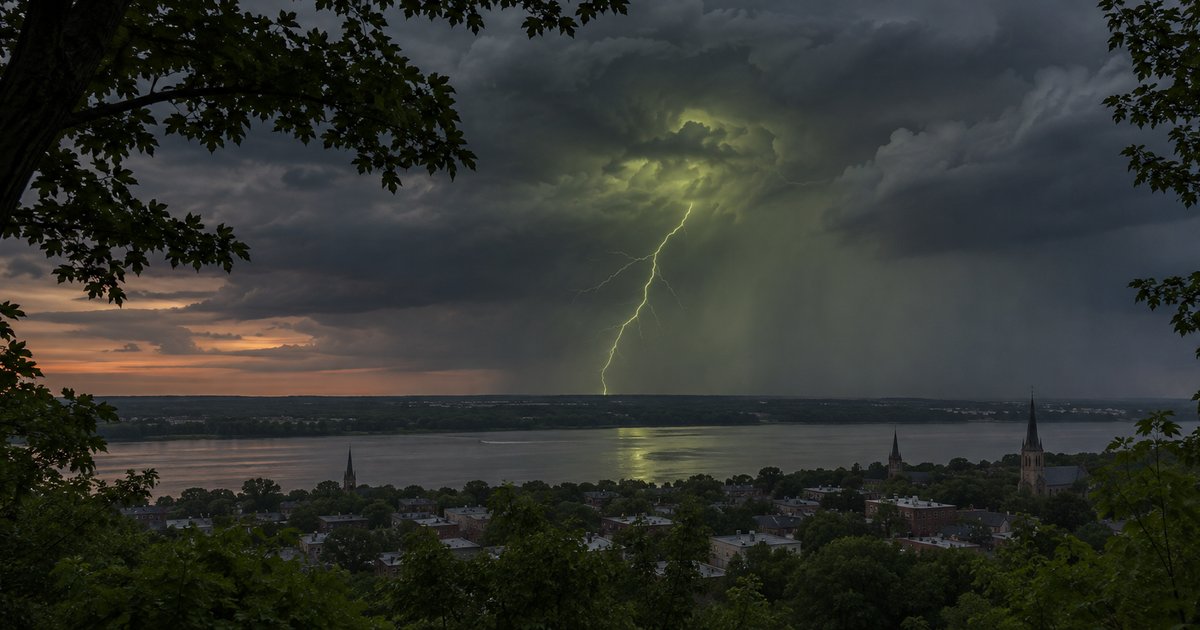
ECCC’s 1999–2018 study recorded an average of 32.5 lightning days a year within 25 km (16 miles) of central Montréal. Thunderstorms are mainly a warm-season concern, but the historical season extends into spring and fall. Check Environment and Climate Change Canada (ECCC) for Montréal warnings and detected lightning, and follow the City of Montréal’s shelter and outage guidance when thunder arrives.
When Montréal gets thunderstorms
Environment and Climate Change Canada (ECCC) counted an average of 32.5 days with detected lightning each year within 25 km (16 miles) of central Montréal in its 1999–2018 study. That is a historical measure of lightning days, not a count of storms over a particular neighborhood or a prediction for any future summer. The same ECCC table records 37,189 cloud-to-ground flashes in that circle across the 20-year period. A flash can occur outside the rain, so the city total should not be read as a count of rainy days.
ECCC’s 1999–2018 season maps put the average start for southern Québec around April 1 and the average end for southwestern Québec around October 20. Those are regional averages, not a fixed opening and closing date for Montréal. ECCC’s national statistics identify July as the month with the most cloud-to-ground flashes across Canada. The practical Montréal season therefore reaches beyond summer, while summer is the main period for planning around thunderstorms.
Montréal’s position in the city table also gives useful scale: ECCC lists Laval at 32.1 lightning days a year and Longueuil at 32.5, using the same 25 km (16 mile) radius method. These circles overlap, so their numbers cannot be added to estimate flashes across the metro area.
| Circle | Days with lightning |
|---|---|
| Montréal | 32.5 |
| Longueuil | 32.5 |
| Laval | 32.1 |
ECCC says a city can have more flashes than another yet the same number of lightning days because individual storms vary in duration and strength.
Where to check an alert for Montréal
ECCC’s August 2026 guidance directs readers to its Weather Information map for forecasts and alerts, the WeatherCAN app for notifications, and its Thunderstorm Outlook for advance planning. Choose Montréal and read the full alert text and the area it covers. An outlook is a planning product, not an alert; ECCC says it looks up to 36 hours ahead and can be issued even though no storm develops. An absent outlook does not rule out a thunderstorm.
A watch means conditions favor severe weather and you should prepare; a warning means severe weather is happening or expected and you should act, according to ECCC’s August 2026 Weather Alerts page. ECCC now draws targeted warning areas for severe thunderstorms, while watches still use established forecast zones. Check the warning’s mapped area and text rather than assuming that a notice for the wider Montréal region covers every address equally. ECCC also says only some severe thunderstorm warnings meet its criteria for an interruptive Alert Ready phone alert; a missing phone interruption does not mean there is no warning.
For detected lightning, ECCC’s Lightning Map page links to the lightning layer in its Weather Information map. The layer shows detections, not a forecast. ECCC says an empty display can mean no ground strikes in the past hour, an update delay, an undetected strike, or lightning that stayed within or between clouds. That distinction matters when checking how lightning is detected: hearing thunder is already reason to seek shelter, even when no circle appears on a screen.
What Montréal asks you to do during a storm
The City of Montréal’s July 2026 guide says to take shelter as soon as you hear thunder. Its preferred options are a building or a car, and it warns against trees, posts, fences, bus shelters, and other open structures. ECCC similarly directs people who see lightning or hear thunder into a building or vehicle with closed windows. A transit shelter is therefore no substitute for shelter from lightning in an enclosed building or vehicle.
Montréal advises postponing outdoor activities if a thunderstorm is forecast, and points out that people struck by lightning were not necessarily standing in rain. Its July 2026 guide says to wait 30 minutes after the last thunderclap before going outside. If thunder sounds again, the 30-minute wait begins again. The city also tells residents indoors to move away from windows, use a cell or cordless phone rather than a landline, and favor battery-powered devices during lightning-related power surges.
The city says severe storms can bring flooding and power outages as well as lightning. If a storm has damaged your home, its July 2026 guidance says to contact 911 when you fear entering is dangerous. For branches touching electric lines, it points residents to Hydro-Québec; for a displaced sewer cover or large accumulation of water in the street, it directs them to 311. The city also warns against driving through flooded roads. These local instructions address hazards that a lightning detection display cannot assess.
Lightning Tracker works in Montréal and elsewhere, but it is an English-language iPhone app: its interface and alerts are in English only. It can alert you when it detects lightning within the radius you set for a place; use ECCC for official warnings.
Not a substitute for official weather warnings.
If you hear thunder, seek shelter even if the app shows no nearby strike.
Sources
- Environment and Climate Change Canada, Lightning activity in Canadian cities
- Environment and Climate Change Canada, Maps and statistics: lightning in Canada
- Environment and Climate Change Canada, Severe thunderstorms and tornadoes
- Environment and Climate Change Canada, Weather Alerts
- Environment and Climate Change Canada, Lightning Map
- City of Montréal, How to protect yourself during a severe thunderstorm