 Lightning Tracker
App Store
Storm basics
Schumann resonances: how lightning makes the planet ring
November 10, 2026 · 8 min read
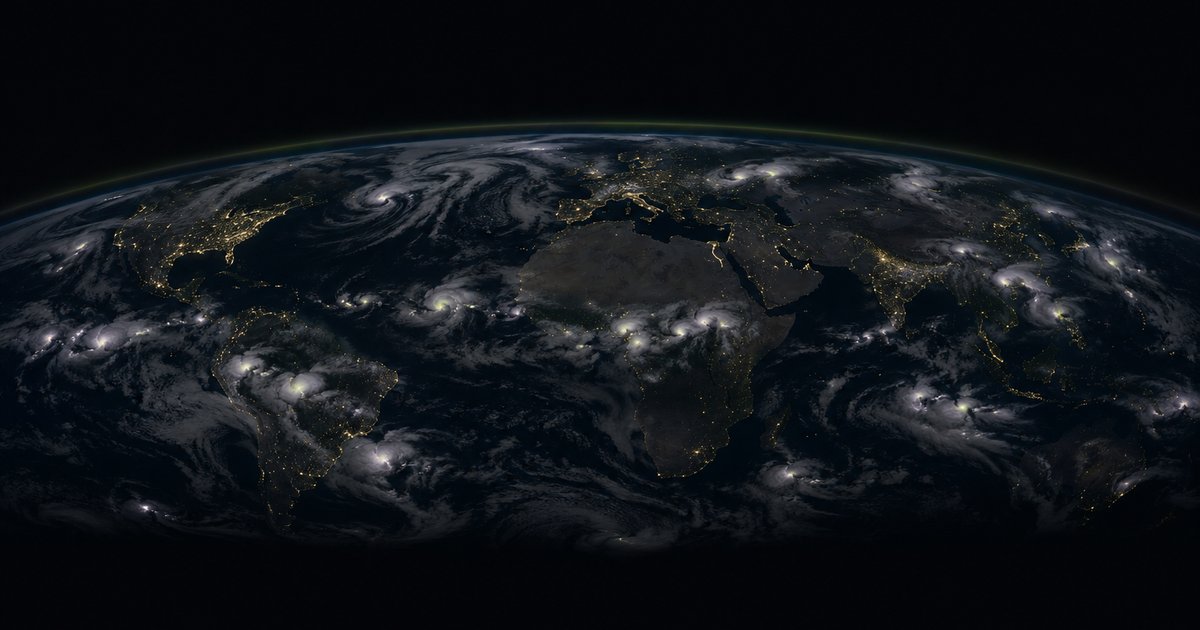
Schumann resonances are a faint, steady set of electromagnetic signals at extremely low frequencies, with peaks near 8, 14 and 21 cycles per second, according to NASA. Lightning creates them: NASA’s Earthdata site says the planet flashes about 35 to 55 times every second, and those flashes keep setting the space between the ground and the ionosphere ringing. The signal is real and measured. MIT News describes it as adding up lightning from the whole planet, so it says nothing about whether a storm is near you, and the sources reviewed here do not show that it affects your health.
Lightning keeps a cavity around the Earth ringing
A paper from NASA’s Goddard Space Flight Center, posted as a preprint on the NASA Technical Reports Server, describes the surface of the Earth and the lower edge of the ionosphere as a cavity in which electromagnetic waves travel. The ionosphere is the electrically conductive upper atmosphere, and the paper puts its lower boundary at about 62 miles (100 km). When broadband sources such as lightning excite that cavity, a resonant state can develop, and the paper calls the result Schumann resonance. The name honors the German physicist Winfried Otto Schumann, who described it mathematically in 1952, according to the HUN-REN Institute of Earth Physics and Space Science in Hungary.
The cavity is struck all the time. NASA’s Earthdata site says more than 2,000 thunderstorms are active worldwide at a given moment, and that the global flash rate runs from 35 flashes per second in Northern Hemisphere winter to 55 in summer. A 2003 paper in the Journal of Geophysical Research on data from NASA’s Optical Transient Detector, a satellite lightning sensor, counted nearly 1.4 billion flashes a year. It found that lightning occurs mainly over land, by about 10 to 1, with the Congo basin standing out year-round. Because some storm is flashing at every moment, the resonance never switches off.
The pitch comes from the size of the planet
A resonance favors the wavelengths that fit the space around it. The NASA paper says the cavity resonates when Earth’s circumference is about equal to a whole number of wavelengths. It gives the average measured frequencies of the five lowest modes as about 7.8, 14.3, 20.8, 27.3 and 33.8 hertz (Hz, cycles per second), all in the extremely low frequency (ELF) range.
A rough check shows why the lowest mode sits near 8 Hz. Radio waves travel at the speed of light, 299,792,458 meters per second according to the National Institute of Standards and Technology (NIST), so one cycle at 7.8 Hz is about 38,400 km (23,900 miles) long. NASA lists Earth’s equatorial radius as 6,378 km, which puts the distance around the equator at about 40,000 km (24,900 miles), close to the same length.
The peaks are broad, not sharp. The NASA paper gives the Q-factor of the resonances, a measure of how little energy the cavity loses in each cycle, as about 5. That is a low value, so the cavity is heavily damped: a muffled drum more than a bell.
The signal drifts with the sun, the storms and the time of day
The HUN-REN institute notes that measurements of this kind have been conducted at the Nagycenk observatory since 1993, and calls the frequencies “remarkably stable — but not entirely fixed.” It says they are influenced by solar activity, which changes the height of the ionosphere, by the global distribution of thunderstorms, and by the distance between the measuring station and the world’s active storm regions. The NASA paper adds that the ionosphere, which forms the roof of the cavity, is lower by day than by night.
What do the live daily charts and their “spikes” show? None of the sources reviewed here explains those charts. The HUN-REN Institute wrote on May 11, 2026 that the frequencies are influenced by solar activity, the global distribution of thunderstorm activity, and the distance between the measuring station and active storm regions. A paper in Science by Boccippio and colleagues, published August 25, 1995, describes transient Schumann resonance excitations that were often coincident with large positive cloud-to-ground lightning in two summertime storm systems. That is two storms, not a daily chart, so reading a spike as an event that affects people goes beyond what these sources show. That last point is this article’s reading.
Scientists use those changes as a record of lightning. The NASA paper says the resonances are used to study the daily and seasonal variability of lightning. In 1992, MIT’s Earle Williams reported in Science that monthly averages of the signal closely followed monthly changes in tropical temperature over five and a half years, because lightning increases with temperature, according to MIT News. That makes the resonance a research tool for lightning and climate, not a measure of any one storm.
Tesla’s July 1899 storm: what his notes record
Nikola Tesla arrived in Colorado Springs, Colorado, in May 1899 and experimented there for nine months, according to PBS. In the July 4, 1899 entry of his Colorado Springs Notes, a receiver connected to the ground and to a plate above it kept responding to lightning as a storm moved away, went quiet, and then began responding again after about half an hour, when the storm was at least 200 miles away. Tesla wrote that this “showed clearly the existence of stationary waves,” meaning waves that hold fixed high and low points instead of traveling past. He then weighed where they were reflected from. It “would be difficult to believe” they came back from the opposite side of the Earth, “though it may be possible,” and he thought it more likely that they were reflected from the cloud where the conducting path began.
In a March 5, 1904, article in Electrical World and Engineer, which PBS reproduces, Tesla told the story in public. As the storm moved away, he wrote, “the receiving circuit came successively upon their nodes and loops,” and “this planet, despite its vast extent, behaved like a conductor of limited dimensions.” The article states the planetary conclusion more firmly than the notes do.
What Tesla patented, and where the sources disagree
Tesla’s U.S. patent 787,412, filed May 16, 1900, and granted April 18, 1905, says he began by studying “the effects of lightning discharges upon the electrical condition of the earth.” It claims a method of “establishing stationary electrical waves in the earth,” and its title, “Art of transmitting electrical energy through the natural mediums,” suggests the aim was power transmission rather than lightning measurement. The patent gives the lowest frequency as six per second, and it assumes a mean velocity of about 471,240 kilometers per second over the Earth’s surface, faster than the speed of light (299,792 km per second, according to NIST).
Accounts disagree about what he calculated. PBS says Tesla calculated a resonant frequency of about 8 hertz for the space between the Earth and the ionosphere, and that researchers in the 1950s found the resonance in that range. The 8-hertz figure does not appear in the patent, which gives six and does not mention the ionosphere.
A commentary in the Nikola Tesla Museum’s 1978 edition of the notes quotes the physicist J. D. Jackson, who wrote that Tesla “did not know of the ionosphere” and estimated the lowest frequency at 6 Hz, against 6.6 Hz for a perfectly conducting sphere. The same commentary notes that Tesla had suggested the upper layers of air conduct electricity, says he was “certainly in error” in some generalizations about wave frequency, and argues that the waves he believed ran through the Earth were in fact waves in the cavity between the Earth and the ionosphere. It adds that Schumann and other physicists of the 1950s built their treatment on essentially the same principles as Tesla.
| Question | Tesla’s account, 1899–1905 | Schumann resonances as measured |
|---|---|---|
| What carries the waves? | Stationary electrical waves in the Earth, as the patent claims | Electromagnetic waves in the cavity between the surface and the ionosphere, excited by lightning (NASA) |
| Lowest frequency? | Six per second in the patent; about 8 Hz according to PBS | About 7.8 Hz, averaged over measurements (NASA) |
| Wave speed? | About 471,240 km per second assumed in the patent | The idealized formula uses the speed of light, 299,792 km per second (NASA, NIST) |
| How was it shown? | A receiver responding during one storm in 1899 (notes) | Described by Schumann in 1952; observations published by Balser and Wagner in Nature in 1960 (HUN-REN, NASA reference list) |
A fair summary is that Tesla recorded storm signals that faded and returned, proposed that the Earth acts as a resonator, and estimated a very low frequency that lies near the measured one. Nothing in the sources reviewed shows that he recorded the resonance peaks themselves, which NASA’s paper shows as horizontal lines in a spectrogram of recorded electric-field data. The claim that Tesla discovered or predicted the 7.8 Hz resonance goes further than those sources support.
The “heartbeat of the planet” and other claims: what the sources support
The HUN-REN institute says Schumann resonance is commonly known in esoteric circles as the “heartbeat of the planet,” but that it is more accurately a natural, low-frequency electromagnetic hum. On health, the institute states that a direct causal link between negative effects such as headaches or anxiety and resonance anomalies has not been scientifically established, and that alarm claims deserve a critical eye. The same page adds that research suggests the resonance may support the body’s ability to cope with stress, without naming a study.
A 2025 review in Electromagnetic Biology and Medicine argues that cells and proteins may have evolved to use frequencies like these; its abstract says research indicates that human brain activity is highly dependent on the resonance, and concludes that “further research is required to fully understand these mechanisms.” Taken together, these sources describe an open question, not a demonstrated effect, and none of them supports health advice built on a daily Schumann chart.
What protects you from real lightning
A Schumann chart cannot tell you whether a storm is nearby, because the signal adds together lightning from the whole planet. MIT News described it as a signal that “integrates the electrical noise from every lightning bolt on earth.” The National Weather Service gives guidance that works without any chart: if you hear thunder, you are likely within striking distance of the storm, and you should wait 30 minutes after the last lightning or thunder before going back outside.
Flash to bang shows how to estimate a storm’s distance from the count between flash and thunder, why wait 30 minutes explains why the clock restarts, and where to shelter from lightning covers where to go. How lightning is detected covers the sensors behind the strike data. Lightning Tracker is an iPhone app that shows detected strikes on a live map, with the distance and direction to the nearest one and how many minutes ago it was, and it does not replace official warnings.
Not a substitute for official weather warnings.
If you hear thunder, seek shelter even if the app shows no nearby strike.
Sources
- NASA Goddard Space Flight Center (Simões, Pfaff and Freudenreich), Observation of Schumann Resonances in the Earth’s Ionosphere, preprint on the NASA Technical Reports Server (PDF)
- NASA Earthdata, Lightning
- Christian and colleagues, Global frequency and distribution of lightning as observed from space by the Optical Transient Detector, Journal of Geophysical Research 108(D1), 2003 (PDF, NASA Earthdata)
- NASA Goddard Space Flight Center, Earth Fact Sheet
- National Institute of Standards and Technology, Fundamental Physical Constants: speed of light in vacuum
- HUN-REN Institute of Earth Physics and Space Science, The Earth’s ‘Hum’: What Does Schumann Resonance Actually Tell Us?, May 11, 2026
- MIT News Office, Schumann resonance as a tropical thermometer, November 12, 1992
- Nelson, Exploring the influence of Schumann resonance and electromagnetic fields on bioelectricity and human health, Electromagnetic Biology and Medicine, 2025 (abstract)
- Boccippio and colleagues, Sprites, ELF Transients, and Positive Ground Strokes, Science, August 25, 1995 (abstract)
- Nikola Tesla Museum, Belgrade, Nikola Tesla, Colorado Springs Notes, 1899–1900, 1978 edition with scientific commentary (scan on the Internet Archive)
- Tesla, U.S. Patent 787,412, Art of transmitting electrical energy through the natural mediums, filed 1900, granted 1905
- PBS, Tesla, “The Transmission of Electric Energy Without Wires,” Electrical World and Engineer, March 5, 1904
- PBS, Tesla: Master of Lightning, Colorado Springs
- National Weather Service, Overview: Lightning Safety