 Lightning Tracker
App Store
Storm basics
Can a laser guide a lightning bolt?
November 19, 2026 · 4 min read
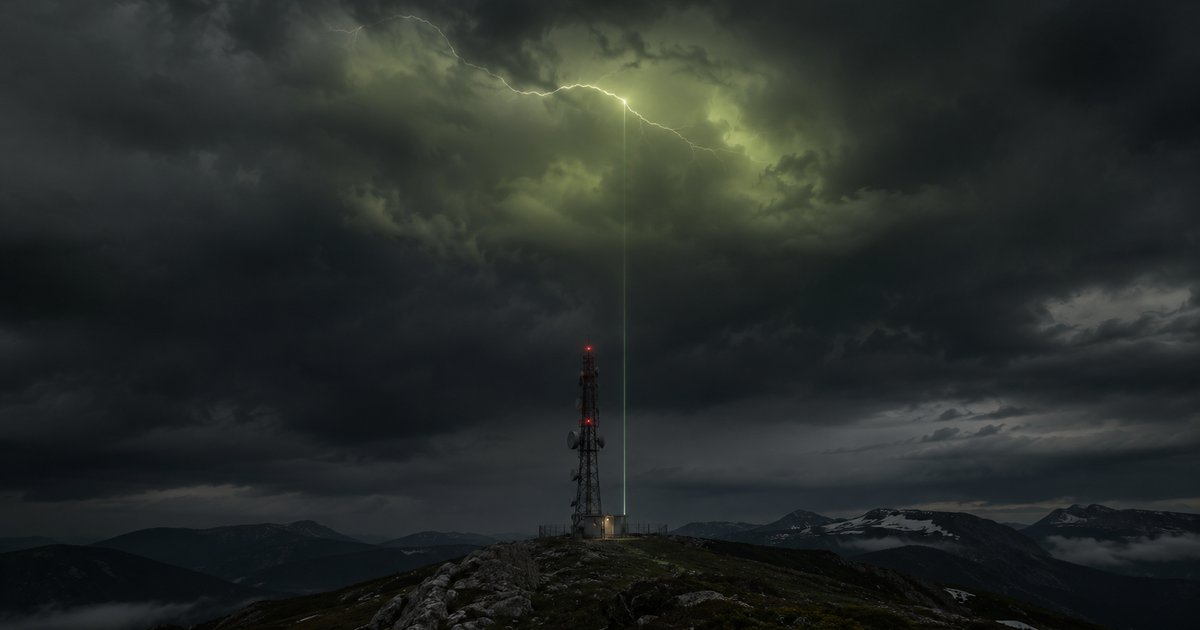
Yes. In a Swiss mountain trial run in 2021 and published by Houard and colleagues in January 2023, a laser guided the first roughly 164 feet (50 meters) of an upward lightning leader near a tower. The result showed a measurable influence on a natural discharge, not a deployed laser lightning rod.
The field test guided a leader near an existing tower
The experiment described by Houard and colleagues in Nature Photonics in January 2023 took place on Switzerland’s Säntis mountain during the summer of 2021. The team installed a powerful pulsed laser near a 407-foot (124-meter) telecommunications tower that already had a conventional grounded lightning rod. The beam passed near the tower tip and rose into the air above it. The tower was a useful test site because the paper says it is struck about 100 times a year; the researchers were observing a place where lightning was already likely to occur.
The laser ran for 6.3 hours during thunderstorm activity from July 21 through September 30, 2021, according to the study. At least 16 flashes struck the tower during the campaign, four while the laser operated. Every recorded strike in that set traveled upward from the tower. The investigators therefore tested whether the beam could influence an upward leader, the developing electrical channel, rather than demonstrate control of every bolt descending from a cloud.
On July 24, 2021, a sufficiently clear sky let two high-speed cameras record one of the laser-on flashes from separate locations. The study reports that its initial path followed most of the first 164 feet (50 meters) of the laser track. The path was not a perfectly straight line, and the filmed segment was only the beginning of the discharge.
Radio measurements supplied a second kind of evidence
The 2023 paper says the other three laser-on events could not be photographed as clearly. A very-high-frequency radio interferometer instead located radio emissions from their developing lightning channels. For those events, the emissions clustered closer to the laser path than comparable laser-off events. In the first 197 feet (60 meters) above the tower, the authors calculated a 45% reduction in the spread of radio-source distances from the beam when the laser was on. Above that height the reduction was much weaker.
Those radio positions are measurements of where the developing discharge emitted signals, not photographs of an entire bolt riding a visible beam. The study calls the overall evidence preliminary and asks for further campaigns with other configurations.
| Instrument | Events | Result |
|---|---|---|
| Two high-speed cameras | One laser-on flash, July 24, 2021 | The initial path followed most of the first 164 feet (50 meters) of the laser track, and was not a perfectly straight line |
| Very-high-frequency radio interferometer | The other three laser-on events | Emissions clustered closer to the laser path than in comparable laser-off events; a 45% reduction in the spread of radio-source distances in the first 197 feet (60 meters) above the tower, much weaker higher up |
Short pulses changed a narrow path through the air
Houard and colleagues explain in their 2023 paper that intense, short laser pulses ionize air molecules and heat a narrow channel. Expanding heated air leaves a lower-density path with higher electrical conductivity for milliseconds. Repeated pulses can make that path favorable to a developing electrical discharge. The laser did not carry the lightning current like a metal wire; the discharge formed in the air along part of the beam’s route.
The Säntis instrument fired 1,000 pulses a second, the paper says. The authors suggest that this repetition rate may have helped the field test succeed where earlier attempts in New Mexico and Singapore had not shown evidence of lightning guidance. Their explanation is a proposed mechanism, not a separate measurement proving which single setting caused the result. The test also relied on a tall tower and an existing rod.
Guiding is different from routinely protecting a site
The 2023 study describes the laser approach as a step toward possible protection for large infrastructure, such as airports and launchpads. It does not report a deployed laser protection system, a protected area around the tower, or a reduction in damage. The observed guidance distance was about 164 feet (50 meters), and the authors explicitly call for more field campaigns.
The distinction also matters for rocket-triggered artificial lightning. In that method a rocket trails a grounded conducting wire into the storm’s strong electric field, according to the paper. At Säntis, the laser shaped part of a natural discharge near a tower; the grounded rod remained the current path into the tower system.
The National Weather Service says to seek shelter immediately when thunder is heard. The Säntis experiment did not test a way for people to remain outdoors during a storm.
For ordinary storms outside the lab, Lightning Tracker, an iPhone app, shows recently detected strikes on a live map and the distance to the nearest one.
Not a substitute for official weather warnings.
If you hear thunder, seek shelter even if the app shows no nearby strike.
Sources
- Houard et al., Laser-guided lightning
- National Weather Service, Lightning Tips