 Lightning Tracker
App Store
Storm basics
Upward lightning: flashes that start at a tall object and climb
November 19, 2026 · 9 min read
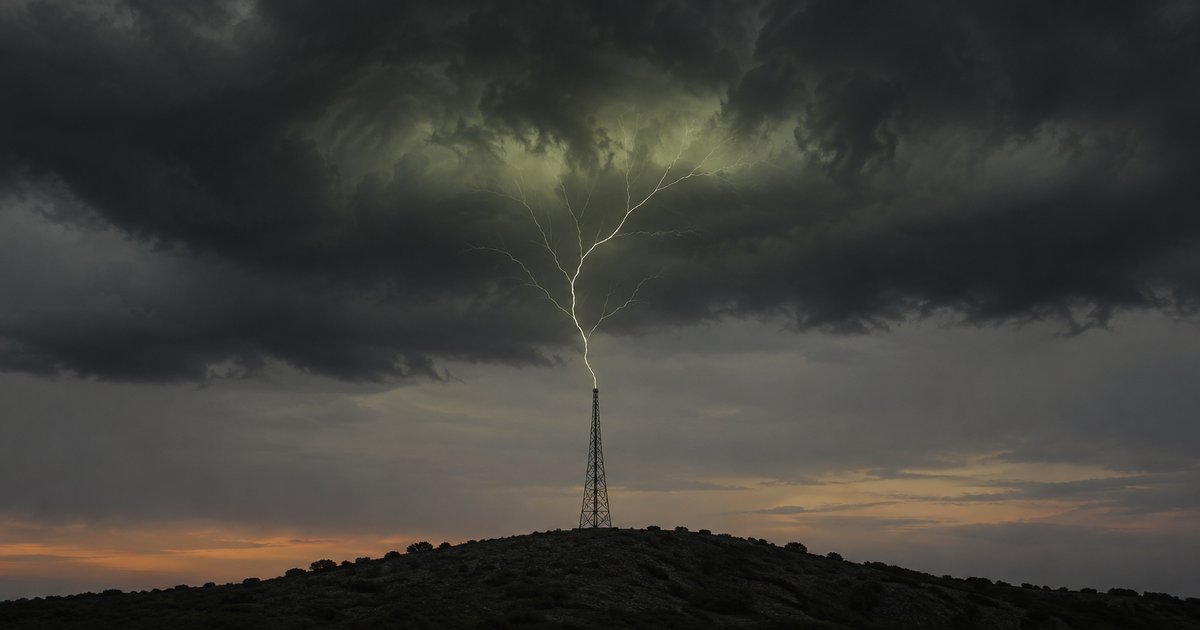
Upward lightning is a flash whose first leader starts at a tall object on the ground, such as a tower, wind turbine, skyscraper or mountaintop, and climbs toward the storm cloud instead of coming down from it. The National Weather Service calls such discharges possible but rare. Researchers split them into flashes triggered by nearby lightning and flashes that start on their own, and both differ from the short upward spark every ordinary ground strike sends out to meet a descending leader.
Upward lightning starts at the tall object and climbs toward the cloud
The National Weather Service (NWS) says most lightning is initiated by downward leaders, and that upward-propagating discharges, both negative and positive, are possible but rare. Its page on upward leaders (undated as of November 2026) says they almost always start from towers, tall buildings or mountaintops, are thought to occur only when the charges aloft change rapidly, most likely after a very recent lightning strike, and are usually branched upward. That page does not mention flashes that begin with no lightning nearby. The National Severe Storms Laboratory (NSSL) does: it says upward triggered lightning usually follows a natural flash, but on rare occasions can be “self-triggered,” usually in winter storms with strong winds.
A 2019 paper in Scientific Reports by Carina Schumann and colleagues, among them Tom Warner of the South Dakota School of Mines and Technology, defines upward lightning as a self-propagating leader that grows from a tall object toward the storm cloud overhead. The ZT Research site adds that the tall, narrow shape of the object concentrates the electric field at its tip, and that without the object the flash would not occur. In still photographs, the site says, upward flashes show up mainly by branches that point up, and the leader often reaches the cloud base and then turns to run along it.
Three processes get called upward, and only two are upward flashes
Every ordinary cloud-to-ground strike has an upward part. NSSL says that as the downward leader nears, an upward streamer is sent out from the object about to be struck, that the two paths meet, and that a return stroke then travels back up to the sky. That is a downward flash with a short upward connecting leader, not an upward flash.
A 2024 preprint by Ryan Said, Eric Grimit and Martin Murphy draws the line. All upward lightning, they write, begins with an upward leader that develops in response to a strong electric field at the structure, though “this electric field enhancement is not from an approaching stepped leader.” They treat triggered and self-initiated upward lightning as separate categories of strikes to wind turbines because different factors control how often each occurs.
| Process | What starts the upward leader | Kind of flash |
|---|---|---|
| Upward connecting leader (streamer) | A downward stepped leader approaches and raises the field at the object (NSSL; Said and colleagues, October 2024) | Downward flash |
| Lightning-triggered upward flash | A nearby flash changes the field at the tip of a tall structure (Schumann and colleagues, July 2019) | Upward flash |
| Self-initiated upward flash | The tip is near enough to a charge layer in the storm, and no other lightning comes first (Said and colleagues, October 2024; Schumann and colleagues, July 2019) | Upward flash |
Researchers can also start an upward leader on purpose. NSSL lists very tall structures, rockets and towers as the settings for artificially initiated, or triggered, upward lightning, and Stucke and colleagues (May 2023) say that tower-initiated and rocket-triggered upward lightning have been found to be very similar.
Height decides which structures launch upward flashes
The 2003 Cambridge University Press book Lightning: Physics and Effects says that structures about 330 to 1,640 feet (100 to 500 meters) tall experience both downward and upward flashes, with the share of upward flashes rising with height. Structures under about 330 feet (100 meters) are usually assumed to be struck only by downward lightning, and structures over about 1,640 feet (500 meters) only by upward flashes.
Wind turbines now reach that range. Said and colleagues (October 2024) say upward discharges affect structures above approximately 328 feet (100 meters), and that the average tip height of U.S. wind turbines rose from under 100 meters in 2000 to about 538 feet (164 meters) in 2022. They add that upward lightning tends to have lower peak currents than ground strikes but a higher charge transfer. Stucke and colleagues (May 2023) say upward flashes can transfer up to hundreds of coulombs over a comparatively long time, so their damage potential might be much larger.
Skyscrapers produce them too. Fox Weather reported that on Monday night, September 13, 2021, Vaisala detection equipment counted 15 cloud-to-ground strikes within five miles of New York’s World Trade Center over 45 minutes, at least eight of which appeared to hit the building, and that at least one was a rare upward strike. Vaisala meteorologist Chris Vagasky told the outlet that upward leaders start off a tall object such as a skyscraper or radio tower when a strong electric field passes over it. The report does not say whether nearby lightning triggered those flashes. Earlier, in a 1939 paper on lightning at the Empire State Building, K. B. McEachron wrote that a tall structure like the building acts as “a great needle point” and may influence the character of the discharge.
Height raises the odds but does not decide them. NSSL says lightning usually strikes the tallest object, and adds: “Never say always!”
Nearby lightning triggers most upward flashes in summer studies
Schumann and colleagues (July 2019) analyzed 110 upward flashes recorded in summer thunderstorm seasons from 2011 to 2016 in Rapid City, South Dakota, and São Paulo, Brazil, using high-speed and standard video, still cameras, electric field meters, fast antennas and, for two seasons, a Lightning Mapping Array. They concluded that the most effective trigger is the in-cloud negative leader that travels during the continuing current after a positive return stroke.
The ZT Research site says upward flashes in summer are most often lightning-triggered, that horizontally extensive storms, such as mesoscale convective systems with large stratiform precipitation areas, are the most favorable for them, and that the horizontally extensive positive ground flash is the most common trigger. It says that when such a storm moves slowly over tall buildings or towers, many flashes can arrive close together. It cites 52 upward flashes from the CN Tower in Toronto in 84 minutes on August 24, 2011, and 39 from a group of tall towers in north Oklahoma City in 112 minutes on the night of October 21, 2017, of which its author recorded 31.
Self-initiated flashes favor cold-season storms where the charge sits low
Said and colleagues say self-initiated upward lightning typically occurs in cold months, when the charge layer is at a low altitude. Stucke and colleagues (May 2023) used 329 classified upward flashes recorded at the Gaisberg Tower in Austria from 2000 to 2015 and found that the most important variable was the height of the −10 °C (14 °F) isotherm above the structure: the closer it is, the higher the probability that a flash is self-initiated. Fujii and colleagues (2013) found that when upward lightning hit wind turbines on the Sea of Japan coast in winter, the −10 °C layer was lower than about 6,600 feet (2,000 meters) in most cases.
Wind may also help. Wang and Takagi (2012) watched a wind turbine and its lightning protection tower in Japan for six winters, 2005 to 2010, and found that self-initiated upward lightning always started either from the stationary tower under larger wind speeds or from a rotating turbine blade. The sources do not fully agree: Stucke and colleagues note that two earlier studies found no significant link between wind speed and self-initiated flashes at Gaisberg, while another stressed its importance at Gaisberg and at Säntis in Switzerland.
The ZT Research site describes an extreme case in Rapid City: a blizzard on October 4, 2013, which it says produced 25 self-initiated flashes from the towers there. The towers were hidden in cloud and snow, an interferometer recorded five of the flashes, and the site says no nearby flash preceded the upward leader in those cases. The share of self-initiated flashes differs widely from place to place.
| Site and study | Self-initiated : other-triggered |
|---|---|
| Japan, six winter seasons (Wang and Takagi, 2012) | 1:1 |
| United States (Warner and colleagues, 2012) | 1:4, with almost 80% of self-initiated flashes in the cold season |
| Gaisberg Tower, Austria | 3:1 |
| Peissenberg Tower, Germany (Manhardt and colleagues, 2012) | 9:1, all self-initiated flashes in the cold season |
| Six warm seasons at towers in the United States and Brazil (Schumann and colleagues, 2019) | Only other-triggered flashes occurred |
Tower studies have recorded upward lightning since the 1930s
The tower record starts in New York. A paper by Tom Warner, Marcelo Saba and Richard Orville (undated, citing work through 2012) says that K. B. McEachron described filming upward lightning from the Empire State Building with Boys cameras in 1936. The sources reviewed do not split his flashes into triggered and self-initiated ones, so those early observations show that a skyscraper can launch a flash, not how often it does so on its own.
Later studies instrumented towers to measure the current itself. Stucke and colleagues say only a few specially instrumented towers in the world can record the type of upward flash that consists only of a continuous current, and Gaisberg in Austria is one of them. The studies below were run at different sites over different periods, so their counts are not rates that apply to every tall structure.
| Site | Period | What was recorded |
|---|---|---|
| Empire State Building, New York (McEachron; reported by Warner and colleagues) | Filming described in 1936; paper published in 1939 | Upward lightning filmed with Boys cameras |
| Gaisberg Tower, Salzburg, Austria: a 100-meter (328-foot) tower on a mountain 4,226 feet (1,288 meters) above sea level (Watanabe and colleagues, June 2019; Stucke and colleagues, May 2023) | Current measured since 1998; flashes counted 2000 to 2018 | 865 flashes, of which 823 (95%) were upward and 4 (0.5%) downward |
| Japan Sea coast: a wind turbine and its protection tower (reviewed by Schumann and colleagues, 2019) | Winters 2005 to 2010 | 53 upward flashes: 28 other-triggered, 25 self-initiated |
| Rapid City, South Dakota, and São Paulo, Brazil (Warner and colleagues; Schumann and colleagues, 2019) | Video of Rapid City towers since 2004, high-speed video from 2008; joint campaigns in summers 2011 to 2016 | 110 upward flashes in the campaigns, recorded with video, field meters and, for two seasons, a mapping array |
Detection networks miss part of upward lightning
Said and colleagues say lightning detection networks typically catch more than 95% of cloud-to-ground flashes but a significantly smaller share of upward discharges. A return stroke gives off a radio burst, whereas the long, low-current continuing current of an upward flash gives off radio emissions that are harder to detect, so what a network catches depends on whether return strokes or strong pulses occur. Stucke and colleagues (May 2023) say that networks detect most upward flashes with pulses or return strokes but miss the type made only of a continuous current, and that current measurements cited in their paper indicate more than half of upward flashes might go undetected. Vagasky made the same point about the 2021 World Trade Center storm: upward lightning is harder to detect, so the building may have been hit more often than the count shows.
Lightning Tracker, an iPhone app that shows recently detected strikes on a live map, notes that detection networks miss some strikes, and it labels delayed or missing data instead of treating it as quiet.
Sprites and blue jets rise from storm tops, not from the ground
NSSL describes red sprites, blue jets and elves as transient luminous events that occur high in the atmosphere above large thunderstorms, rarely observed and not well understood, and says sprites can extend up to 60 miles (about 97 kilometers) from the cloud top. They also travel upward, but they appear above the storm cloud, not at a tower or a building, and NSSL treats them as separate electrical phenomena.
The sources give people no separate rule for upward lightning
The sources reviewed describe upward lightning mostly through damage to turbines, towers and instruments, and none gives a separate rule for people. The NWS lightning safety overview keeps one rule for any storm: if you hear thunder, you are likely within striking distance of the storm, and you wait 30 minutes after the last lightning or thunder before going back outside.
Not a substitute for official weather warnings.
If you hear thunder, seek shelter even if the app shows no nearby strike.
Sources
- National Weather Service, Understanding Lightning: Upward Leaders/Discharges
- National Weather Service, Overview: Lightning Safety
- NOAA National Severe Storms Laboratory, Severe Weather 101: Lightning Types
- NOAA National Severe Storms Laboratory, Severe Weather 101: Lightning FAQ
- Schumann et al., On the Triggering Mechanisms of Upward Lightning, Scientific Reports, July 2019
- Stucke et al., Upward Lightning at the Gaisberg Tower: The Larger-Scale Meteorological Influence on the Triggering Mode and Flash Type, Journal of Geophysical Research: Atmospheres, May 2023
- Watanabe et al., Characteristics of Currents in Upward Lightning Flashes Initiated From the Gaisberg Tower, IEEE Transactions on Electromagnetic Compatibility, June 2019
- Said, Grimit and Murphy, A multi-year CONUS-wide analysis of lightning strikes to wind turbines, arXiv preprint, October 2024
- Wang and Takagi, Characteristics of Winter Lightning that Occurred on a Windmill and its Lightning Protection Tower in Japan, IEEJ Transactions on Power and Energy, 2012
- Fujii et al., Characteristics of Winter Lightning Threatening Wind Turbines in Coastal Area of the Sea of Japan, Electrical Engineering in Japan, 2013
- Cambridge University Press, Lightning: Physics and Effects, chapter 6: Upward lightning initiated by ground-based objects, 2003
- Warner, Saba and Orville, Characteristics of Upward Leaders from Tall Towers, conference paper hosted by Vaisala (undated)
- ZT Research, Upward Lightning from Tall Objects
- Fox Weather, Backwards bolt: Watch as lightning heads skyward from NYC’s World Trade Center, September 2021