 Lightning Tracker
App Store
Home and everyday
How often lightning strikes the Empire State Building
November 17, 2026 · 6 min read
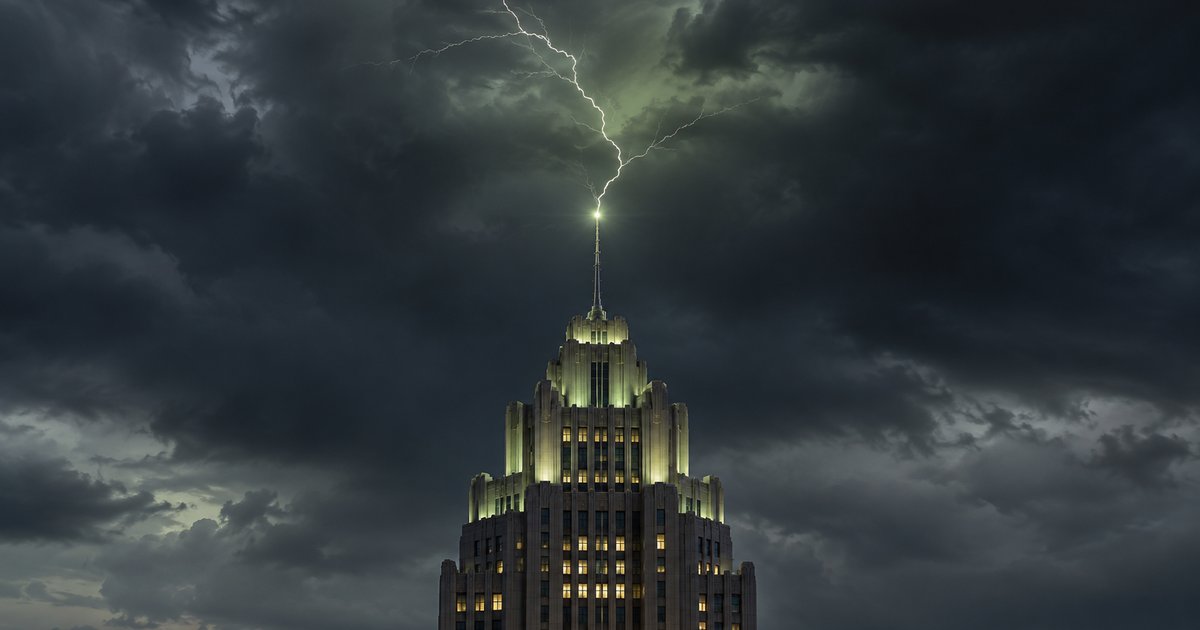
The Empire State Building is struck by lightning about two dozen times in a typical year, by the building’s and the National Weather Service’s own estimates: the building’s website gives an average of 25 strikes a year, and the NWS myths page gives 23. Both are undated estimates with no stated method, and other published figures run from 20 to 100. The tower is hit repeatedly because it is very tall, pointed and exposed: the building’s own site puts it among New York City’s five tallest buildings, and the NWS says repeat strikes are most likely at tall, pointy, isolated objects.
Published estimates of yearly strikes run from about 20 to 100
The Empire State Building’s Facts & Figures page lists 25 lightning strikes per year, and a March 28, 2023 post on the building’s blog calls 25 an average. The National Weather Service (NWS) myths page, which uses the building as its example of repeat strikes, gives an average of 23 times a year. New York City Emergency Management credits the NWS with 25. Martin Uman, a lightning researcher at the University of Florida, told Live Science in April 2011 that the building is struck about 20 to 25 times each year on average. Two company pages give more: a 2018 GE News article says 100, and a testing-lab blog says between 25 and 100.
| Source | What it says | Date |
|---|---|---|
| The building, Facts & Figures page | 25 lightning strikes per year | Undated |
| The building, blog post | An average of 25 times per year | March 28, 2023 |
| NWS, Lightning Myths page | An average of 23 times a year | Undated |
| NYC Emergency Management | 25 times per year, credited to the NWS | Undated |
| Martin Uman, University of Florida, in Live Science | About 20 to 25 times each year on average | April 13, 2011 |
| GE News | 100 times per year on average | July 9, 2018 |
| Element Materials Technology blog | Between 25 and 100 times every year | March 29, 2019 |
None of these pages says how strikes were counted, over which years, or whether the figure counts flashes, strokes or hits to the antenna alone. The building, the NWS and Uman agree on a range of about 20 to 25 strikes a year; the two higher figures come from a GE News article and a testing-lab blog, neither of which gives a method. “About two dozen” is therefore the fairest summary, and none of the numbers is a measured rate.
The tower’s height makes it a repeat target
The Empire State Building rises 1,250 feet (380 meters) to its highest occupied floor and 1,454 feet (443 meters) to the top of its antenna, and its own site says it is among New York City’s five tallest buildings. The National Severe Storms Laboratory (NSSL) says lightning usually strikes the tallest object, adds “Never say always!”, and explains that taller objects are more likely than shorter ones to send up the channel that joins the downward flash. The NWS lists “lightning never strikes the same place twice” among its myths and says lightning often strikes the same place repeatedly, especially a tall, pointy, isolated object; its example is this building.
For scale, New York City Emergency Management calls New York State’s lightning “moderate,” at 3.8 strikes per square mile a year, while Uman told Live Science that a 1,000-foot (300-meter) building in Florida, where lightning is more common, might average hundreds of strikes a year.
A yearly average hides large swings between storms and years
New York City Emergency Management says the building was hit eight times in 24 minutes during one storm. Xweather’s 2023 annual lightning report counted 104 strikes on ten of the most famously tall US buildings in 2023, and it found that One World Trade Center had 58 lightning strokes in 2018 but just 8 in 2021. Xweather’s January 2024 summary names only the top three buildings and gives no Empire State Building count, and it says the analysis had a median location accuracy of 81 meters (about 266 feet). An average of 23 or 25 describes a typical year; it does not predict any one storm or season.
Lightning Tracker, an iPhone app that shows recently detected strikes on a live map, notes that detection networks miss some strikes, and it marks delayed or missing data instead of treating it as quiet.
General Electric engineers measured strikes to the tower from 1935 on
The building opened on May 1, 1931, according to its history page. General Electric (GE) says it set up its High Voltage Engineering Laboratory in Pittsfield, Massachusetts, in the 1920s to study lightning, and that the work included a special project run from a room on the building’s 102nd floor. K. B. McEachron’s September 1941 paper in the Transactions of the American Institute of Electrical Engineers says the investigation had been under way since 1935. Its abstract reports what the team had gathered by then and what the instruments showed.
| Topic | Reported result |
|---|---|
| Records at the time of the paper | Boys camera photographs of 62 strokes and 99 oscillograms, 20 of them taken together with photographs of the same stroke |
| Upward step leaders | Discovered |
| Continuing strokes | Shown to be in the nature of a direct current arc; 91% of all strokes recorded to the building were classified as continuing, meaning they had a low current component |
| Polarity, 1937 to 1940 | Of 49 strokes recorded with oscillographs, none was entirely positive and 41 (84%) were entirely negative |
| Charge | Half of the 49 strokes carried 25 coulombs or more; the largest measured charge was 164 coulombs |
| Current | The first recorded current peak in stroke 13 was positive, with a crest current of 58,000 amperes |
McEachron’s December 1938 article in Electrical Engineering describes combined photographic and oscillographic studies of strokes to the 1,250-foot building over several seasons. This section follows the published abstracts of the two McEachron papers. The 1941 abstract counts strokes recorded in particular seasons with the instruments of the time; it gives no yearly total of strikes to the building and does not settle whether the figure is 23 or 25.
A lightning protection system leads a strike to the ground, and indoor rules still apply
The NWS says a lightning protection system does not prevent lightning from striking a structure: it intercepts the strike, gives the discharge a conductive path (UL-listed copper or aluminum cable) and disperses the energy into the ground through a grounding network. Live Science reported in 2011 that the antenna was designed to double as a lightning rod, and the building’s own 2023 blog post shows a photograph of a strike on its antenna. The building’s own pages do not describe its protection system in detail or any damage from strikes.
For damage in general, National Bureau of Standards Handbook 46, issued in December 1952, says metal receives a lightning discharge with little damage to itself, and that a No. 13 copper wire should carry the most intense discharge McEachron observed at the building, in the 1941 paper above. It adds that insulating or semi-insulating material that takes a discharge usually suffers severe damage of an explosive character. The handbook is a 1952 code, and the NWS says any protection system should follow the standards of the Lightning Protection Institute, the National Fire Protection Association and Underwriters Laboratories.
New York City Emergency Management’s thunderstorm guidance explains why people inside a struck building still have rules. It says that if lightning strikes a building, the current will likely flow through the electrical wiring or the water pipes, and a person using them could receive a fatal shock, so it tells people not to use the telephone or electrical appliances connected to the wiring or showers, sinks and other plumbing. The same page says to wait 30 minutes after the last clap of thunder before going back out.
The 86th Floor Observation Deck is open-air, according to the building’s Facts & Figures page. The NWS says no place outdoors protects a person caught in a thunderstorm and tells people to run to a substantial building or a hard-topped vehicle. The building’s own pages state no storm policy for the deck.
The tower lights are a color display, not lightning
The Empire State Building’s Tower Lights page says its tower lights change for holidays, causes and cultural events in more than 16 million colors, and that they shine from sunset to 2 a.m. EST each night. A lit-up tower at night is that scheduled display and says nothing about a strike.
Not a substitute for official weather warnings.
If you hear thunder, seek shelter even if the app shows no nearby strike.
Sources
- Empire State Building, Facts & Figures
- Empire State Building, History
- Empire State Building, Tower Lights
- Empire State Building, Through Still and Storm: Our Favorite ESB Weather Shots, March 28, 2023
- National Weather Service, Lightning Myths
- National Weather Service, Lightning Rods
- NOAA National Severe Storms Laboratory, Severe Weather 101: Lightning FAQ
- NYC Emergency Management, Thunderstorms & Lightning
- K. B. McEachron, Lightning to the Empire State Building, Transactions of the American Institute of Electrical Engineers, September 1941 (abstract)
- K. B. McEachron, Lightning to the Empire State Building, Electrical Engineering, December 1938 (abstract)
- National Bureau of Standards, Handbook 46: Code for Protection Against Lightning, issued December 10, 1952
- Live Science, Video Captures Lightning Striking Empire State Building 3 Times, April 13, 2011
- GE News, Empire Strikes: GE Scientists Studied Lightning Atop New York’s Iconic Skyscraper, July 9, 2018
- Element Materials Technology, Lightning Strikes Empire State Building, March 29, 2019
- Xweather, Highlights from the 2023 Annual Lightning Report, January 4, 2024