 Lightning Tracker
App Store
Storm basics
Which trees does lightning strike most?
November 17, 2026 · 4 min read
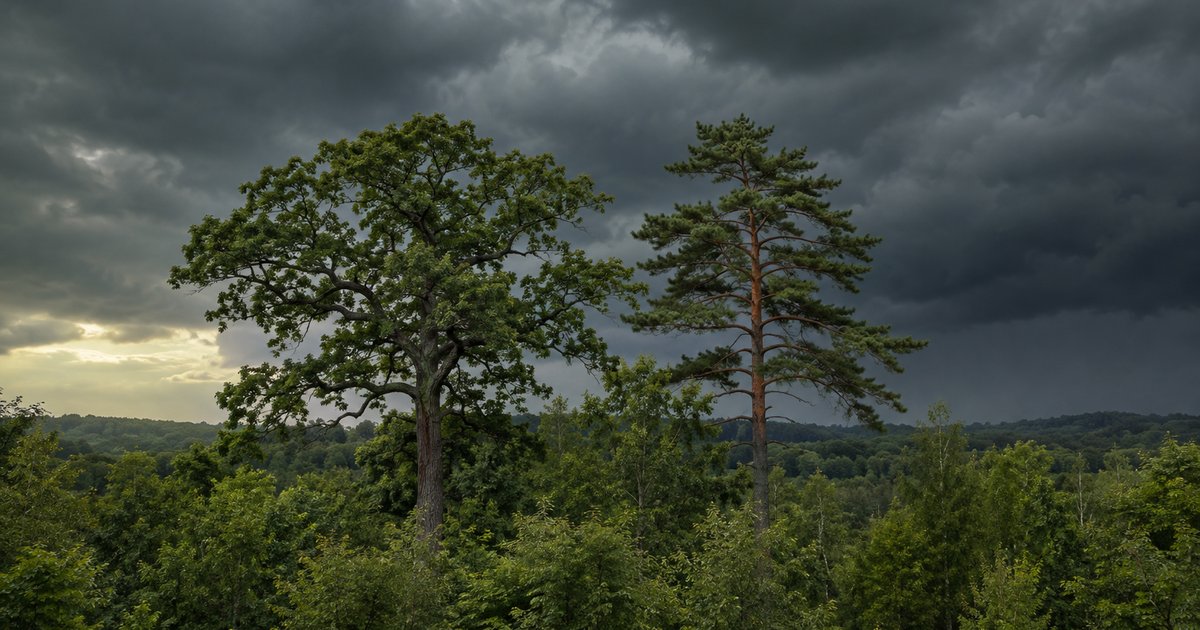
Oak and pine appear often in older observations, but no species has a universal “most struck” ranking. In a 2015 Michigan forest survey, 13 of 14 clearly lightning-damaged trees were conifers, while a 2026 Central African study found that species differences remained after accounting for tree size. Neither result makes another species a place to shelter.
The Michigan count favors conifers, with a major caveat
Yanoviak and colleagues surveyed a hemlock and hardwood forest in Michigan for a 2015 paper in the Canadian Journal of Forest Research. Their structured transects contained 309 trees, none bearing a lightning scar. In adjoining meander surveys they examined thousands more and found 14 clear cases of lightning damage. This is a count of recognizable damage, not a live count of flashes reaching each species.
Of those 14 damaged trees, 13 were conifers: five white pines, three red pines and five eastern hemlocks, the 2015 study reports. Conifers were 53% of the comparison trees but 93% of the damaged trees. The authors did not find an obvious bias among the three conifer species in that small sample. That count cannot establish that oak is rarely hit: 14 damaged trees are far too few for a species ranking.
The same 2015 review reports older field observations in which oak and pine appeared comparatively often and beech comparatively infrequently. It also says rigorous quantitative support for species differences was limited. An older list repeated in the struck tree article is therefore a set of historical observations, not odds a homeowner can apply to an individual oak, pine or beech.
Height and crown position change the comparison
In the Michigan study, half of the lightning-damaged trees rose above neighboring canopy trees, versus 22% of the comparison trees. The researchers call this a correlation and caution that the sample is small. The National Weather Service (NWS), in its undated lightning myths page, identifies height, pointed shape and isolation as dominant factors controlling where a bolt will strike. A tall oak in an open field and a shorter oak inside a stand do not offer the same exposure, regardless of their shared species.
A 2026 Functional Ecology study adds a different forest test. Zoletto and colleagues walked about 83 miles (134 kilometers) of transects in forests in Uganda and the Democratic Republic of the Congo, identifying 121 locations with lightning damage. They compared each directly damaged tree with neighboring trees. Greater relative canopy height raised the likelihood of visible damage, especially in the lowland forest; crown area mattered in the montane forest but not the lowland one. The study also found differences among species after accounting for size.
The two studies differ in location and method, but both ask which trees show damage against a local comparison group. The Michigan work counted old scars; the African work surveyed damage across transects and compared focal trees with neighbors. The NWS factor of isolation also explains why exposure above the tree line matters to people even where no particular tree species is involved.
A scar is an imperfect record of a strike
The Michigan researchers describe three possible explanations for why conifers stood out: conifers may be hit more often, their damage may be more visible, or they may survive longer after a strike and remain available to be counted. Their post-event survey could not distinguish these explanations. They cite filmed strikes that left no visible evidence on the trees when inspected. UC IPM's undated guidance likewise warns that other damage can resemble a lightning strike unless the event was observed or the tree was inspected soon afterward.
Survival creates the opposite blind spot. A tree that dies and falls may disappear from a standing-tree survey, while a tree with a long-lived scar remains countable. The review also reports filmed strikes to trees that left no visible evidence when the trees were inspected afterward. A visible scar count can thus favor species that retain recognizable marks and omit strikes on trees with little outward injury.
No species supplies thunderstorm shelter
The NWS says a tree is not a protective place during a thunderstorm: its myths page names sheltering beneath a tree as a leading source of lightning casualties. Its science page explains that current can jump from the struck tree to someone near it and can spread outward through the ground. The practical choice is a substantial building or hard-topped vehicle, not an oak-versus-beech calculation.
NWS outdoor guidance says to get into such a building or vehicle when thunder threatens and wait 30 minutes after the last thunder before returning outdoors. The 30-minute wait after thunder still applies in a forest, and the tree shelter myth remains false for every species.
Lightning Tracker for iPhone shows recently detected strikes on a live map, with distance, direction and minutes ago. No tree or forest protects you: when you hear thunder, go to a substantial building or a hard-topped vehicle, even if the map looks quiet. Detection networks can miss strikes or report them late.
Not a substitute for official weather warnings.
If you hear thunder, seek shelter even if the app shows no nearby strike.
Sources
- Canadian Journal of Forest Research, Direct effects of lightning in temperate forests
- Functional Ecology, Landscape, stand and tree characteristics
- University of California IPM, Lightning
- National Weather Service, Lightning Myths and Facts
- National Weather Service, Five Ways Lightning Strikes People
- National Weather Service, Outdoor Lightning Guidance