 Lightning Tracker
App Store
Storm basics
Why did Franklin favor pointed lightning rods?
November 19, 2026 · 4 min read
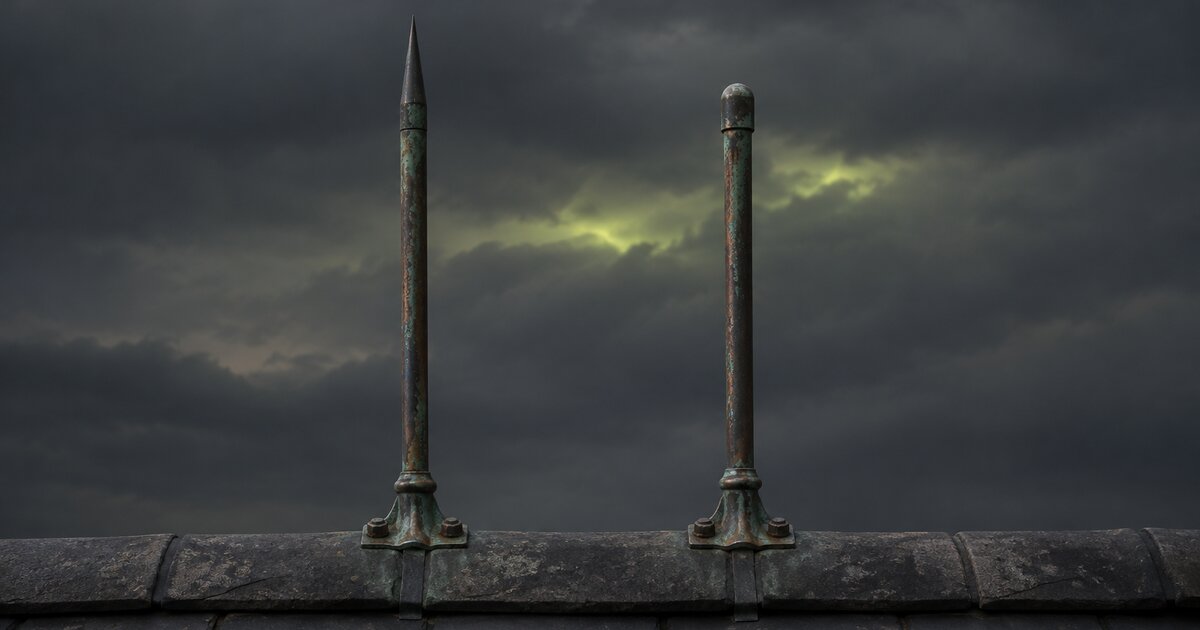
Franklin favored a sharp point because his electrical experiments suggested that it could release charge from a storm cloud before a strike. The Franklin Institute’s account of his 1750 proposal says he hoped a grounded point would draw electricity off silently; experiments reported in 2000 instead found nearby moderately blunt rods received strikes while sharp ones did not. Those observations test strike reception, not whether a point can empty a cloud.
Franklin’s point began as a way to discharge a cloud
The Franklin Institute describes Franklin’s experiment with a sharp iron needle and a charged metal sphere two years before the 1752 kite account. The needle drew charge from the sphere, leading him to imagine an elevated iron rod connected to earth. He thought the tip might gradually drain a charged cloud before lightning formed. A small laboratory sphere was not a thundercloud.
The National Park Service’s 2017 Preservation Brief 50 traces Franklin’s letters to 1751 London publication. It says the May 1752 experiment by Thomas-François Dalibard and a colleague drew sparks from an insulated tall metal rod in France, helping confirm that thunderclouds carried electric charge. The spark observation supported the link between storm and laboratory electricity.
Franklin’s proposal had a second route to protection. According to the same NPS brief, he came to recognize that a system could provide a path for a discharge even if it did not prevent one. His 1762 description still called for a rod tapering to a sharp point, joined to a conductor and earth as a complete lightning protection system.
English critics wanted a rounded end for a different reason
The Franklin Institute recounts that Franklin’s English colleagues preferred a blunt tip. They reasoned that a point might attract a stroke and raise the risk of a hit, while a blunt rod would be struck less often. The institute says King George III had a blunt rod installed at his palace and that the choice acquired political meaning in the colonies. That history records what the sides believed, not a controlled comparison proving either claim.
The 1882 Lightning Rod Conference proceedings preserve a later account of the dispute. They describe Benjamin Wilson’s objection that a point could draw charge from a cloud at a greater distance, while Edward Nairne took the same observation as evidence that gradual discharge might reduce damage. The proceedings say both sets of experiments found that pointed conductors drew off electricity farther away than blunted ones. Their argument was about what that electrical behavior meant for storm protection, a step the tabletop experiment could not settle.
The same proceedings report that a later Royal Society committee favored elevated, acutely pointed conductors over lower rounded ones for powder magazines.
Field tests changed the strike-reception question
In a study published in May 2000 in the Journal of Applied Meteorology, Charles Moore and colleagues exposed pointed and rounded metal rods to thunderstorms on South Baldy Peak in New Mexico. The researchers placed the tips at the same height, on roughly 20-foot (6.1-meter) masts, and used fuses or flash counters in their conductors to identify a direct strike. The nearby blunt rods, rather than the sharper ones, received the recorded hits.
The authors’ 2003 follow-up reports 13 strikes to blunt tips about 0.5 to 1 inch (12.7 to 25.4 millimeters) in diameter and none to the sharp rods about 17 feet (5.3 meters) away. The authors concluded that moderately blunt ends were better strike receptors in those competitive tests. They also distinguished moderately blunt from very blunt: the result was not a claim that the widest possible end wins. A count of 13 versus zero at one mountain site is evidence about the tested arrangement, not an all-building failure rate for pointed rods.
The 2003 paper explains the apparent reversal. A very sharp tip concentrates the electric field right at its surface, but the field falls away steeply a few millimeters above it. Under strong fields, sharp tips emit ion bursts that reduce the nearby field. A rounded tip can maintain a stronger field farther above its surface, favoring the upward discharge that can connect with an approaching leader. The earlier leader and return stroke sequence explains why a strike receptor needs a connection above the tip, not merely a high field at the metal itself.
Tip shape is only one part of the historical system
The National Park Service’s 2017 brief says early systems could fail because conductors were too small, too few rods were used, or nearby metal was not bonded. Its account of later nineteenth-century equipment notes that rounded points were available, though less popular in the United States than in Europe. Tip geometry was therefore one design choice amid many, and historical popularity cannot be read as a measured performance ranking.
If you are watching a storm near a lightning rod, Lightning Tracker, an iPhone app, maps recent detected lightning strikes and shows the distance and direction to the nearest one.
Not a substitute for official weather warnings.
If you hear thunder, seek shelter even if the app shows no nearby strike.
Sources
- The Franklin Institute, Franklin’s Lightning Rod
- National Park Service, Preservation Brief 50: Lightning Protection for Historic Structures
- American Meteorological Society, Lightning Rod Improvement Studies
- American Meteorological Society, The Case for Using Blunt-Tipped Lightning Rods as Strike Receptors
- Lightning Rod Conference, Report and Proceedings