 Lightning Tracker
App Store
Home and everyday
Why do old lightning rods have glass balls?
November 19, 2026 · 4 min read
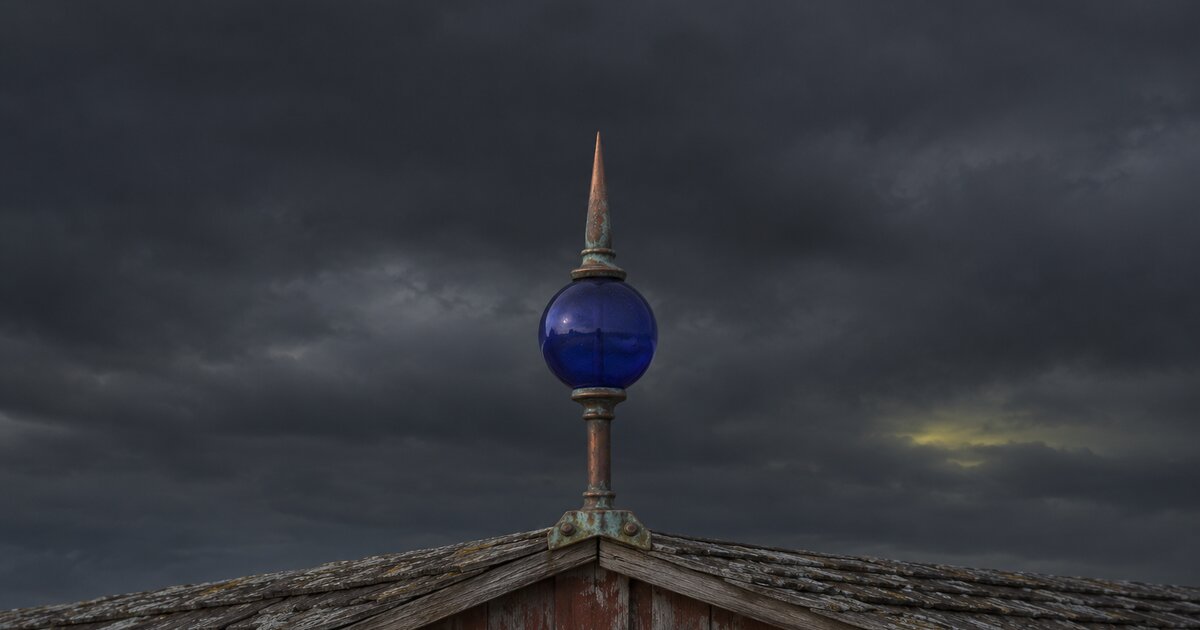
The glass balls on many antique lightning rods were decorative: the National Park Service’s 2017 preservation brief says the colorful globes helped sell rods, and identifies 4- to 5-inch examples common in the late 1800s and early 1900s. The familiar claim that a ball broke to reveal a strike is disputed: the NPS calls it folklore, while The Henry Ford museum describes that function for a surviving 1900–1920 bulb.
Color helped sell a visible rooftop system
The National Park Service’s October 2017 Preservation Brief 50 describes plain, round colored glass and ceramic balls as common on late nineteenth- and early twentieth-century rods. Balls appeared in multiple patterns, colors and shapes, and could be placed on one or more rods along a roof. The brief says they were decorative and intended to help sales. Some assemblies carried more than one ball, custom metalwork or a weather vane.
The NPS places this fashion after the Civil War, when protection equipment became mass-produced and shipped by railroad across the country. Isolated farmsteads and grain storage buildings on the Great Plains made a visible market. Sellers could offer specialized connectors, insulators and air terminals in both practical and decorative forms. A tall, ornate rod made the product conspicuous above a roof; the glass globe made its color visible from below.
The 1977 collector account in Crown Jewels of the Wire describes lightning-rod balls as hollow glass with openings at both ends, fitted over a metal rod. Its authors call the colorful examples decorative and suggest they could signal status in a neighborhood. The NPS brief documents pleated round examples as well as plain spheres, so “ball” does not imply a perfectly smooth orb.
The breakage story has conflicting museum descriptions
The NPS’s 2017 brief calls the supposed strike indicator a piece of folklore: a ball would break when lightning struck, telling the owner the system had worked and should be inspected. The brief then says the balls were purely decorative. The Henry Ford museum’s undated object record takes a different position. Describing a dark-blue bulb made around 1900–1920, it says a mounted glass ball would shatter after a strike and alert the owner to inspect the system. The two institutions therefore disagree about its intended function.
A broken globe, by itself, does not establish a lightning strike. The NPS preservation brief separately describes glass balls broken by vandalism on vacant and isolated buildings. It also calls historic and reproduction balls fragile and warns about breakage during handling and cleaning. Neither museum record establishes how often a strike breaks an intact ball. A missing or intact ball is not a dependable record of past lightning strikes.
A ball, an insulator and a metal tip are different parts
The NPS brief’s diagrams and descriptions distinguish the air terminal, which is the metal rod exposed above the roof, from the roof cable, down conductors and ground rods. It says the glass ball was an embellishment on a rod. A separate glass or porcelain insulator held a cable away from a building surface in some historic systems. That insulator could also be colored glass, but its job and location differed from the globe threaded onto the vertical rod. Calling every bit of old rooftop glass an “insulator” loses that distinction.
The 1997 National Register nomination for Maryland’s Orendorff Farm records seven lightning rods with white glass ball insulators along a barn ridge. The farm record calls the white pieces “insulators” without describing how they were mounted. The NPS preservation brief distinguishes a globe on an upright rod from an insulator that held a cable off the building.
The ball was also separate from the shape of the metal tip. The NPS brief says old rods often ended in shell or bayonet points; rounded metal ends were also sold. The colored globe sat lower on an assembly and did not replace the exposed metal terminal. The path from roof rod to ground depended on connected metal components, not the decorative glass.
Surviving examples tell more than an empty roof
The Henry Ford records its dark-blue glass bulb as an object 5 inches high and 4.5 inches across, made between 1900 and 1920. The museum’s record gives an object ID, 2022.157.8, and says it is not on public display.
The NPS’s 2017 brief says surviving decorative rods can be historic features in their own right. It notes that vandalism and theft threaten glass balls and weather vanes, and that some old systems are incomplete or too deteriorated to function. The appearance of an antique ball therefore says little about the state of the metal system underneath it.
For storms near you, Lightning Tracker, an iPhone app, shows recently detected strikes on a live map and the distance to the nearest one.
Not a substitute for official weather warnings.
If you hear thunder, seek shelter even if the app shows no nearby strike.
Sources
- National Park Service, Preservation Brief 50: Lightning Protection for Historic Structures
- The Henry Ford, Lightning Rod Bulb, 1900–1920
- National Park Service, Orendorff Farm National Register nomination
- Crown Jewels of the Wire, Lightning Rod Balls