 Lightning Tracker
App Store
Home and everyday
Church steeples and lightning: strikes, rods and bells
November 19, 2026 · 9 min read
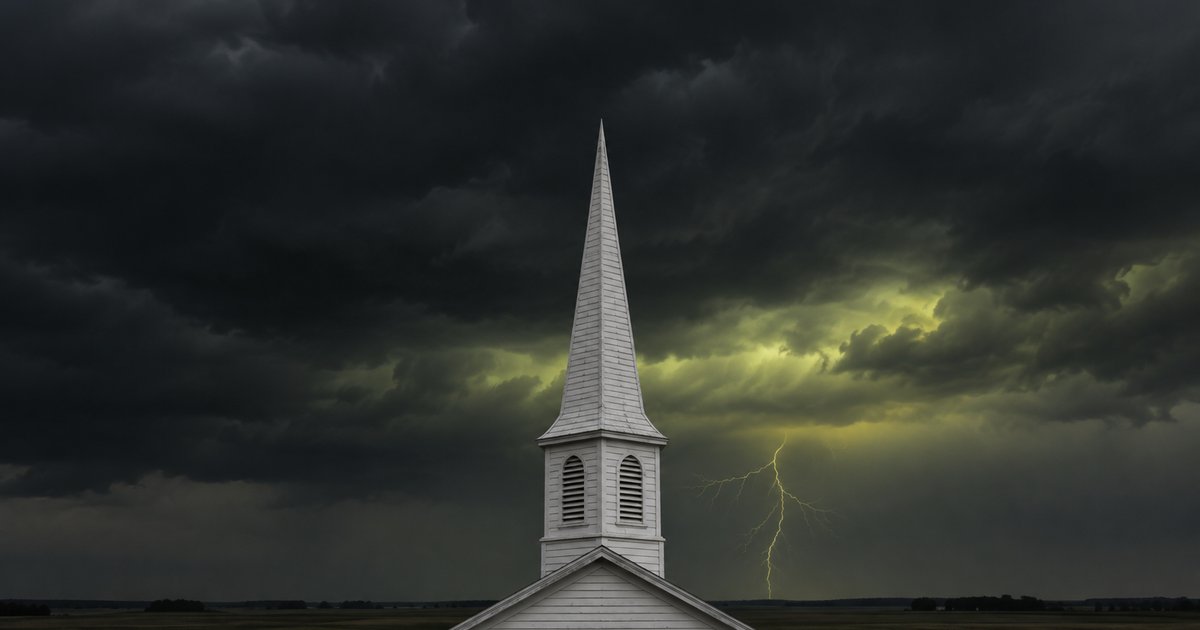
Church steeples are struck often because builders made them the tallest objects in their towns, and the National Severe Storms Laboratory says lightning usually strikes the tallest object. Being struck is not the same as being badly damaged. The history of the question is mostly about people trying to protect churches from them: bell ringers first, rod installers later. Today, the National Park Service’s Preservation Brief 50 leaves the protection of a historic steeple to a qualified professional’s assessment.
Steeples were built to be the tallest objects in town, and lightning usually strikes the tallest object
The National Park Service says church steeples were designed to be the tallest objects in their towns and thus the most exposed to wind and lightning damage. That comes from a 2008 article in its series on timber-framed steeples, whose author reports that perhaps a quarter of the hundreds of steeples examined had their upper portions, usually the lantern, cupola or spire above the belfry, replaced because of wind damage (the article adds fire, and does not separate lightning from the other causes).
The National Severe Storms Laboratory (NSSL) explains the mechanism: lightning usually strikes the tallest object, because the tallest object is the most likely to produce upward streamers that connect with the downward leader. Its answer carries a warning, “Never say always!” The National Weather Service adds that lightning often strikes the same place repeatedly, especially a tall, pointy, isolated object, and lists the belief that it never does among its lightning myths.
Height is relative to what surrounds the building. The National Park Service’s Preservation Brief 50 (October 2017) says buildings with towers or spires, such as historic courthouses and churches, are at greater risk because of their height and because they are often the most prominent buildings in a small community. It adds that a downtown historic building, even one with a tower, set among much taller and newer buildings is less likely to be struck. The same brief says the number of strikes varies considerably across the country: in a 2016 example it cites, Louisiana and Kansas each had over a million cloud-to-ground flashes, while Maine and New Hampshire each had around 10,000.
A strike on a steeple and serious damage to a church are different measures
Ecclesiastical Insurance, a British insurer of churches, says in an undated guidance note that direct lightning effects on churches are usually minor, damaging copings and pinnacles mostly on the tower or spire, though there is also a risk of fire and of falling masonry. The same note says about six in ten insurance claims for lightning damage to churches are for electrical wiring and equipment rather than structure. It lists alarms, boiler controls, sound systems and electronic organs among the equipment exposed to surges, and suggests considering surge protection equipment. It writes about British parish churches, so its proportions are not a US figure. It also says statistics indicate that a church with no lightning protection is about five times more likely to suffer structural strike damage than one with it, without giving a period or a count.
When a strike does damage the structure, Preservation Brief 50 describes two routes. The mechanical force can have a blast effect, exploding for example a large chimney, parapet or corner of a building, and heat up to 50,000 °F (27,760 °C) along the path through wood and other building material can start a fire. The timber-steeple article says lightning and wind are likely to affect the upper levels of a steeple most severely, tearing off a stage or blasting apart or burning a spire or belfry, and that even a fire inside a church tends to follow a chimney effect into the upper portions of the steeple.
The loss figures that circulate are shares of fires, not strike rates. Preservation Brief 50 says lightning accounts for nearly one-third of all church-building fires each year, and a 1996 column by the New York Landmarks Conservancy puts it at more than 30% of fires in religious properties. The brief also reports that when the National Fire Protection Association published its specifications in 1904, it noted that within a five-year period 3,842 dwellings, 9,375 barns, 328 churches and 59 ice houses had losses from fires due to lightning. Those are counts without totals of each kind of building, so they say nothing about how likely any one steeple is to be hit or to burn.
Preservation Brief 50 treats a steeple’s protection as a decision for qualified professionals
The National Park Service’s Technical Preservation Services published Preservation Brief 50 in October 2017 for owners, property managers, architects, contractors and others who care for historic structures. It says old systems that survive on historic structures may be historic features in their own right and deserve preservation. The brief has no steeple-specific design chapter, and this page gives none. The table shows what the brief says about the decisions an owner faces.
| Situation | What the brief says |
|---|---|
| Historic rods and other parts still work and are in fair to good condition | Identifying steps to conserve and secure them in place is usually the preferred preservation approach |
| The system is in poor condition and needs substantial upgrading | Replacement may be the only alternative |
| A rare or distinctive rod has deteriorated | It may be appropriate in some cases, particularly with museums and public buildings, to replace it with a replica and keep the original |
| A historic structure has no system, in a lightning-prone area or deemed irreplaceable | A modern lightning protection system may merit installation |
| A weathervane stands on a building that has no system | It may be best to leave the weathervane ungrounded rather than undertake a do-it-yourself project |
The brief says a lightning risk assessment should be done by a qualified, experienced individual, usually an architect or engineer, who is independent of any lightning protection company. It says licensed and certified installers should be used in most cases, and that a visual inspection of a system should take place annually and, at least every five years, be done by a professional who also tests the ground and the system’s conductivity. It explains that bonding nearby metal to the system helps deter side flash, the jump of current to other conductive objects.
Bells, covered in the next section, raise their own question. Ecclesiastical says whether to bond a metal bell frame to the nearest lightning down conductor is complex and needs a bespoke approach for each location, and that specialist advice should be obtained. Read together, the sources point the same way: the historical accounts below record what people tried and where they failed, and the agencies and insurers leave design, bonding and inspection of a steeple system to qualified professionals.
For centuries bells were rung against thunderstorms
The National Weather Service’s history page says that throughout early Europe church bell ringers made as much noise as possible, hoping to scare storms away from holy buildings that lightning struck frequently. George Tyack’s A Book About Bells, in the Whiting Society of Ringers’ scan, says no theory of the beneficent power of bells was more widespread than the belief that they protected against lightning and storm. It cites a 1464 churchwardens’ account from the parish of Sandwich that paid for refreshments for the ringers “in the great thundering.”
Benjamin Franklin described the practice in a letter to John Winthrop written in London on July 2, 1768. Bells, he wrote, had been solemnly consecrated by the Roman Catholic Church for a thousand years in the expectation that their sound would drive away storms and protect buildings. Experience, he said, had not shown that places within reach of the blessed sound were any better protected, and the lightning “seems to strike steeples of choice” at the very time the bells are ringing. That is the argument of a rod advocate: it records what Franklin observed and claimed, not a count.
A 1718 report from Brittany ties strikes on 24 churches to bells being rung
A note Franklin attached to the same letter quotes the 1719 history of the French Royal Academy of Sciences. It says Deslandes reported that on the night of April 14 or 15, 1718, lightning fell on 24 churches between Landernau and Saint-Pol-de-Léon in Brittany, that these were precisely the churches where bells were being rung and that the lightning spared those where they were not, and that in one church, entirely ruined, it killed two of the four people ringing. Tyack repeats the pattern. The report comes from one storm and one correspondent, and the sources do not say what the bells had to do with it.
Franklin also described the advice of the Abbé Nollet, whose paper appeared in the memoirs of the French Academy of Sciences and who cautioned against ringing church bells in a thunderstorm lest the lightning be conducted down the bell ropes to the ringers. Franklin pointed out that rope is a poor conductor and asked why Nollet did not favor metal rods outside the steeple, which the lightning would prefer. Nollet, in Franklin’s account, objected to external metal conductors as useless or dangerous.
Franklin said church vestries were slow to adopt lightning rods, and some objected on religious grounds
In the same 1768 letter Franklin wrote that it was not so extraordinary that “unlearned men, such as commonly compose our church vestries” were not yet acquainted with the benefits of metal conductors. He added that church buildings, from their greater height, are more exposed to the stroke of lightning than ordinary dwellings. Winthrop had written from Cambridge on January 6, 1768, that after reading the account in the Philosophical Transactions of the effects of lightning on St. Bride’s steeple, it amazed him that anyone would think of repairing that steeple without conductors.
Preservation Brief 50 gives the other side of the story. Despite some initial resistance on religious grounds, it says, lightning rods soon appeared on many larger steeple-topped churches that were prone to being struck. A number of early installations seem to have worked reasonably well despite no real manuals or standards, the brief says, and it records failures from undersized conductors, too few rods or lack of bonding to nearby metal. It says such failures reinforced the belief among some people that rods attract lightning and should not be used. The rod on Christ Church in Philadelphia was struck in June 1777 and rendered useless, although the church seemingly took no further damage. The brief also quotes an 1847 newspaper report of a Philadelphia church destroyed by lightning whose conductor ran down from the steeple inside the church, and adds that the precise reason for the failure was not stated.
The sources do not agree on one point readers ask about. Ecclesiastical says a conductor makes a building more rather than less liable to attract a strike, adding that its purpose is to direct the energy to earth. Preservation Brief 50 answers the question “is there a greater risk of a lightning strike?” with “No,” and says a conventional system’s function is not to prevent lightning from striking a structure but to give the current a path of low resistance to the ground.
Brescia in 1769 was a gunpowder disaster, not a steeple strike
Scipione Garbelli, a patrician of Brescia who published an account of the city’s ruin in 1771, says that in a storm that began at dawn on August 18, 1769, lightning entered the tower beside the St. Nazaro gate, where a large quantity of war gunpowder was stored, and set it off. He counts 190 houses demolished or ruined, housing 1,316 inhabitants, and reports that the old parish church of Santi Nazaro e Celso lost its entire roofing. A Royal Society committee report on the powder magazines at Purfleet, drawn up by Franklin on August 21, 1772, called the blowing up of a magazine of gunpowder by lightning at Brescia within a few years past, which demolished a considerable part of the town with the loss of many lives, a strong reason to guard such magazines.
The committee had been consulted by the British Board of Ordnance about magazines, not about churches. What the sources show is that the event was cited in the 1770s as a reason to put rods on a building that held gunpowder.
When a storm approaches your own neighborhood, Lightning Tracker, an iPhone app, shows recently detected strikes on a live map and the distance to the nearest one.
Not a substitute for official weather warnings.
If you hear thunder, seek shelter even if the app shows no nearby strike.
Sources
- National Park Service, Technical Preservation Services, Preservation Brief 50: Lightning Protection for Historic Structures, October 2017
- National Park Service, Timber-Framed Steeples: Reproducing Burned or Destroyed Steeples, from Timber Framing 87, March 2008
- Benjamin Franklin, letter to John Winthrop of July 2, 1768, and the Purfleet magazines report of August 21, 1772, in The Works of Benjamin Franklin, Volume V (Bigelow edition, 1904), Online Library of Liberty
- Scipione Garbelli, Le rovine di Brescia per lo scoppio della polvere (Brescia, 1771), Internet Archive
- George S. Tyack, A Book About Bells, pages 137 to 219 (chapter VIII onward), Whiting Society of Ringers
- National Weather Service, History and Mystery of Lightning
- National Weather Service, Lightning Myths
- NOAA National Severe Storms Laboratory, Severe Weather 101: Lightning FAQ
- Ecclesiastical Insurance, Church Guidance Note: Lightning protection for churches (undated)
- New York Landmarks Conservancy, “Lightning Protection Systems,” Common Bond, May 1996, hosted by Partners for Sacred Places