 Lightning Tracker
App Store
Places and activities
Why the Washington Monument Needed More Lightning Rods
November 19, 2026 · 3 min read
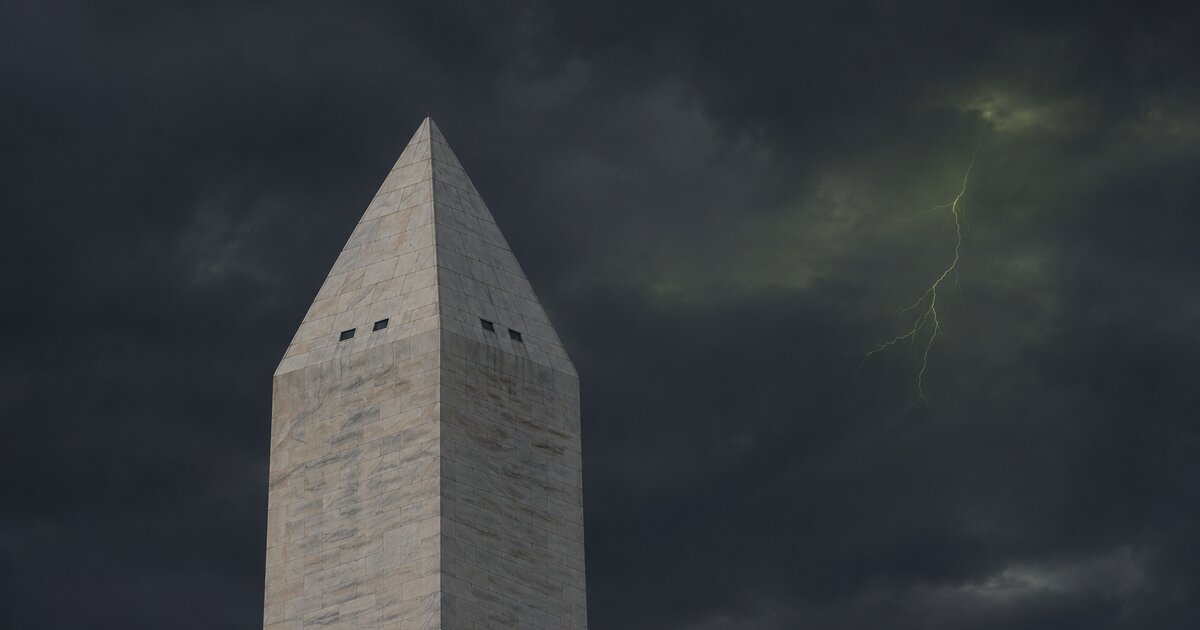
The Washington Monument needed more lightning rods because its 1884 aluminum tip did not adequately protect the stone just below it: the National Park Service’s October 2017 preservation brief records a crack after a strike within a year, followed by copper points and a band tied to the monument’s iron system.
The aluminum point was part of an incomplete plan
The National Park Service's brochure, updated January 2026, says the monument received its marble capstone and 9-inch cast aluminum pyramid in December 1884. The obelisk was dedicated in February 1885. The NPS's October 2017 preservation brief calls the point the first use of aluminum as a lightning rod in the United States.
The National Archives' Summer 2014 study of construction letters adds a distinction: the maker proposed aluminum partly because it conducted electricity for a lightning rod system. An aluminum top was chosen, but a metal point alone did not finish that system. The NPS preservation brief says the monument had an otherwise functioning system connected to its interior iron elevator shaft. The vulnerable part was the arrangement at the apex, where a strike could still affect the stone immediately below it.
The National Archives reports that the tip was installed on December 6, 1884. That date describes the completion of the outside of the obelisk, not the completion of every feature inside it.
A strike exposed the weak point within a year
The NPS preservation brief says the 1884 aluminum point proved deficient within a year: after lightning struck, a crack appeared under the top stone. The crack below the point prompted a change to the arrangement around it.
The National Archives' Summer 2014 account independently places lightning strikes before June 9, 1885. On that date, the aluminum supplier wrote to the monument's engineer with advice on a lightning rod system and offered points. The engineer instead hired a different Philadelphia maker, meeting him on June 12. Those dated letters explain why the design change belongs to 1885; they do not establish how often the monument was struck that year.
The NPS brief does not identify the electrical path that made this particular crack. A complete lightning rod system needs a continuous route from the exposed point toward ground.
Copper points and a band changed the route
The NPS's October 2017 description says workers placed copper rods around the base of the aluminum apex and attached them to a copper band. The band connected directly to the iron elevator shaft, part of the existing system. The repair did not replace the aluminum top with a single taller point. It added multiple interception points and a conductor connection at the part of the pyramidion where the crack had appeared.
The National Archives' Summer 2014 history names the maker chosen for the work. The NPS preservation brief makes the technical point: rods, conductors, connections and grounds form a system. The top metal by itself cannot certify the path beneath it.
Later damage has a different cause
The National Park Service's 2019 account attributes widespread cracks, spalls and displaced stone joints to the magnitude 5.8 earthquake of August 23, 2011. NPS project planning says the earthquake also damaged the lightning protection system and elevator. Its repair plan included removing and reinstalling that system. Those facts describe earthquake damage to an existing lightning system, not another lightning failure that created the 1885 crack.
Modern strike photos do not by themselves reveal damage. A 2021 WTOP report quoted an NPS spokesperson saying a strike affected electronic access and elevator calling equipment, with no structural or elevator damage reported in that event. That was a separate episode from the 2011 earthquake and the nineteenth-century stone crack. The sources here do not give a continuously measured annual count for direct strikes, so a dramatic video cannot be converted into one.
The monument stands in an open public setting. The NPS brief concerns protection of the structure; it does not designate the plaza around a rod as shelter for a visitor. The National Weather Service's lightning myths explain that strikes can reach beyond rain, and its lightning shelter guidance directs people indoors or into a hard-topped vehicle when thunder is heard.
For a storm during your own visit outdoors, Lightning Tracker, an iPhone app, maps recent detected lightning strikes and shows the distance and direction to the nearest one.
Not a substitute for official weather warnings.
If you hear thunder, seek shelter even if the app shows no nearby strike.
Sources
- National Park Service, Preservation Brief 50: Lightning Protection for Historic Structures
- National Park Service, Washington Monument Park Brochure
- National Archives, Topping Off the Tip
- National Park Service, 2011 Earthquake
- National Park Service, Washington Monument Earthquake Damage Repairs
- WTOP News, Washington Monument closes for repairs after dramatic lightning strike
- National Weather Service, Lightning Myths
- National Weather Service, Overview: Lightning Safety