 Lightning Tracker
App Store
Storm basics
Franklin’s kite experiment: what the record says
November 17, 2026 · 8 min read
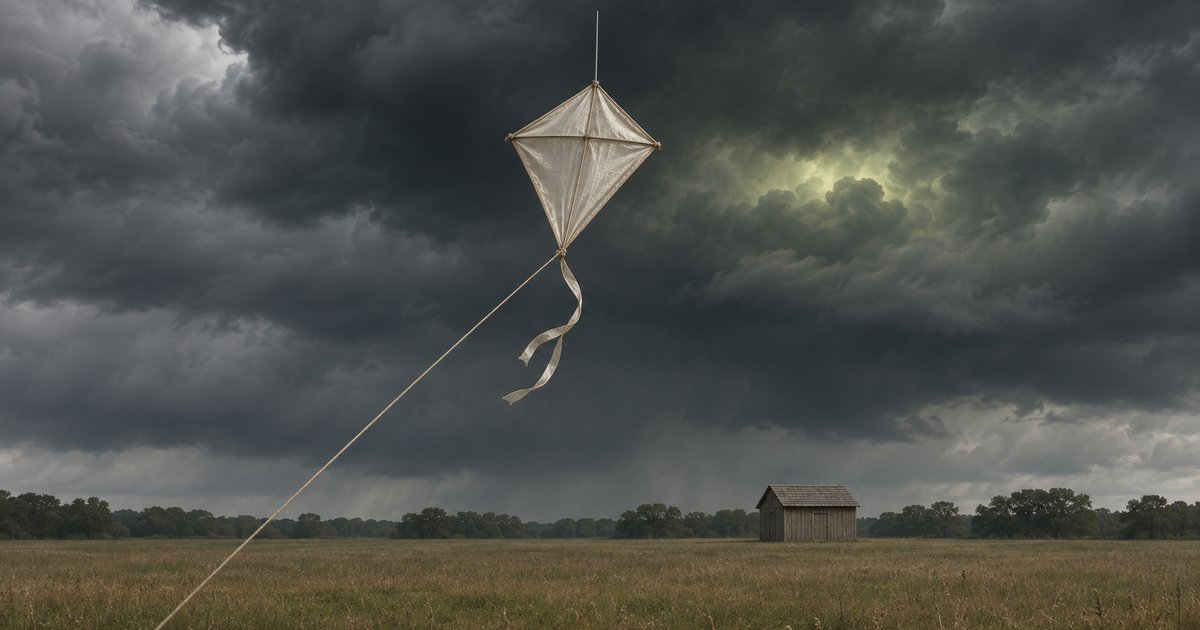
Benjamin Franklin’s kite experiment tested whether lightning and electricity are the same thing: in the standard account, a silk kite with a pointed wire rose into a thunderstorm, and a spark came from a key at the end of the string. The only account in Franklin’s own words is a set of instructions printed on October 19, 1752 with no date, and most of the detail in the familiar scene comes from Joseph Priestley’s 1767 book, which gives only the month of June 1752. The Franklin Institute says the kite was not struck by lightning, and the experiment was dangerous.
Franklin’s kite was meant to test whether lightning is electricity
The editors of the Franklin Papers at Founders Online (the National Archives site, printing volume 4 of the papers, 1961) write that Franklin was the first scientist to propose that the identity of lightning and electricity could be proved by an experiment, but not the first to suggest the identity, nor even the first to perform the test. His own notes of November 7, 1749 list twelve particulars in which “electrical fluid agrees with lightning,” and end with a challenge the editors quote: “Let the experiment be made.” In July 1750 his “Opinions and Conjectures” proposed the “sentry-box” experiment, which the same editors call the first public suggestion of an experiment to prove the identity.
The kite grew out of a problem of height. Joseph Priestley, writing in 1767, says Franklin was waiting for a spire to be built in Philadelphia, not imagining that a rod of moderate height would do, until it occurred to him that a common kite gave better access to the region of thunder. Meanwhile the rod version was done first, in France: the Franklin Papers chronology records that on May 10, 1752 Dalibard’s assistant carried out Franklin’s proposed experiment at Marly, and that Delor repeated it in Paris on May 18.
The Franklin Institute, a science museum in Philadelphia, adds a correction in its 2017 article: Franklin did not discover electricity with the kite, or at all, and his experiment showed the connection between lightning and electricity.
Franklin’s own statement is a set of instructions, printed October 19, 1752
The Pennsylvania Gazette of October 19, 1752 printed Franklin’s statement that the Philadelphia experiment had succeeded “in a different and more easy Manner” than rods on tall buildings, and then gave instructions for repeating it. They are not reproduced here: the Franklin Institute calls it “a very dangerous experiment,” and Georg Wilhelm Richmann was killed attempting a similar trial.
The statement says nothing about a date, a place in the city, a witness or what Franklin himself saw. The Franklin Papers editors call it not really an account of the experiment but a brief statement that it had taken place, followed by instructions. It ends by claiming that the “Sameness of the Electric Matter with that of Lightning” would be completely demonstrated.
The text exists in two versions, and neither is in Franklin’s handwriting, the editors say. One is the Gazette printing. The other is a copy in the hand of Peter Collinson, Franklin’s correspondent in London, headed as a letter from Franklin to Collinson and dated Philadelphia, October 1, 1752. It was read to the Royal Society on December 21, 1752 and printed in the Philosophical Transactions. The editors weigh whether Collinson’s date is a slip and say later correspondence does not settle it. That is why this experiment appears both as a Gazette item dated October 19 and as a letter dated October 1.
Franklin mentioned the flight once more in his autobiography, written in 1788, where the editors quote him declining to describe “a similar one I made soon after with a Kite at Philadelphia.”
Priestley’s 1767 book supplies most of the detail in the familiar scene
Joseph Priestley, a British scientist, published the most detailed surviving account in The History and Present State of Electricity in 1767, about fifteen years after the event. The Franklin Papers editors say there is every reason to believe he learned the details directly from Franklin, who was in London while Priestley wrote. They add that the account may err in some details through faulty memory or misunderstanding, but is probably correct in all major respects. The Franklin Papers cite the passage at pages 179 to 181 of the 1767 book, and the quotations here follow their transcription.
In Priestley’s telling, Franklin made a kite and walked into a field with a shed on the first approaching thunderstorm, fearing ridicule if he failed and telling only his son. The kite flew for a considerable time with no sign of charge, and one promising cloud passed over it without effect. Then Franklin saw loose threads of the hempen string stand erect and avoid one another, touched his knuckle to the key, and “perceived a very evident electric spark.” Priestley adds that more sparks came before the string was wet, and that when rain wet it Franklin “collected electric fire very copiously.” He charged phials at the key and kindled spirits from it.
The son was William Franklin, who the editors say was at least 21 years old at the time, not the child in the well-known Currier and Ives print, which they say has a number of other errors.
June 1752 comes from Priestley, and no source names a day
Priestley’s one-line date is the origin of June: he wrote that the flight happened in June 1752, a month after the electricians in France had verified the same theory. The Franklin Papers editors believe there is no good reason to doubt June, and note that when the idea came to Franklin and when he carried it out cannot be established with absolute certainty. Other sources read the same record differently, as the table shows.
| Source | What it says about the date |
|---|---|
| Franklin, Pennsylvania Gazette, October 19, 1752 | The experiment “has succeeded in Philadelphia”; no date given |
| Priestley, 1767 | June 1752, a month after the French experiments |
| Franklin Papers editors, 1961 | No good reason to doubt June; the exact timing cannot be established with certainty |
| Abbott Lawrence Rotch, October 1906 | Exact date unknown; June is due to Priestley; he argued for later in the summer |
| Hagley Museum and Library, June 15, 2021 | “According to some accounts,” June 15, 1752 |
Rotch, writing in the Proceedings of the American Antiquarian Society, noted that a May 26, 1752 letter from Paris was not reprinted in the Pennsylvania Gazette until August 27, and argued that if Franklin knew of the French results, the flight must have come after June, in the summer or early autumn. He also noted that Priestley says Franklin had not heard of them. A June 15, 2021 post from the Hagley Museum and Library gives June 15, 1752 only as what some accounts say and calls the experiment “possibly apocryphal.” Neither Franklin nor Priestley names a day, so a specific June date is a retelling, not a record. If Priestley’s month is right, June 2027 will be 275 years after the flight, with no documented day to mark.
Some historians doubt the flight happened, and the Franklin Papers editors do not
Live Science reported in 2021 that some historians doubt Franklin did the experiment himself rather than merely outlining its possibility. It cites Tom Tucker’s 2003 book Bolt of Fate: Benjamin Franklin and His Electric Kite Hoax, which noted that the Gazette statement is written in the future conditional and gives no date, time or location, and it says other historians point to Priestley naming the month. The Franklin Papers editors take the other side: they accept Priestley’s June date and call his account probably correct in all major respects. They also describe the Collinson copy as the only account of the experiment in Franklin’s own words. The open questions are the day and the details Priestley supplied, not whether Franklin printed his statement in October 1752.
The kite was not struck by lightning, and the experiment was still dangerous
The Franklin Institute says Franklin’s kite was not struck by lightning, adding that if it had been, he would probably have been electrocuted, experts say. In its account the kite picked up the ambient electrical charge from the storm. Priestley’s own words are stronger, saying Franklin “contrived actually to bring lightning from the heavens,” but what he goes on to describe is standing threads and sparks from a key, not a bolt.
Franklin’s printed instructions tried to keep the experimenter dry; that did not make the experiment any less dangerous. The Franklin Institute calls the experiment very dangerous. It reports that about a year later the physicist Georg Wilhelm Richmann attempted a similar trial and was killed, which the museum attributes to ball lightning, and the Hagley post dates his death to August 6, 1753.
The National Weather Service gives the rule for storms in one line: if you hear thunder, you are likely within striking distance of the storm, so “When Thunder Roars, Go Indoors!” Its lightning safety overview adds that people should wait 30 minutes after the last lightning or thunder before going back outside. A shed and a silk ribbon do not make flying a kite into a thunderstorm anything other than dangerous. Lightning Tracker, an iPhone app, shows recently detected strikes on a live map, with the distance to the nearest one and how many minutes ago it was detected.
The lasting result was the lightning rod, not the kite
Franklin put up a lightning rod with a bell attachment on his own house in September 1752, according to the Franklin Papers chronology. His first published description of a rod came in Poor Richard Improved for 1753, which the October 19 Gazette announced as in the press. It told readers to set an iron rod three or four feet into moist ground, with the other end six or eight feet above the highest part of the building, topped with about a foot of sharpened brass wire. Franklin wrote that a house “thus furnished will not be damaged by Lightning.” That is Franklin’s claim, not a guarantee.
The National Weather Service describes a lightning protection system as designed to protect a house or building from a direct strike and, in particular, from a fire started by lightning, and says such systems do not prevent lightning from striking the structure.
Not a substitute for official weather warnings.
If you hear thunder, seek shelter even if the app shows no nearby strike.
Sources
- National Archives, Founders Online, The Kite Experiment, 19 October 1752 (Papers of Benjamin Franklin, vol. 4, Yale University Press, 1961)
- National Archives, Founders Online, Poor Richard Improved, 1753
- Joseph Priestley, The History and Present State of Electricity (London, 1767), pp. 179–181, scan of the first edition
- The Franklin Institute, Benjamin Franklin and the Kite Experiment, June 12, 2017
- The Franklin Institute, Franklin’s Lightning Rod
- Abbott Lawrence Rotch, Did Benjamin Franklin Fly His Electrical Kite Before He Invented the Lightning Rod?, Proceedings of the American Antiquarian Society, October 1906
- Hagley Museum and Library, Stories from the Stacks: Franklin’s kite experiment, June 15, 2021
- Live Science, Did Benjamin Franklin really discover electricity with a kite and key?, December 28, 2021
- National Weather Service, Overview: Lightning Safety
- National Weather Service, Lightning Rods