 Lightning Tracker
App Store
Storm basics
Dalibard’s 1752 Marly experiment: sparks from a cloud
November 17, 2026 · 7 min read
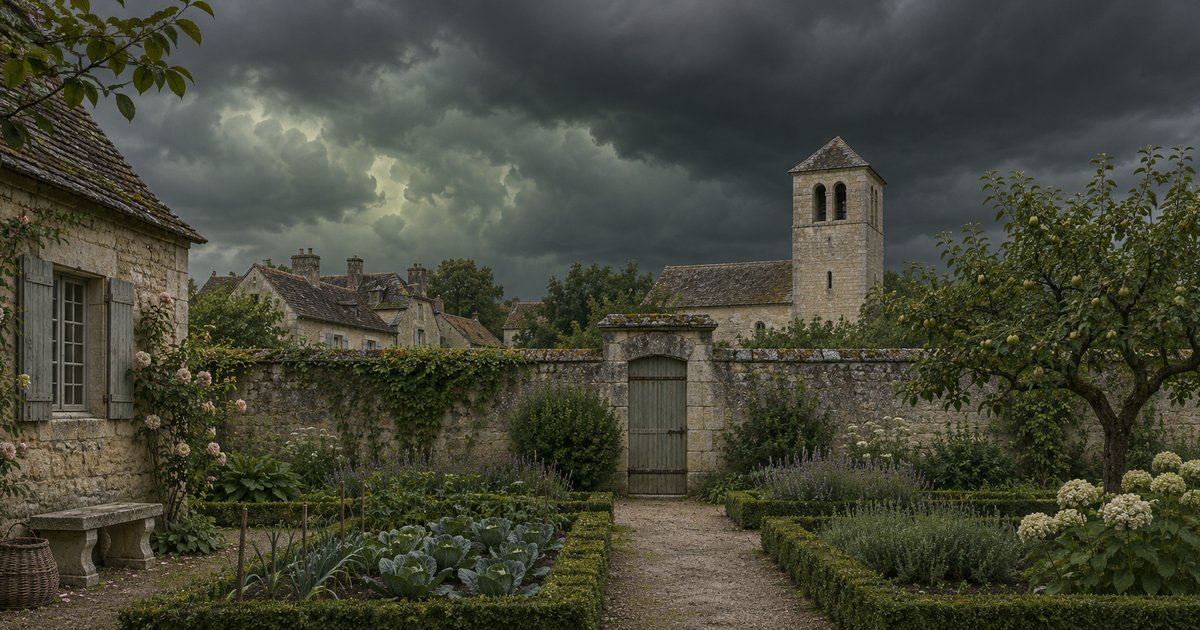
On May 10, 1752, at Marly-la-Ville near Paris, a man acting for Thomas-François Dalibard drew sparks from an iron rod while a storm cloud passed over. The Franklin Papers editors say Dalibard and Delor were the first to undertake the experiment Benjamin Franklin had proposed, and that Dalibard’s efforts met with success that day. Joseph Priestley wrote that Franklin’s kite flight came a month later, in June 1752, and Dalibard reported Marly to the Paris Academy of Sciences on May 13. Such experiments killed at least one experimenter, in 1753, and the National Weather Service’s rule is to go indoors when you hear thunder.
Franklin’s sentry-box proposal of 1750 gave Dalibard his plan
The editors of the Franklin Papers at Founders Online (the National Archives site, printing volume 4 of the papers, Yale University Press, 1961) write that in “Opinions and Conjectures,” July 29, 1750, Benjamin Franklin made the first public suggestion by any investigator that the electrical nature of lightning could be proved experimentally. They add that the proposal reached British electricians when Experiments and Observations was printed in April 1751, and that none of them was sufficiently impressed to try it. France reacted differently: after Dalibard translated and published Franklin’s pamphlet in Paris in February 1752, the same editors say, he and Delor, a Paris teacher of experimental philosophy, separately undertook for the first time to carry out the suggestion.
A local man drew the first sparks at Marly-la-Ville on May 10, 1752
Dalibard’s own memoir to the Academy of Sciences says he had a rod made at Marly-la-Ville, a village six leagues from Paris, and that he could not stay in the country to wait for a storm. He left the watch to a local resident named Coiffier, who had served fourteen years in the dragoons. In Dalibard’s account Coiffier heard a fairly strong thunderclap between two and three o’clock on Wednesday, May 10, 1752, drew a small bright spark with a crackling sound, and then a second one, stronger and louder. The storm and hail cloud took no more than a quarter of an hour to pass over the rod, and that was the only thunderclap.
The village priest wrote Dalibard a note dated May 10, 1752, which Dalibard printed. The priest gave the time as twenty past two, said he drew sparks at least six times in about four minutes, and described a bluish column of fire that smelled of sulfur. He also wrote that something struck his arm above the elbow, and that when he got home he and Coiffier saw a bruise running around it. Dalibard suggested the sulfur-like smell might be the phosphorus smell that follows violent electrical experiments.
Guillaume Mazéas, a correspondent of the Academy, described the rod in a letter of May 20, 1752 as a pointed iron bar 40 feet high, and the 2006 Physics Today article by E. Philip Krider gives a height of about 43 feet (13 meters) in its figure caption and calls the rod carefully insulated from ground. The rigging is not described here; this account says what happened and is not a design.
Later accounts differ on the rod’s height, the place and the Academy date
Four accounts of Marly, one from 1752 and three modern ones, give the rod’s height and place in different ways, as the table shows.
| Account | Rod height, as the account gives it | Place |
|---|---|---|
| Mazéas’s letter, May 20, 1752 | 40 feet | A garden at Marly |
| Marly-la-Ville town history page, December 2016 | About 40 pieds (French feet), given there as 14 meters | Marly-la-Ville |
| Physics Today, January 2006 | 13 meters (about 43 feet) | Marly-la-Ville |
| APS News, May 2000 | 50 feet | “in Paris” |
Three of the four put the rod at about 40 of their feet or about 13 meters, while APS News gives 50 feet and places the experiment in Paris. The town’s history page also says the experiment was presented to the Academy on December 22, 1751. That date cannot fit the same page’s May 10, 1752 experiment, and it does not match the Franklin Papers, which date Dalibard’s report May 13, 1752.
The Academy heard Dalibard’s report on May 13, and the news crossed Europe that summer
Dalibard’s memoir was read to the French Academy of Sciences three days after the experiment, according to the Franklin Papers editors, and the achievement, together with Delor’s on May 18, was recognized at once in France. Mazéas wrote that Delor, repeating the trial at his house in Paris on May 18, drew sparks from a cloud that brought rain and a little hail but, in the letter’s words, no thunder or lightning. From that trial Mazéas conjectured that an iron bar placed in a high situation might attract the storm and deprive the cloud of all its thunder.
| Date | Event | Source |
|---|---|---|
| May 13 | Dalibard reports Marly to the Academy of Sciences | Franklin Papers, vol. 4 |
| May 17 | The Abbé Nollet files a written objection and asks the Academy to delay publication | Franklin Papers, vol. 4 |
| May 18 | Delor draws sparks in Paris | Mazéas, May 20, 1752 |
| May 20 and 26 | French reports on both experiments are sent to England | Franklin Papers, vol. 4 |
| June 7 | Delor and Dalibard try again and fail | Franklin Papers, vol. 4 |
| July 1 | The Academy postpones publication of Dalibard’s memoir | Franklin Papers, vol. 4 |
| July to August | Canton, Wilson and Bevis repeat the experiment in England | Franklin Papers, vol. 4 |
| August 27 | The Pennsylvania Gazette reprints the French report of May 26 | Franklin Papers, vol. 4 |
Jean-Antoine Nollet, whom the Franklin Papers editors call the principal electrician of France, asked in his objection for further confirmation before publication and for recognition of his own priority, and the editors note that Dalibard’s history of electricity had ignored his work. The Academy postponed publication, and Dalibard printed his report in the second edition of his translation, in 1756. A successful repetition by another French experimenter, Le Monnier, followed shortly after June 7, the editors add. Krider writes that within weeks of hearing the news, many others across Europe had repeated the experiment. Historian Paola Bertucci writes, in a 2009 article on lightning rods in eighteenth-century Italy, that when the news reached Bologna, the town’s leading electrician hurried to replicate it.
Priestley’s June 1752 date puts Franklin’s kite a month after Marly
Joseph Priestley’s 1767 history of electricity, as printed by the Franklin Papers, says Franklin’s kite flight happened in June 1752, “a month after the electricians in France had verified the same theory,” and before Franklin heard of anything they had done. The editors see no good reason to doubt June. In that case, they write, Franklin performed his experiment before he learned of Dalibard’s and Delor’s, and word reached Philadelphia toward the end of August, when the Gazette printed the account on August 27. Krider’s 2006 article says the same: Franklin drew sparks from his kite key in June 1752, shortly after Marly but before he knew about it. The Franklin Institute, a Philadelphia science museum, wrote on June 12, 2017 that Dalibard had successfully demonstrated the electrical nature of lightning a month before Franklin.
Abbott Lawrence Rotch read the evidence differently in the Proceedings of the American Antiquarian Society in October 1906: authorities differ on whether Franklin knew of the French experiments, he wrote, and if he did, the kite flight must be dated later than June, in the summer or early autumn of 1752. Both readings leave Marly first. Franklin’s own printed statement of the kite experiment came on October 19, 1752, and the Franklin Papers editors note that neither Franklin nor Priestley on his behalf ever claimed priority in carrying out the experiment he had been first to propose. The American Physical Society’s APS News said in May 2000 that, contrary to popular belief, Franklin was not the first to conduct it successfully.
Marly showed that a storm cloud carries electric charge
Dalibard concluded in his memoir that the matter of thunder is incontestably the same as that of electricity, and that Franklin’s idea had stopped being a conjecture. Krider’s 2006 article says the sparks showed that thunderclouds are electrified and that lightning is an electrical discharge. Mazéas described Delor’s sparks as like those of a gun in the electrical experiments of the day.
Dalibard went further and predicted that pointed metal rods put on towers, steeples and ship masts in place of weathervanes and crosses would protect them from lightning, and that a pointed rod would discharge a storm cloud entirely of its fire. Krider says the French results validated the assumptions behind Franklin’s idea that tall, grounded rods can protect buildings. The National Weather Service describes a lightning protection system as designed to protect a house or building from a direct strike and, in particular, from a fire started by lightning, and says such systems do not prevent lightning from striking the structure.
The experiments killed at least one experimenter
Georg Wilhelm Richmann was killed by lightning on August 6, 1753, say the Franklin Papers editors, and Krider writes that he was electrocuted in St. Petersburg while trying to quantify the response of an insulated rod to a nearby storm. Krider adds that the incident was reported worldwide and underscored the dangers of experimenting with insulated rods. The priest’s note records that his own repeat of the trial left a bruise around his arm.
The National Weather Service says no place outside protects you when thunderstorms are in the area, and that if you hear thunder you are likely within striking distance of the storm. Its slogan is “When Thunder Roars, Go Indoors!” and it advises waiting 30 minutes after the last lightning or thunder before going back outside. The Service names substantial buildings and hard-topped vehicles as the places to go. None of this is a procedure to repeat.
For a storm you encounter today, Lightning Tracker, an iPhone app, shows recently detected strikes on a live map and the distance to the nearest one.
Not a substitute for official weather warnings.
If you hear thunder, seek shelter even if the app shows no nearby strike.
Sources
- National Archives, Founders Online, Thomas-François Dalibard: Report of an Experiment with Lightning, 13 May 1752 (Papers of Benjamin Franklin, vol. 4, Yale University Press, 1961)
- National Archives, Founders Online, Guillaume Mazéas to Stephen Hales, 20 May 1752 (Papers of Benjamin Franklin, vol. 4, 1961)
- National Archives, Founders Online, The Kite Experiment, 19 October 1752, editorial headnote and chronology (Papers of Benjamin Franklin, vol. 4, 1961)
- National Archives, Founders Online, Jean-Antoine Nollet: Letters on Electricity, [January 1753?], editorial headnote (Papers of Benjamin Franklin, vol. 4, 1961)
- National Archives, Founders Online, Account of the Death of Georg Richmann, 5 March 1754, editorial headnote (Papers of Benjamin Franklin, vol. 5, Yale University Press, 1962)
- The Franklin Institute, Benjamin Franklin and the Kite Experiment, June 12, 2017
- E. Philip Krider, Benjamin Franklin and lightning rods, Physics Today, January 2006 (doi 10.1063/1.2180176)
- Paola Bertucci, Enlightening Towers: Public Opinion, Local Authorities, and the Reformation of Meteorology in Eighteenth Century Italy, 2009 (published in Playing with Fire, American Philosophical Society Press)
- Abbott Lawrence Rotch, Did Benjamin Franklin Fly His Electrical Kite Before He Invented the Lightning Rod?, Proceedings of the American Antiquarian Society, October 1906
- American Physical Society, May 10, 1752: First Experiment to Draw Electricity from Lightning, APS News, May 2000
- Marly-la-Ville town hall, Dalibard Thomas-François, history page, December 7, 2016
- National Weather Service, Overview: Lightning Safety
- National Weather Service, Lightning Rods