 Lightning Tracker
App Store
Behind the data
Pan Am Flight 214: the lightning crash that changed fuel-tank design
November 11, 2026 · 10 min read
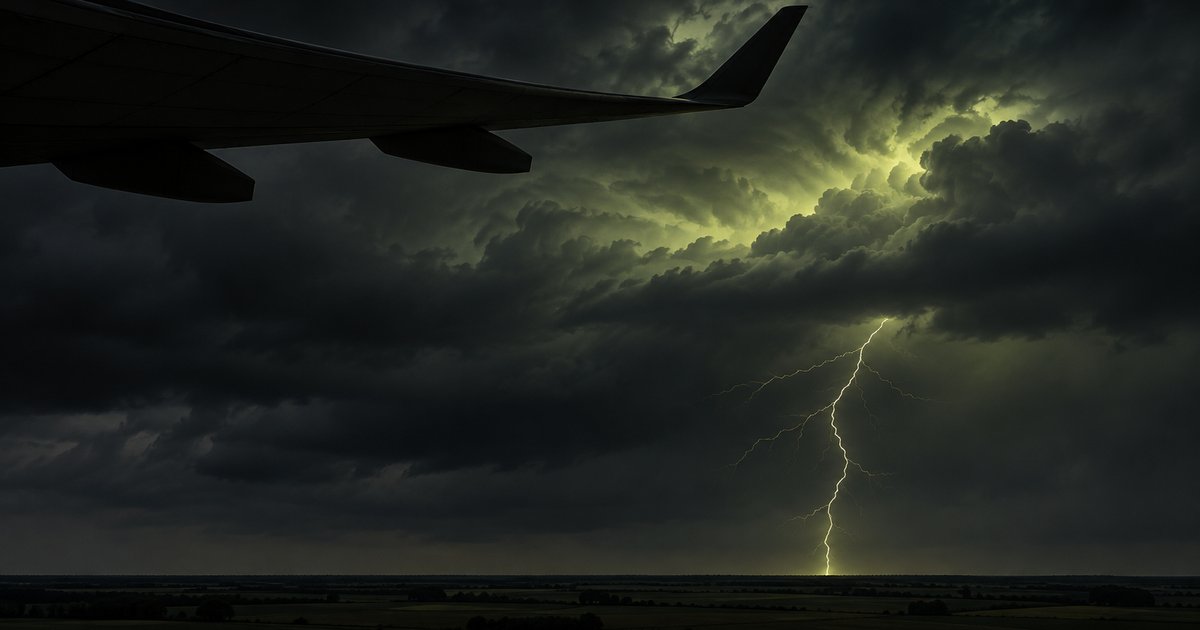
On December 8, 1963, lightning ignited fuel vapor in a wing tank of Pan American Flight 214, a Boeing 707 holding near Elkton, Maryland, and all 81 people aboard died. The Civil Aeronautics Board named lightning-induced ignition in the No. 1 reserve fuel tank as the probable cause but never found where or how the spark occurred, and the Federal Aviation Administration says the crash became one of the catalysts for the lightning-protection research, rules and designs that followed.
Flight 214 was holding for a squall line to pass Philadelphia
Pan American Flight 214, a Boeing 707-121 with 73 passengers and a crew of eight, left Baltimore for Philadelphia at 8:24 p.m. Eastern Standard Time on December 8, 1963, according to the Civil Aeronautics Board report adopted in February 1965. It reported over the New Castle, Delaware, navigation beacon at 8:42 p.m. and was told to hold at 5,000 feet west of it. Philadelphia approach control reported surface winds of 20 knots with gusts to 30 and asked whether the crew wanted an approach clearance or would hold until the squall line passed Philadelphia. The crew said they would hold.
At 8:58:56 p.m. a distress call from the flight was heard on the approach control frequency. The first officer of National Airlines Flight 16, holding in the same pattern 1,000 feet higher, saw the Pan American airplane descending on fire. The airplane crashed at 8:59 p.m. in open country two miles east of Elkton, Maryland. The report states that everyone aboard was killed instantly and that the aircraft was destroyed by explosion, impact and fire.
A thunderstorm was present at the time and place of the accident, the Board wrote. Witnesses near the crash described cloud, light rain and lightning, and Wilmington, Delaware, nine nautical miles east, reported a thunderstorm that began at 8:54 p.m. with lightning in the cloud and cloud-to-ground lightning to the west-northwest. The first officer of Flight 16 described the holding area as cloudy with comparatively smooth air, and the Board judged the turbulence there to be light to moderate, not the strength normally associated with loss of control or structural failure. The crew of Flight 16 also saw lightning strike their own aircraft while holding; examination afterward found lightning damage to its left wing tip and tail assembly. The report adds that most lightning strikes on aircraft occur near the freezing level, and that Flight 214 was at or near it just before the accident.
Ground witnesses placed a lightning stroke at the start of the fire
The Board interviewed 140 ground witnesses and reported what they saw. Ninety-nine saw an aircraft or a flaming object in the sky, 72 of those 99 saw lightning, and seven said they watched the lightning strike the aircraft. Seventy-two witnesses said a ball of fire appeared at the same moment as the lightning stroke or right after it. In its analysis the Board gave weight to witnesses, some of them particularly well qualified, who saw a cloud-to-earth discharge of exceptionally great magnitude where, moments later, the burning aircraft emerged. It concluded that the lightning and the start of the accident sequence correlate directly in time and location. The report describes the stroke only in those terms and does not state its polarity.
The report also explains how an aircraft joins a lightning path, in terms still recognizable today. When the stepped leader of a stroke approaches a flying aircraft, the intense electric field induces streamers from the aircraft’s extremities toward the stroke, and the Board said such streamers can carry enough energy to ignite fuel vapors.
The flight recorder and the wreckage pointed to an explosion in the left wing
The flight recorder tape, about 95 percent of which investigators reassembled and read, showed roughly 32 minutes 50 seconds from liftoff at Baltimore to impact. The first 32 minutes were normal, with no severe turbulence. Abnormal excursions began 32:15 after takeoff, which the Board took as the time of the explosion in the left wing; the airplane stayed at 5,000 feet for about 15 seconds more and then descended rapidly with little change in heading.
Nearly 600 pieces of wreckage lay outside the main impact crater, spread over an area about four miles long and one mile wide, and nearly all of the left outer wing panel lay along a separate straight path about two miles long. The complete left wing tip was found about 1.8 miles east-northeast of the main impact area. It carried multiple lightning-strike marks, including an irregular hole about 1.5 inches across with fused metal around it. The FAA’s case history says investigators found that lightning had attached to fasteners along the wing tip rib and melted the fastener and the skin around it, next to the left wing surge tank. The Board determined that explosions occurred in the left reserve, center and right reserve fuel tanks, that the first was in the left reserve tank, and that no fire-damaged part separated from the aircraft before it.
The Board found lightning damage on the wing tip but not the spark inside the tank
The Board’s 1965 report separates what the physical evidence established from what it could not establish, and the two lists are the core of the case.
| Question | What the report says |
|---|---|
| Probable cause | Lightning-induced ignition of the fuel and air mixture in the No. 1 reserve fuel tank, with explosive disintegration of the left outer wing and loss of control |
| Where lightning attached | Several places at the left wing tip, but none of the damage was on wing skin enclosing a fuel tank or vent system space, so the Board could not tie that damage directly to the tank explosion |
| State of the fuel vapor | Expert testimony indicated that vapors in the tanks’ air spaces were well within the flammable range |
| How the vapor ignited | Not determined: examination of tank surfaces, joints, rivets, screws, fittings and fuel quantity probes found no identifiable evidence of electrical arcing |
| Possible mechanisms | Streamers from extremities and surface discontinuities, plasma, shock waves, and sparking from induced voltages; the Board did not say which occurred |
| Limits of lightning knowledge | The upper limits of voltage, current and total energy in lightning were not conclusively defined |
The Board tested and set aside other explanations. It found no flight crew incapacitation and no powerplant or system malfunction that could have caused the explosion, and it did not consider icing a factor. It explored a fuel leak in the trailing edge of the left inboard wing, but metal spatter on the left horizontal stabilizer and fire damage on the left side of the tail could occur only after the left outer wing was lost. It also noted that the fuel vent system connected all the tanks, so the first ignition could have occurred inside the left reserve tank, inside the left surge tank or at the left vent outlet. Its conclusion was worded carefully: given the known facts, there was no logical explanation for ignition of the vapors other than some effect stemming directly from the lightning strike.
A blend of two jet fuels left the vapor flammable across a wider range
The FAA’s case history explains that a tank explosion needs both flammable vapor and an ignition source, and that Flight 214 carried a blend of two turbine fuels. The airplane arrived in San Juan with about 25,500 pounds of Type A fuel remaining and was fueled there with Type B fuel to a total of 78,000 pounds; the Board’s report adds that 27,400 pounds of Type A were added at Baltimore. Type A is a kerosene-type fuel, and Type B, a “wide-cut” fuel, has a cooler flammability range. The FAA says the blend kept the lean limit of Type B and the rich limit of Type A, so it burned across a larger range of conditions than either fuel alone. The Board also noted a Coordinating Research Council review, which concluded that one industry-wide turbine fuel would not significantly improve the overall safety record of commercial aviation.
The 707 was designed under rules that had no lightning requirement
The FAA says the Boeing 707 was designed to Civil Air Regulations part 4b as amended through December 31, 1953, which contained no lightning design requirements, and that only rudimentary lightning protection standards were in effect when it was developed. The Board concluded that the state of the art had been fully exploited within the limits of the airplane’s structure and configuration and that known lightning protection information and specific testing were applied during design.
The FAA describes the knowledge gap in its case history. A large body of knowledge about lightning existed in the electric power industry, but only a small part had reached aircraft manufacturers and airworthiness authorities. The prevailing view was that aluminum skin conducted lightning currents, which were brief, so components inside the skin were not expected to carry current. A subcommittee of the National Advisory Committee for Aeronautics, formed around 1934 and disbanded around 1948, worked mostly on avoiding strikes and protecting skins and radios, and little of its work centered on fuel tanks. A 1959 Lockheed Constellation accident near Milan, Italy, whose ignition source was also never found, prompted research on fuel vents and filler caps, but the FAA says research did not extend into other aspects of fuel system design.
Tests during the investigation produced partial answers. The Board reported that direct lightning strikes to over-wing filler caps and access plates of the type on the 707 could produce sparks inside the tank, though it found no sign of a direct strike on those parts of N709PA. Electrical resistance measured across 21 fuel tank access plates ranged from 0.000 to 250,000 ohms, with the higher readings where bonds had been broken. A complete test wing section of essentially the same configuration, struck with simulated lightning up to the test facility’s capability, showed no recorded sparking inside the reserve tank. The Board added that the state of the art did not allow extending test results to unqualified conclusions about natural lightning.
The FAA answered with a research committee, airworthiness directives and new rules
The FAA’s case history and the rule texts date the response step by step, and the table lists them in order. Dates are as the sources give them: effective dates for the directives and the 1967 rule, issue dates for the later amendments.
| Date | Action | What it required or did |
|---|---|---|
| January 1964 | FAA lightning-protection committee | The FAA outlined a research scope less than a month after the crash and formed a committee of FAA, CAB, other agencies and industry lightning experts |
| December 12, 1964 | Airworthiness directive 64-05-01 | Additional aluminum skin over the entire vent surge tank area of the wing |
| June 30, 1965 | Airworthiness directive 64-03-01 | Modified wing tank access panels to address possible internal sparking due to lightning |
| September 10, 1967 | Airworthiness directive 67-23-02 | A flame and explosion suppression system in the vent outlet system, or an added vent tube with a flame arrester |
| October 10, 1967 | 14 CFR 25.954, Amendment 25-14 | Fuel systems designed to prevent ignition of vapor by direct strikes, swept strokes, and corona and streamering at vent outlets |
| 1970 | 14 CFR 25.581, Amendment 25-23 | The airplane must be protected against catastrophic effects from lightning |
| June 6, 2001 (issued) | 14 CFR 25.981, Amendment 25-102 | A fuel tank ignition rule, written after the 1996 TWA Flight 800 accident, that required ignition sources including lightning to be addressed |
| September 6, 2018 (issued) | 14 CFR 25.954, Amendment 25-146 | Catastrophic fuel vapor ignition from lightning must be extremely improbable, with inspection, test and replacement limits for protective features; lightning protection was also excepted from 25.981 |
The FAA also describes what changed on the airplane. Access panels, filler caps, drain valves and dip sticks in wing tank skins received more emphasis on electrical bonding to the surrounding structure. Passive flame arrestors in vent pipes cool flames at vent outlets, and the 707’s suppression system uses a photoelectron cell in the overboard vent duct to detect flame and discharge suppressant into the surge tank area. Skin thickness changed too. The FAA’s page, last updated December 19, 2022, says the accident airplane’s wing skin was 0.064 inch at its thinnest where lightning attached and that aluminum skins are defined as at least about 0.080 inch to resist melt-through. Melting matters because the FAA says it can expose flammable vapor to a lightning arc near 30,000 °C (about 54,000 °F).
The FAA’s lesson was that bonding alone was not enough
The FAA lists a flawed assumption as the accident’s common theme: during the 707’s development, engineers assumed that electrical bonding of fuel system parts gave inherent protection against lightning. Research since then showed that bonding needs electrical shielding, thicker skins to prevent penetration and a better understanding of where lightning strikes on an aircraft, according to the FAA. The agency adds that lightning does not strike all areas of an airplane equally often, which led to the concept of strike zones, and that laboratory tests expose panels to a test lightning waveform whose components are applied by zone. It says specialists did not begin to think equally about currents inside fuel tanks until a 1976 Boeing 747 accident near Madrid, Spain, and some military accidents.
The FAA’s 2018 advisory circular for the current rule asks designers to determine strike zones, identify failures that could degrade protection and identify ignition sources. It names voltage sparks, thermal sparks, edge glow in carbon-fiber material and ignition near vent outlets, and it says vent outlets should be located outside the zones where lightning is most likely to attach. The FAA’s case page describes the 707 as built with the safety features available at its time and says much less was known then about lightning and airplanes. Readers who want the present-day picture, including how often a transport airplane is struck and what an inspection after a strike involves, will find it in what happens when lightning hits a plane.
For storms near you on the ground, Lightning Tracker, an iPhone app, shows recent detected strikes and alerts you when one is detected inside a radius you set for each place.
Not a substitute for official weather warnings.
If you hear thunder, seek shelter even if the app shows no nearby strike.
Sources
- Federal Aviation Administration, Lessons Learned: Pan American World Airways Flight 214, Boeing 707-121 (page last updated December 19, 2022)
- Civil Aeronautics Board, Aircraft Accident Report: Pan American World Airways, Inc., Boeing 707-121, N709PA, near Elkton, Maryland, December 8, 1963 (adopted February 25, 1965; copy hosted by the FAA)
- Federal Aviation Administration, 14 CFR 25.954 as adopted in Amendment 25-14 (effective October 10, 1967)
- Electronic Code of Federal Regulations, 14 CFR 25.954, Fuel system lightning protection
- Electronic Code of Federal Regulations, 14 CFR 25.581, Lightning protection
- Federal Aviation Administration, Advisory Circular 25.954-1, Transport Airplane Fuel System Lightning Protection (September 24, 2018)