 Lightning Tracker
App Store
Places and activities
Can you fly a drone near lightning or a thunderstorm?
November 18, 2026 · 9 min read
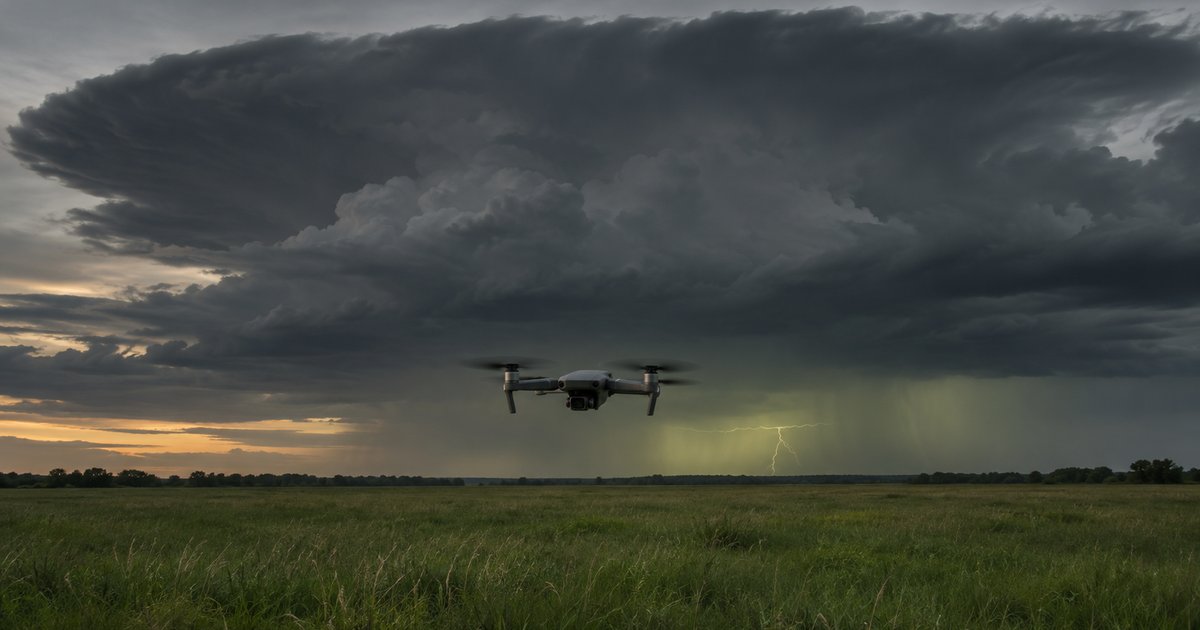
DJI’s safety guidelines for its Mini 4 Pro say not to fly in lightning, and DJI Japan’s flight manual warns that a strike could cause loss of the aircraft. The FAA’s Part 107 rules, in the eCFR text of November 9, 2026, require a weather assessment before flight and set visibility and cloud-clearance minimums, but they never mention lightning and set no lightning distance, so the decision rests on the pilot, the maker’s manual and the National Weather Service’s rule for people outdoors.
FAA Part 107 requires a weather check but sets no lightning distance
The Federal Aviation Administration (FAA) says its Part 107 rules cover commercial and government uses of drones weighing less than 55 pounds. In the Electronic Code of Federal Regulations (eCFR) text, up to date as of November 9, 2026, weather enters in a few places, shown in the table. None of them says which weather rules out a flight or how far from a storm to stay.
| Section | What the text requires | What it leaves unsaid |
|---|---|---|
| § 107.49(a)(1) | Before flight, the remote pilot in command assesses the operating environment, and the assessment includes local weather conditions | Which conditions rule out a launch |
| § 107.51(c) | Flight visibility of at least 3 statute miles from the control station | How far lightning can reach |
| § 107.51(d) | At least 500 feet below a cloud and 2,000 feet (about 0.4 mile) horizontally from it | A distance from a strike, as opposed to a cloud |
| § 107.19(b)–(c) | The pilot in command is directly responsible for the operation and is its final authority, and must ensure the aircraft poses no undue hazard to people, aircraft or property if control is lost for any reason | Whether a lightning strike counts as a cause of lost control |
| § 107.23(a) | No careless or reckless operation that endangers the life or property of another | Which weather makes a flight reckless |
The words lightning, thunder and storm do not appear in the Part 107 text. A flight can therefore meet every number in the table and still happen within reach of a strike. The National Weather Service (NWS) says lightning often strikes more than three miles (5 km) from the center of a thunderstorm, far outside the rain or the cloud, and that “bolts from the blue” can strike 10 to 15 miles (16 to 24 km) from the storm. The 2,000-foot horizontal clearance is measured from a cloud, and the NWS says lightning often strikes far outside the cloud, so keeping that clearance does not keep a drone out of reach of strikes. Part 107 sets general duties, and the lightning decision is left to the pilot.
Recreational flyers fall under a different rule, and the AMA handbook’s weather text does not mention lightning
Part 107 does not apply to an aircraft subject to the recreational exception in 49 U.S.C. 44809 (§ 107.1(b)(2)). The FAA’s page for recreational flyers, last updated October 29, 2026, tells them to follow the safety guidelines of an FAA-recognized community-based organization. The FAA’s list of recognized organizations, last updated May 5, 2026, includes the Academy of Model Aeronautics. Its member safety handbook, a March 2023 edition, tells flyers to continually monitor and assess the weather conditions, and its weather text does not mention lightning.
FAA training material lists thunderstorms and lightning as hazards for small drones
The FAA’s Airman Certification Standards for remote pilots, effective April 6, 2021, list “thunderstorms and microbursts” and “lightning” among the weather factors a remote pilot must understand for the knowledge test. The same document names the Aeronautical Information Manual (AIM) among its references for those weather topics.
The FAA’s Remote Pilot Study Guide, in its August 2016 edition, spells out what that means for a small aircraft. If a small drone enters a thunderstorm, it says, it could meet updrafts and downdrafts above 3,000 feet per minute (about 34 mph), and thunderstorms can also produce large hailstones, damaging lightning, tornadoes and large quantities of water. A typical microburst, the guide says, has a horizontal diameter of 1 to 2 miles and lasts about 5 to 15 minutes, and can produce downdrafts of up to 6,000 feet per minute (about 68 mph) and headwind losses of 30 to 90 knots (about 35 to 104 mph). Its decision-making chapter includes the question “Are there any thunderstorms present or forecast?”
The FAA’s advisory circular for Part 107 operations, AC 107-2A of February 1, 2021, asks pilots to set limits on flight conditions, such as minimum weather, and to ask whether they are experienced enough for the forecast conditions and have left themselves an “out.” It sets no lightning limit of its own.
The AIM gives a thunderstorm distance, though its thunderstorm advice speaks of ATC deviations and cockpit lights and so is written with crewed aircraft in mind. It says to avoid by at least 20 miles any thunderstorm identified as severe or giving an intense radar echo. It is not a Part 107 limit. The same AIM section warns against landing or taking off in the face of an approaching thunderstorm, because a sudden gust front of low-level turbulence could cause loss of control, and notes that lightning can strike aircraft flying in the clear in the vicinity of a thunderstorm.
Drone makers’ documents name lightning in some places and not in others
DJI’s paperwork for one model, the Mini 4 Pro, shows how a single maker can differ from one document to the next, and Parrot’s ANAFI USA manual gives a different kind of answer.
| Document | Weather wording | Lightning named? |
|---|---|---|
| DJI Mini 4 Pro User Manual, v1.4 (June 2024) | Do not operate in severe weather, including wind above about 24 mph (10.7 m/s), snow, rain and fog | Not named |
| DJI Mini 4 Pro Safety Guidelines, v1.2 (copyright 2024) | Do not use in severe weather, including heavy wind above about 24 mph (10.7 m/s), snow, rain, fog, hail or lightning | Yes |
| DJI Japan, UAS Flight Manual for the Mini 4 Pro (first edition, May 23, 2025) | Wind above about 24 mph (10.7 m/s) and rain, snow, icing and fog are prohibited environments; flying into areas of lightning activity is prohibited, because a strike could cause loss of the aircraft | Yes |
| Parrot ANAFI USA User Manual (updated January 7, 2026) | Check the weather; do not fly in fog or in wind above 32.8 mph (14.7 m/s); the drone is listed as IP53, rain and dust resistant | Not named |
The DJI Japan manual names “DJI JAPAN K.K.” as its document controller, so it comes from DJI’s Japanese unit. It is the only one of the four that gives a reason for the lightning ban. A rain or dust rating such as IP53 is not a lightning rating, and Parrot’s manual lists no lightning rule.
The wind limit also shows how far a severe thunderstorm’s gusts can exceed one small drone’s rated wind. The AIM gives the criteria for a severe thunderstorm as hail of 1 inch or larger and/or wind gusts of 50 knots (58 mph) or greater. That gust speed is more than twice DJI’s 24 mph limit. The National Severe Storms Laboratory’s own drone procedure bars flights when the weather exceeds visual flight rules minimums or the aircraft tolerance listed in the maker’s manual, and requires a flight to end when conditions become unsuitable, for example precipitation or winds beyond the maker’s recommendation. It does not mention lightning.
A lightning strike could cause a drone to be lost, and the evidence comes from tests rather than counts
DJI Japan’s flight manual says a lightning strike could cause loss of the aircraft. No source counts how many consumer drones have been struck, so the chance that a given drone is hit is not known. The sources describe laboratory work and one field experiment.
A 2019 paper in TELKOMNIKA tested a drone with a lightning impulse from a high-voltage generator and proposed aluminum-foil shielding over its body. With a 150 kV impulse supplied to the electrode and the strike area on the wing, the highest voltage measured in the drone’s compartment was 1 V, far below the 100 V insulation level of the low-voltage equipment inside. The strike still burned a hole in 0.006-inch (0.15 mm) foil, and a 0.012-inch (0.3 mm) layer overcame it. The authors call electromagnetic interference from lightning a critical issue because it could severely damage the electronics on board. A 2024 paper in Aerospace simulated lightning pulses entering a drone’s navigation receiver and then injected pulses on a bench. It reports blocking interference that lowered the receiver’s sensitivity and dynamic range, with a notable reduction once the pulse peak reached 250 V. Both are laboratory or bench work.
The field experiment is NTT’s. On December 13, 2024, in the mountains of Hamada City, Japan, NTT flew a drone fitted with a conductive metal cage to about 980 feet (300 meters) as a thundercloud approached. A conductive wire tied the drone to the ground, with a high-voltage switch on the ground side, and a rapid rise in the local electric field triggered a strike directed at the drone. NTT’s April 18, 2025 release calls it the world’s first successful triggering and guiding of lightning using a drone. The cage partly melted, and the drone kept flying. NTT also says its cage withstood artificial strikes of up to 150 kA in tests. The same release says that merely flying a drone under a thundercloud is not enough to attract lightning, and that an active triggering method is required. The method resembles the rocket-and-wire technique that University of Florida researchers describe in a 2012 paper, in which a small rocket trails a grounded wire into a storm.
That NTT statement does not settle the question for an ordinary drone. The NWS says aircraft often initiate a strike because their presence enhances the electric fields typical of thunderstorms. The two statements concern different aircraft and different tests, so no source gives the odds for a hobby drone. The NWS says airliners are built with conducting paths to carry a strike, while the FAA says it does not require small drones to meet its airworthiness standards or obtain aircraft certification.
The pilot on the ground is usually outdoors, and the NWS says no place outdoors protects people from lightning
Part 107 requires the pilot in command and the person at the controls, or a visual observer, to be able to see the aircraft throughout the flight (§ 107.31), and the section says nothing about where the pilot stands. A pilot who keeps the aircraft in sight is in practice usually outdoors or at a window. That puts the person under the NWS rule: its lightning safety overview says no place outside protects people when thunderstorms are in the area, and that hearing thunder means you are likely within striking distance of the storm.
Not hearing thunder does not rule out a strike. The NWS says thunder can be heard only about 10 miles (16 km) from a flash, while bolts from the blue can strike 10 to 15 miles (16 to 24 km) from the storm, so lightning from a storm too far away to hear can still reach a launch site. For shelter the NWS names substantial buildings and hard-topped vehicles, and says rain shelters, small sheds and open vehicles do not qualify. After the storm, the NWS advises waiting 30 minutes after the last lightning or thunder before going back outside, and says many people go out too soon, waiting only for the rain to lighten or end. The NWS rule is about people outdoors and does not mention drones. For a pilot, going back outside to fly is going back outside.
Lightning Tracker is an iPhone app that shows recently detected strikes on a live map, with the distance and direction to the nearest one and how many minutes ago it was detected, and it does not replace official warnings or local procedures.
Not a substitute for official weather warnings.
If you hear thunder, seek shelter even if the app shows no nearby strike.
Sources
- Electronic Code of Federal Regulations, 14 CFR, Part 107 — Small Unmanned Aircraft Systems
- Federal Aviation Administration, Small Unmanned Aircraft Systems (UAS) Regulations (Part 107)
- Federal Aviation Administration, Recreational Flyers & Community-Based Organizations
- Federal Aviation Administration, FAA-Recognized Community-Based Organizations
- Academy of Model Aeronautics, AMA Member Safety Program Handbook (March 2023)
- Federal Aviation Administration, Remote Pilot – Small UAS Airman Certification Standards (FAA-S-ACS-10B, April 2021)
- Federal Aviation Administration, Remote Pilot – Small UAS Study Guide (FAA-G-8082-22, August 2016)
- Federal Aviation Administration, Advisory Circular 107-2A, Small Unmanned Aircraft Systems (February 1, 2021)
- Federal Aviation Administration, Aeronautical Information Manual, Chapter 7, Section 1: Meteorology
- DJI, DJI Mini 4 Pro User Manual, v1.4 (June 2024)
- DJI, DJI Mini 4 Pro Safety Guidelines, v1.2
- DJI Japan K.K., UAS Flight Manual, DJI Model DJI Mini 4 Pro (May 23, 2025)
- Parrot, ANAFI USA User Manual (updated January 7, 2026)
- NOAA National Severe Storms Laboratory and CIWRO, NSSL UAS Standard Operating Procedure (revised July 2023)
- NTT, World’s First Successful Lightning Triggering and Guiding Using a Drone (April 18, 2025)
- Permata et al., TELKOMNIKA, Electromagnetic interference shielding in unmanned aerial vehicle against lightning strike (2019)
- Ma et al., Aerospace, Analyzing the Indirect Effects of Lightning on Unmanned Aerial Vehicle Navigation Receivers (2024)
- Hill et al., University of Florida and partners, Correlated Lightning Mapping Array and Radar Observations of the Initial Stages of Florida Triggered Lightning Discharges (2012)
- National Weather Service, Overview: Lightning Safety
- National Weather Service, Lightning Myths
- National Weather Service, Heat Lightning
- National Weather Service, Lightning and Planes