 Lightning Tracker
App Store
Places and activities
Why lightning delays flights even when the sky looks clear
November 13, 2026 · 7 min read
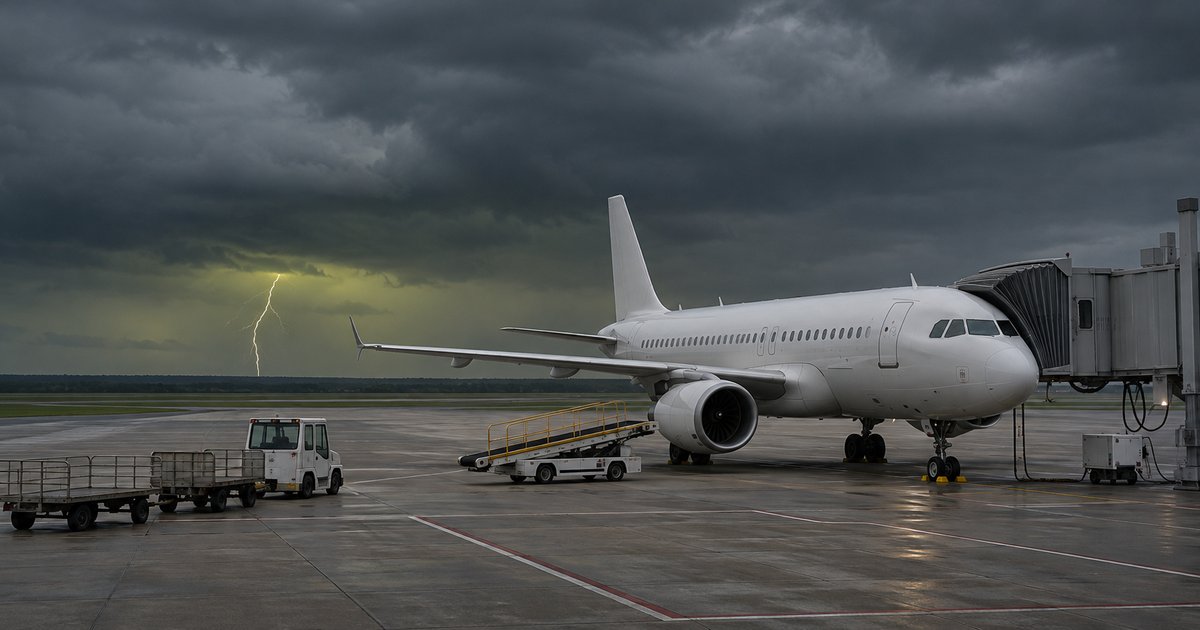
Flights wait during lightning because ground crews stop outdoor work around the aircraft once lightning is detected within a distance their airline or airport has set, often several miles away, so the storm need not be overhead. The reason is protection for the people working outdoors, not a problem with the plane: a 2008 report from the Transportation Research Board’s Airport Cooperative Research Program says a ramp closure does not directly or immediately affect flight operations, but a plane scheduled to leave cannot load or pull away from its gate until the ramp reopens.
A ramp closure stops the outdoor work that keeps a parked plane moving
ACRP Report 8, published in 2008 by the Transportation Research Board’s Airport Cooperative Research Program (ACRP), says cloud-to-ground lightning is a clear and immediate danger for ground personnel doing outdoor ramp work, meaning the jobs done around parked aircraft, such as aircraft fueling, baggage handling, food service, tug operations, and guiding aircraft to their gates. When that danger is present, the report says, ramp operations are suspended until the threat has passed. The National Center for Atmospheric Research (NCAR) describes the same procedure on its aviation page: the closure suspends outdoor work and brings baggage handlers, fuel and food suppliers and mechanics inside.
ACRP Report 8 spells out what a closure means for the people waiting, while noting that ramp procedures vary from airline to airline. In general it lists:
- no new boarding or deplaning;
- no new loading or unloading of baggage, and bags already on carts stay put;
- no servicing of the aircraft, including fuel and food service;
- passengers and flight crew remain on the aircraft, or stay in the terminal waiting to board.
The same report separates the closure from the flight itself. In its words, suspending ramp operations does not directly or immediately affect flight operations, but a plane scheduled to leave cannot load or pull away from its gate, and arriving planes may reach a gate while their baggage cannot be unloaded.
Airports and airlines, not the FAA, decide when the ramp closes
ACRP Report 8 states that decisions about ground personnel and ramp operations are made by airports and airlines, not by the Federal Aviation Administration (FAA). Charlotte Douglas International Airport says the same about its own role in an August 19, 2026 news story: the airport advises on lightning threats and does not mandate stoppages, and individual airlines and other stakeholders set their own response policies. The people being protected are workers. The OSHA and NOAA fact sheet on lightning safety for outdoor work (May 2016) lists airport ground personnel operations among the worker activities at higher risk for lightning hazards.
The aircraft is a separate matter. The National Weather Service says commercial transport planes are designed with conducting paths that carry a strike’s current through the structure, and what happens when lightning hits a plane follows that path. A closed ramp is about the person holding a fuel hose or a bag cart, not about whether the airliner can take a strike.
Each airport and airline sets its own distance, and no law fixes it
ACRP Report 8 found that the industry uses two measures to govern stopping and restarting ramp work, the distance of the lightning and the time since the last event, and that the values vary with the decision maker’s risk tolerance, shaped by past experience at the airport. A March 2025 press release from the lightning-detection company Vaisala states that no laws govern the safety radius or the all-clear time at airports. A 2015 conference abstract by an FAA author and two co-authors adds that large airports and major airlines usually have procedures that stop ramp work when lightning is within a specified distance, while most small and regional airports have minimal procedures or none.
| Who set it, and when published | Distances that trigger action | When work may restart |
|---|---|---|
| Charlotte Douglas airport (CLT), August 2026 | Advisory at 25 miles, warning at 10 miles, red alarm at cloud-to-ground lightning within 3 miles of the airport perimeter | 10 minutes with no cloud-to-ground lightning within 3 miles, or no lightning of any kind within 10 miles |
| Denver airport, 2008 survey | Advisory at 10 miles, warning at 5 miles | 15 minutes with no lightning within 5 miles |
| American Airlines at Dallas-Fort Worth, 2008 survey | Hand signals on the ramp at 5 miles, all ramp operations shut down at 3 miles | At least 10 minutes with no strike within 3 miles |
| United Airlines at Chicago O’Hare, 2008 survey | Alert status at 50 miles, clearing preparations at 25 miles, ramp cleared at 10 miles | Not listed in the report |
| UPS at Louisville, 2008 survey | Pre-alert at 12 miles, fueling banned at 5 miles, ramp operations banned at 3 miles | Not listed in the report |
The 2008 rows come from ACRP Report 8’s survey of airports and airlines, and the Charlotte revision shows how the values move: its advisory distance was 20 miles before summer 2026. The report also notes that the 30/30 rule, which curtails outdoor activity after a strike within 6 miles and resumes it 30 minutes after the last one, did not appear to be used in practice at the airports and airlines it surveyed. The National Weather Service’s public rule is still to wait 30 minutes after the last lightning or thunder.
Lightning can be detected miles from a sky that looks clear
The National Weather Service says lightning often strikes more than three miles from the center of a thunderstorm, far outside the rain or the storm cloud, and that “bolts from the blue” can strike 10 to 15 miles from the storm. The OSHA and NOAA fact sheet says lightning can strike outside the heaviest rainfall or even up to 10 miles from any rainfall. Thunder, by the National Weather Service’s account, can only be heard for about 10 miles from a flash, and heat lightning is its name for flashes too far away to see the ground strike or hear thunder. A warning radius of 10 miles, as at Charlotte, therefore reaches lightning that a person at the gate may neither see nor hear.
Charlotte’s August 2026 story adds a second reason a closure can look unexplained. American Airlines gave the airport data showing that 75 to 80 percent of its ramp closures in 2024 and 2025 were caused by in-cloud lightning rather than cloud-to-ground lightning, and the airport’s operations manager said some closures happened with no cloud-to-ground strike detected during the entire storm. Charlotte responded by removing in-cloud lightning from its inner 3-mile circle. NCAR cautions that the lightning data behind these decisions carry their own uncertainty, and that observers found human behavior sometimes produced delayed or inconsistent closures.
A closure typically adds tens of minutes, and the delay spreads
NCAR’s study, funded by the FAA and described on its website (undated, as read in November 2026), found that a ramp closure delays gate pushback by several tens of minutes per affected flight on average. A backlog of departures adds about five to fifteen minutes of taxi-out time, and arrivals see about five to twenty minutes of extra taxi-in time because gates stay occupied by planes that cannot be readied. NCAR says the delay at one airport likely ripples through the national airspace system and grows as the day goes on. Vaisala’s 2025 release gives an industry figure for the clock: average downtime of 30 to 60 minutes per lightning episode, depending on the alerting radius and how fast the storm moves away.
The radius matters in minutes. Vaisala’s Miami International example says a 3-mile radius with a 10-minute window would put the airport under lightning alert about 4,373 minutes a year, against 6,737 minutes with a 5-mile radius, and that the smaller radius leaves less time to stop work. Charlotte’s airport says closures beyond 30 minutes can trigger flight delays, crew time-outs and long waits on planes.
A ramp closure is not the same thing as an FAA ground stop. The FAA’s help page defines a ground stop as holding flights destined for the affected airport at their departure points. ACRP Report 8 says a short ramp suspension does not generally close the airport or hold traffic bound for it. If a suspension runs long and every ramp position fills, the report says, an airport manager may have to close the airport, a step it describes as a response to lacking ramp capacity rather than to the lightning itself.
What Lightning Tracker shows about a storm near an airport
Lightning Tracker is an iPhone app, free on the App Store, that shows recently detected strikes on a live map, with the distance and direction to the nearest one and how many minutes ago it was detected. It alerts you when a strike is detected inside an alert radius you set for each place, 10 miles (16 km) by default, a distance trigger much like those in the table. Its 30-minute wait starts after the last strike detected inside the radius and starts over with each new one; when it ends, the app reports what it observed and asks you to judge the conditions yourself. Detection networks miss some strikes, especially weak ones, and data can arrive late, which the app labels instead of treating as quiet. It does not replace official warnings or local procedures, which at an airport means the airline’s and the airport’s own ramp rules.
Not a substitute for official weather warnings.
If you hear thunder, seek shelter even if the app shows no nearby strike.
Sources
- Transportation Research Board, Airport Cooperative Research Program, ACRP Report 8: Lightning-Warning Systems for Use by Airports (2008)
- Charlotte Douglas International Airport, Updated Lightning Program Could Mean Fewer Delays (August 19, 2026)
- NSF NCAR Research Applications Laboratory, Lightning Impacts on Aviation
- American Meteorological Society, 95th Annual Meeting, Bass, Steiner and Deierling, Survey of Lightning Warning Procedures for Ramp Closures at US Airports (January 2015)
- OSHA and NOAA, Fact Sheet: Lightning Safety When Working Outdoors (PDF, May 2016)
- National Weather Service, Lightning Myths
- National Weather Service, Heat Lightning
- National Weather Service, Lightning and Planes
- National Weather Service, Overview: Lightning Safety
- Federal Aviation Administration, Airport Status Information: message help
- Vaisala, Data-driven flight scheduling can significantly reduce risk of thunderstorm delays (press release, March 19, 2025)