 Lightning Tracker
App Store
Home and everyday
Do solar panels attract lightning? What a strike does to a PV system
November 19, 2026 · 9 min read
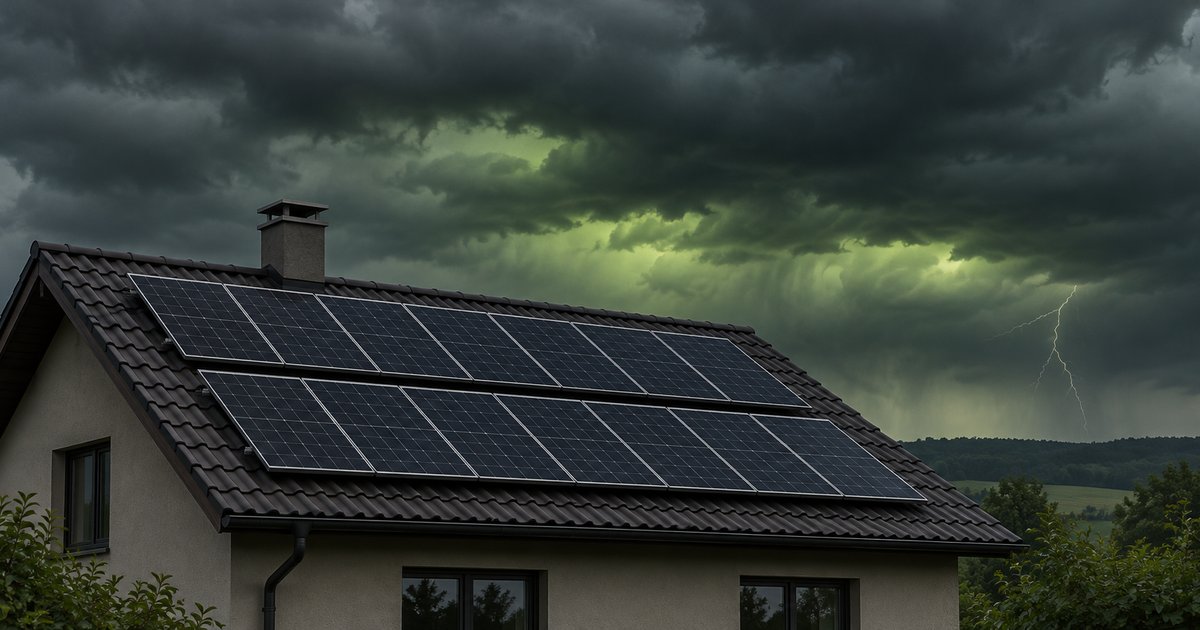
No source opened for this article measured whether rooftop solar panels change a house’s chance of being struck by lightning; the National Weather Service says height, pointed shape and isolation, not metal, decide where a bolt lands. The damage the sources describe is to the PV system itself, from a direct hit, which UL calls rare, or from a nearby strike that induces a surge in the wiring and inverter. The protection they name is grounding, surge protective devices and, for some buildings, a full lightning protection system, and this page leaves the design of any of it to a licensed professional.
Height, shape and isolation decide where lightning lands, and no source measured the effect of panels
The National Weather Service (NWS) says height, pointy shape and isolation are the dominant factors controlling where a lightning bolt will strike, and that the presence of metal makes absolutely no difference to where it strikes. It calls the belief that metal attracts lightning one of its lightning myths, and notes that tall, isolated natural objects with little or no metal, such as trees and mountains, are struck many times a year. By that rule, the question to ask about a roof is how tall and exposed the building and its site are, not how much metal sits on it.
None of the NWS pages opened for this article mentions solar panels. UL, the testing organization that also offers certification of lightning protection systems for solar panels, wrote in a March 2015 note that roof-mounted panels on high buildings are “also a target” and should be protected, and that photovoltaic farms in open areas with no high buildings or trees have a high probability of being hit. DEHN, a maker of surge arresters, says in a white paper copyrighted 2012 that according to recent studies, installing PV modules on buildings does not increase the risk of a lightning strike. The paper names no study and is 14 years old, so this page treats it as a maker’s view and not as a measurement.
An abstract posted in April 2023 on an IEEE section’s events page, by authors at the University of Witwatersrand in Johannesburg, shows why a firm number is hard to find. It says the lightning risk standard it examined, IEC 62305-2, had no method for assessing the risk of only a PV system mounted on part of a large roof, and that the study’s key aim was to show the confusion on the subject, not to propose a method. IEC published a revised third edition of that standard in September 2024, after the study. Read together, the sources point to the exposure of the building and site as what matters; none gives a measured change from adding panels.
UL calls a direct hit rare and a nearby strike the likelier cause of damage
UL’s 2015 note describes two paths. Direct strikes, it says, are rare but would destroy (melt) panels and inverters. Indirect strikes are more likely: they induce high voltages in the system, which can break down conductors, panels and components and can produce sparking that ignites combustible material. Most damage, UL says, comes from nearby strikes to ground, usually within a few hundred feet, and a near strike can induce thousands of volts on an unprotected system. The note closes by describing UL’s own certification service, so it is an organization’s view of its field.
A 2000 conference paper from Sandia National Laboratories describes the same kind of threat from the equipment side. It says electrical surges on the alternating-current and direct-current wiring of inverters, and on diagnostic cables, have the potential to shorten the lifetime of power electronics, and that these surges may come from nearby lightning or from capacitor switching. The NWS adds that lightning enters a structure in three main ways: a direct strike, wires or pipes that extend outside the structure, and the ground.
NIST’s 1989 case histories of two island arrays are thin evidence for a rooftop
The National Institute of Standards and Technology (NIST) published case histories in June 1989, prepared for Sandia National Laboratories, of two photovoltaic installations on the Mediterranean islands of Vulcano (Italy) and Kythnos (Greece) that were damaged during lightning storms. The report says its evidence was insufficient to conclude that all the damage came from the direct effect of lightning. One possible scenario it gives is that lightning-induced overvoltages broke down insulation at the edges of the modules, after which the direct current from the array did further damage.
At Vulcano, the report counts one case of damage attributed to lightning, to one panel among several hundred, and says it is not conclusively attributable to lightning. At Kythnos, where air terminals had been installed, damage occurred anyway; NIST wrote that the effectiveness of lightning rods there appears questionable, while adding that a higher density of rods, or greater height, might have reduced the damage. Its firm conclusions were that lightning does represent a threat to photovoltaic arrays, by direct or indirect damage, and that surge-protective devices with appropriate ratings can protect the electronic equipment. In the report’s 1989 words, lightning strikes on PV systems had been rare, so field experience was limited.
These were two large installations on Mediterranean islands, built in 1983 and 1984, described in a report that calls its own evidence limited. That is thin evidence for a house roof today, so this page uses it to show failure paths and protective devices, not to rank today’s risk.
Insurance claims for 2014 to 2019 put lightning at about 1.5% of solar claims, at a higher cost per claim than hail or wind
The National Renewable Energy Laboratory (NREL), whose website now carries the name National Laboratory of the Rockies, analyzed insurance claims in a December 2020 report. As of May 2020, the claims aggregator Verisk had identified 15,128 property-casualty claims from 2014 to 2019 that included PV equipment, and 98% of them were residential. Hail was the cause of 53% of the claims, wind 32% and fire 8%. Lightning caused 222 claims, about 1.5% by our arithmetic (222 divided by 15,128), with $2.2 million in solar items and $56 million in total claim value, which counts the whole claim and not only the solar equipment.
| Cause | Claims | Average solar-item value per claim |
|---|---|---|
| Hail | 7,979 | $2,555 |
| Wind | 4,784 | $2,641 |
| Fire | 1,282 | $17,309 |
| Lightning | 222 | $9,746 |
The report’s table gives the median lightning claim for solar items as $3,410 and the largest as $82,481, and the report says averages are influenced by relatively few, very large claims. For residential policies, it says, the largest average loss to solar items came from fire, followed by lightning. The data have limits that NREL states: the Verisk data do not represent all U.S. insurance claims, the values include only amounts above policy deductibles, and a claim is a loss that someone reported, not a count of strikes.
The same report says property insurance covers damage to a homeowner’s rooftop PV system from a weather event such as hail, wind, lightning or snow, and that PV systems on the roof of a home are covered under the dwelling coverage and limits. Systems on a detached structure such as a garage, or ground-mounted systems, might be subject to a separate, often lower limit. What a particular policy covers is a question for the policy and the insurer.
Standards and agencies describe grounding, surge protective devices and air terminals, and leave design to qualified people
UL’s note says the requirements for protecting solar panels from lightning are in NFPA 780, the Standard for the Installation of Lightning Protection Systems, where chapter 12 refers back to the chapter 4 rules for ordinary structures and adds specific ones for solar panels. The principle, it says, is to place the panels inside a zone of protection so that a lightning leader attaches to an air terminal and is directed to ground instead of hitting the panels. It cautions that air terminals should not shade the panels and, if avoidable, should not sit on the PV rack, because a strike to a terminal on the rack would put some of the current on the panel. Listed direct-current (PV) and alternating-current surge protective devices need to be installed at various points, such as the input and output of the inverter.
The NWS describes the household version. Its lightning protection system page says rods and their cable protect a building from a direct strike but do not prevent strikes, that a complete system is needed to help prevent surges and fires from lightning entering through wires and pipes, and that any system should follow the standards of the Lightning Protection Institute, the National Fire Protection Association and Underwriters Laboratories. Its indoor page also says that typical surge protectors will not protect equipment from a lightning strike. That statement and UL’s call for listed PV surge devices sit side by side in the sources, and neither compares the two kinds of device, so this page does not either.
Grounding is the least settled part in the older sources. NIST wrote in 1989 that no general agreement had been reached on grounding practices for photovoltaic systems. A DOE procurement template from April 2020, in its lightning protection entry, says that if a dedicated or separate grounding electrode is added for lightning suppression, as described in the 2014 National Electrical Code section 690.47(D), it must be bonded to the premises’ grounding-electrode system. NIST also noted that where a fuse sits in series with a surge device, a failed device blows the fuse and, unless an indication is provided, leaves the equipment unprotected for the next strike.
The DOE’s 2021 PV owner’s guide lists hiring a consulting engineer to help identify and correct vulnerabilities as a step in the process. None of the sources opened here is an installation guide, and this page is not one: grounding, bonding and surge protection are designed and installed by a licensed electrician or lightning protection professional.
The DOE’s 2021 guide says a storm-damaged PV system can feed current into unexpected paths
The PV System Owner’s Guide was sponsored by the U.S. Department of Energy’s Federal Energy Management Program and the General Services Administration, and it was published in September 2021 for federal agencies, not for homeowners. Its special safety notice on storm-damaged systems says torn wires and other damaged electrical components may feed electricity into unpredicted pathways, such as metal racking, module frames, wet surfaces, neighboring heating and air-conditioning equipment and conduit. It adds that some designs use high-voltage direct-current wiring, for example 600 to 1,000 volts. Under no circumstances, it says, should untrained personnel touch any electrical component of a PV system, whether or not it is presumed de-energized.
The notice covers storm damage in general, not lightning alone. For the people in a house, the NWS overview says to wait 30 minutes after the last lightning or thunder before going back outside; in our reading, that includes stepping out to look at the roof.
Fleet-wide performance studies name lightning but give no lightning figure
On January 24, 2024, NREL described a data set of streams from 25,000 inverters at almost 2,500 commercial- and utility-scale PV sites in 37 states and territories. The item lists lightning among the extreme weather events that can damage fielded PV systems, yet the thresholds it names for greater yearly performance losses are hail larger than 1 inch (25 millimeters), winds above 56 mph (90 kilometers per hour) and snow deeper than about 3.3 feet (1 meter). It says most outages came from flooding and rain, followed by wind. This page found no lightning-specific figure in it, and the sites were commercial and utility-scale, not houses.
What Lightning Tracker shows while a storm is near
Lightning Tracker is an iPhone app that shows recently detected strikes on a live map, with the distance and direction to the nearest one and how many minutes ago it was detected, and it does not replace official warnings or local procedures.
Not a substitute for official weather warnings.
If you hear thunder, seek shelter even if the app shows no nearby strike.
Sources
- National Weather Service, Lightning Myths
- National Weather Service, Lightning Rods
- National Weather Service, Lightning Safety Indoors
- National Weather Service, Overview: Lightning Safety
- UL (Underwriters Laboratories), Lightning Protection for Solar Panels Protects Your Investment, Subject 96A, March 16, 2015
- DEHN, Lightning and Surge Protection for Rooftop Photovoltaic (PV) Systems, white paper, copyright 2012
- Gomces et al., University of Witwatersrand, Risk Assessment of Rooftop-Mounted Solar PV Systems, abstract posted April 24, 2023
- International Electrotechnical Commission, IEC 62305-2:2024
- Sandia National Laboratories, Improved PV system reliability results from surge evaluations at Sandia National Laboratories, April 11, 2000
- National Institute of Standards and Technology, Lightning and Surge Protection of Photovoltaic Installations: Two Case Histories, Vulcano and Kythnos, June 1989
- National Renewable Energy Laboratory, Insurance in the Operation of Photovoltaic Plants, December 2020
- National Renewable Energy Laboratory, How Extreme Weather and System Aging Affect the US Photovoltaic Fleet, January 24, 2024
- U.S. Department of Energy, Federal Energy Management Program, PV System Owner’s Guide to Identifying, Assessing, and Addressing Weather Vulnerabilities, Risks, and Impacts, September 2021
- U.S. Department of Energy, Federal Energy Management Program, Solar Photovoltaic Procurement Specifications Templates for Onsite Solar PV, April 2020