 Lightning Tracker
App Store
Behind the data
What lightning does to cell towers and antenna sites
November 19, 2026 · 10 min read
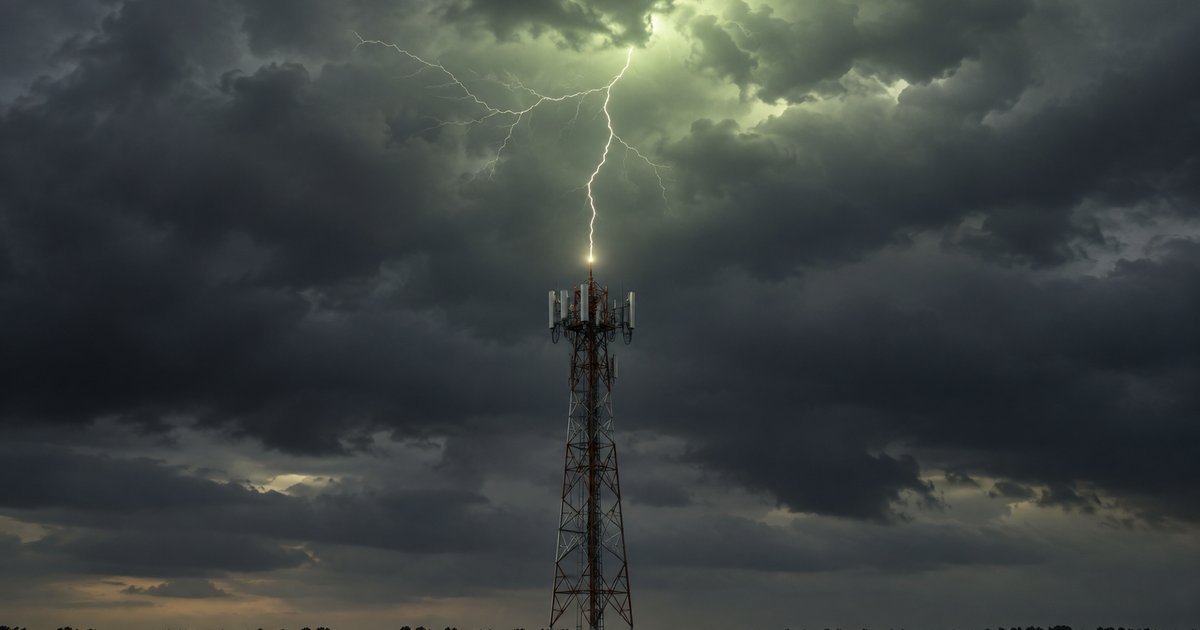
Yes, cell towers are struck by lightning, and a 2017 study of 20 years of U.S. strike data found that the count of cloud-to-ground strikes rises with tower height. The protection the National Weather Service specifies for its own antenna sites is a lightning rod on the tower, cables that carry the current down to a buried ground system, and bonding and surge protection on what enters the equipment building. That manual covers NWS sites only. The NWS counts the idea that a cell phone attracts lightning among its myths, and the sources give no measurement of whether living near a tower changes a person’s own chance of being struck.
Tall towers draw more strikes, and one Swiss tower takes more than 100 a year
The National Severe Storms Laboratory (NSSL) says lightning usually strikes the tallest object, adds “Never say always!”, and explains that the tallest object is the most likely to send up the streamer that meets the downward flash. The National Weather Service (NWS) says height, pointy shape and isolation are the dominant factors in where a bolt lands, and that the presence of metal makes no difference. By that rule, a tall, narrow tower in open ground is a likely target, and the steel in it is not what decides the matter.
OSHA’s communication towers page (undated as of November 2026) says tower workers climb structures from 100 feet to heights above 1,000 or 2,000 feet, so “cell tower” covers a wide range of heights. A study by Kingfield, Calhoun and de Beurs in Geophysical Research Letters (May 2017) gridded 20 years of National Lightning Detection Network data at 1,640 feet (500 meters) and compared it with the antenna towers registered with the Federal Communications Commission. Its abstract reports that 99.8% of grid cells with at least 100 cloud-to-ground strikes lay within 0.6 mile (1 kilometer) of a registered tower, and that strike counts rise with tower height: towers taller than 1,312 feet (400 meters) saw a median 150% increase in cloud-to-ground lightning density over a region 1.2 to 3.1 miles (2 to 5 km) away. It also reports more strikes in the first full year after a tower is built, which creates new lightning hot spots.
The abstract counts strikes detected on the ground around towers. It does not separate cell towers from other antenna towers, does not say how many strikes hit the tower itself, and gives its height figure only for towers above 1,312 feet.
IEEE Spectrum reported on July 11, 2019 that Säntis Tower, a 407-foot (124-meter) telecommunications tower on a peak in the Swiss Alps, is struck more than 100 times a year, making it perhaps the world’s most frequently struck object. The magazine adds that most strikes recorded there are upward lightning, which starts at a structure and climbs toward the cloud, and that Swisscom owns and operates the tower. The peak stands at 8,205 feet (2,501 meters), so our reading is that the figure shows what a tall, exposed tower can take, not what a typical one sees.
| Source and date | What it measured | Result |
|---|---|---|
| Kingfield, Calhoun and de Beurs, Geophysical Research Letters, May 2017 | Cloud-to-ground lightning density around FCC-registered antenna towers, from 20 years of detection-network data | Towers taller than 1,312 feet (400 m): median 150% higher density than 1.2 to 3.1 miles (2 to 5 km) away |
| IEEE Spectrum, July 11, 2019 | Strikes at the 407-foot (124 m) Säntis Tower in Switzerland | More than 100 a year |
| Lightning Protection Institute, advocacy page, undated (archived copy of May 24, 2024) | Its expectation for towers over 1,000 feet (305 m) in much of the United States | Four or more strikes in a single year |
The three figures are a density of detected strikes in the ground around towers, a count at one mountain tower and an advocacy page’s expectation for the tallest towers. None is a yearly strike count for an ordinary cell tower, and no source opened for this page gives one.
The NWS manual lists the parts of a protected antenna site
The National Weather Service publishes the specification it follows for its own sites as manual NWSM 30-4106, “Lightning Protection, Grounding, Bonding, Shielding, and Surge Protection Requirements.” The edition posted at the NWS directives address on November 11, 2026 is dated April 25, 2017. The manual says NWS facilities sit in such different physical and electrical settings that each may need different design and installation methods, so it is one agency’s rulebook and not a description of every carrier’s tower. It names IEEE Std 1692, a guide to protecting communication installations from lightning, and NFPA 780 as its minimum requirements for lightning protection, and it lists Motorola R56B, “Standards and Guides for Communication Sites,” among its applicable documents. The texts of those standards were not opened for this page, so it reports only how the NWS applies them.
For its antenna towers the manual calls for a lightning rod, which it calls an air terminal, and conductors that run from it down to the ground system. The table lists what the manual requires at each point.
| Part of the site | Requirement in the manual |
|---|---|
| Air terminal | At least one on each pole-type tower, placed so every antenna on the tower sits in a zone of protection under NFPA 780 |
| Down conductors | One on a pole-type tower, at least two on other towers, and one per leg on large towers such as radar towers |
| Ground system | A buried ring ground around the tower and another around the equipment building, with 4 to 10 radials off the rings, none longer than 80 feet (24 m); total site ground impedance should not exceed 1 ohm if possible |
| Coaxial cable and waveguide | Shields bonded to the tower at the top, at the bottom and every 50 to 75 feet (15 to 23 m) in between |
| Entry bulkhead | Cables enter the equipment building through a bulkhead, a bonding point the manual says prevents lightning current from entering the building |
| AC power | Surge suppression at the service entrance; the manual says a response time of 5 nanoseconds or less is needed against lightning surges and requires silicon avalanche diode technology |
| Copper communication lines | Isolated from remote ground with transformers where ground potential rise could exceed 1,000 volts peak; any fiber cable must be all-dielectric |
| Equipment building | No roof rods required within 30 feet (9 m) of the base of a tower at least 100 feet (30 m) tall, because the building sits under a 45-degree cone of protection from the tower top |
The last row is the manual’s rule for its own equipment buildings. It says nothing about whether a tower protects any other building.
Other owners’ sites differ in detail. THOR, a surge-protection maker, wrote on October 13, 2026 that on current sites the radio electronics sit in remote radio units beside the antennas, linked to the equipment shelter by fiber, with a shielded copper cable carrying power up the tower. It says that moved the lightning problem from long coaxial runs to that DC feeder, and it names the IEC 62305 series and ITU-T recommendations K.56 and K.97 as covering lightning protection and surge protection at base stations. Another maker, LSP, wrote in June 2025 that such mast-mounted units are exposed to lightning-induced damage. Both are makers describing their own market, so they show one view of how sites are built, not a count of U.S. towers.
A strike sends current into the soil, and the manual plans for the voltage that follows
The NWS manual defines ground potential rise (GPR) as the product of the ground electrode’s impedance and the current that flows through it. It sets a target of 1 ohm or less for the whole site’s ground impedance where possible, and it says a low-resistance grounding system is what minimizes lightning strike current and lightning-induced GPR. The manual also keeps the tower’s ground ring at least 30 feet (9 m) from the equipment building’s ring, because rings closer than that may allow electromagnetic damage to equipment inside.
For people, the manual bonds metal fences within 20 feet (6 m) of the tower’s ring ground to that ring. Its fence section calls for grounding and bonding where personnel may touch the fence and where a significant step potential can arise during lightning activity; the manual does not define that term. The Lightning Protection Institute (LPI) argues on an undated advocacy page (archived May 24, 2024) that towers or guy wire supports within a few hundred feet of private property can be a serious personnel hazard and can damage equipment there. No agency page opened for this article gives a distance beyond which the ground voltage from a tower strike stops mattering, so the “few hundred feet” is LPI’s own statement.
A strike can damage a site’s radios and power gear
The NWS manual describes its purpose as minimizing electrical hazards to personnel and damage to facilities and electronic equipment from lightning, which is where it places the harm. It treats its protective parts as wear items too: any damage noted to its surge-suppression equipment must be repaired or replaced immediately, before other work. Its audit checklist opens with a section in which a single deviation may leave the site open to lightning damage. On communication lines, the manual says standard shunting protectors such as gas-tube or carbon types are too slow at locations where ground voltage rises, and will let the surge pass and damage equipment.
THOR says the air-termination on a tower, the rod system, intercepts the strike and carries the current to earth, but part of that current and the voltages induced along the tower still reach the DC feeder, the AC supply and the data cables. LSP, in a page published June 23, 2025 and updated December 11, 2025, says that without protection induced surges can destroy circuits in connected equipment, and it lists repairs, replacements and downtime among the costs. The NWS manual and the two makers describe equipment damage. None of them says how often a strike takes a site off the air, how many customers lose service or how long a repair takes, so these sources cannot say how likely a strike is to affect any one customer’s service.
Crews who climb towers are told to leave when lightning threatens
OSHA’s communication towers page says employees climb towers throughout the year, including in inclement weather, and lists inclement weather among the frequently encountered hazards. A tower-climber training workbook produced under a 2015 OSHA Susan Harwood grant, which says it does not necessarily reflect OSHA’s views, lists inclement weather such as high winds, rain, thunder and lightning among the hazards of tower climbing. The OSHA and NOAA fact sheet of May 2016 puts steel erection and telecommunications among the higher-risk outdoor jobs. For NWS sites, the manual’s rule is plain: maintenance personnel shall not work on a tower or in the equipment building during a lightning storm, and a team of at least two is recommended at towers prone to lightning, which it says is a legal requirement in some states when conducting an audit.
Living near a tower or carrying a phone: what the sources support
The NWS lists metal on the body, with cell phones among its examples, as a myth: it says such metal does not attract lightning, and repeats that height, pointy shape and isolation decide where a bolt strikes. On its lightning myths page the NWS also says lightning often strikes the same place repeatedly, especially a tall, pointy, isolated object. No source opened for this page measured whether carrying a phone, or living near a tower, changes a person’s own chance of being struck.
The sources do speak to being outdoors near one. The OSHA and NOAA fact sheet (May 2016) says lightning is likely to strike the tallest objects in an area and that you should not be the tallest object, and its list of things to avoid for a person caught outside includes cell phone towers. The same sheet says there may be nothing a person caught outside can do to prevent a strike, and that the answer is a fully enclosed building with wiring and plumbing, with a wait of at least 30 minutes after the last thunder. Read together, the NWS manual’s fence rule, LPI’s statement and the fact sheet point to staying away from a tower’s base, its fence and its guy wires during a storm, and none of them offers an outdoor spot near a tower that protects.
Lightning Tracker, an iPhone app, shows recently detected strikes on a live map with the distance to the nearest one and alerts you when a strike is detected inside a radius you set for each place; it does not replace official warnings or local procedures.
Not a substitute for official weather warnings.
If you hear thunder, seek shelter even if the app shows no nearby strike.
Sources
- National Weather Service, NWSM 30-4106: Lightning Protection, Grounding, Bonding, Shielding, and Surge Protection Requirements (PDF, April 25, 2017)
- NOAA National Severe Storms Laboratory, Severe Weather 101: Lightning FAQ
- National Weather Service, Lightning Myths
- OSHA and NOAA, Fact Sheet: Lightning Safety When Working Outdoors (PDF, May 2016)
- OSHA, Communication Towers
- OSHA Susan Harwood Training Grant SH-27625-SH5 (2015), Fall Prevention Worker Training Instructor Workbook (PDF)
- Kingfield, Calhoun and de Beurs, Antenna structures and cloud-to-ground lightning location: 1995–2015, Geophysical Research Letters, May 2017
- IEEE Spectrum, This Cell Tower in the Swiss Alps Is Struck by Lightning More Than 100 Times a Year, July 11, 2019
- Lightning Protection Institute, Tower Owners need to be held accountable for lightning damage (Internet Archive copy of May 24, 2024)
- THOR, Telecom Surge Protection: Where SPDs Go on a Cell Site, October 13, 2026
- LSP, Surge Protection for Cell Sites, June 23, 2025 (updated December 11, 2025)