 Lightning Tracker
App Store
Storm basics
Blue jets, gigantic jets and elves above thunderstorms
November 19, 2026 · 9 min read
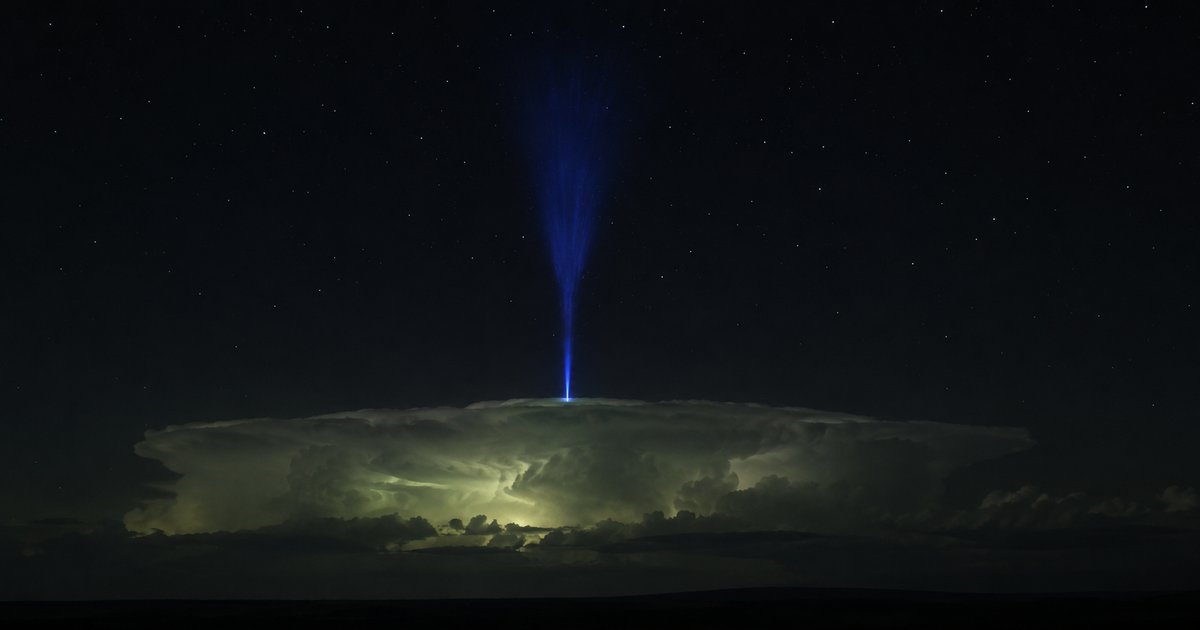
Blue jets, gigantic jets and elves are flashes that large thunderstorms produce above their clouds: blue jets and gigantic jets are discharges that climb out of the cloud top, and elves are rings of glow that spread through the upper atmosphere in less than a thousandth of a second. The National Severe Storms Laboratory calls such events rarely observed and not well understood, and none of the sources opened for this page reports a jet or an elve harming a person on the ground.
Blue jets, gigantic jets and elves differ in where they start and how high they reach
The National Severe Storms Laboratory (NSSL) puts blue jets, gigantic jets and elves under a heading it calls transient luminous events, the electrical phenomena that large thunderstorms produce high in the atmosphere. NSSL says these events are rarely observed visually and not well understood, and it lists red sprites, blue jets and elves as the most common. The three differ in how high they climb and in how they relate to the lightning that reaches the ground.
| Event | What it looks like | Reported height | Link to ground strikes |
|---|---|---|---|
| Blue jet | A narrow cone that fans out as it climbs from the cloud top (NSSL) | Fades at 25 to 35 miles (NSSL); 25 to 31 miles (40 to 50 km) in 1994 aircraft video (Wescott et al., 1995) | Not directly associated with cloud-to-ground lightning (NSSL) |
| Gigantic jet | A discharge that goes higher than a blue jet, to the ionosphere (NSSL) | Ionosphere at 56 miles (90 km), from a cloud at 10 miles (16 km) (Su et al., 2003) | No cloud-to-ground lightning seen triggering five events (Su et al., 2003) |
| Elve | A disk of glow up to 300 miles across that lasts less than a thousandth of a second (NSSL) | 47 to 65 miles (75 to 105 km), in the lower ionosphere (Fukunishi et al., 1996) | Above active cloud-to-ground lightning, just after a stroke begins (NSSL; Fukunishi et al., 1996) |
The mile figures are this article’s conversions of the kilometer figures in the papers. Sprites, which NSSL says usually happen at the same time as powerful positive cloud-to-ground strokes and are mostly red, are a separate group of events. A “bolt from the blue” is another thing again: NSSL defines it as a flash that starts inside a cloud, leaves the side of the storm and travels horizontally before it reaches the ground, and NSSL says even a storm 6 miles away can be dangerous for that reason. A blue jet goes up, and a bolt from the blue goes to the ground.
Blue jets are narrow cones of blue light that climb from a storm top into the stratosphere
NASA’s Earth Observatory, in an image story dated February 10, 2021, calls a blue jet basically a type of lightning that, unlike the lightning seen from the ground, shoots upward from the top of a thunderstorm toward the edge of space. It says a jet can reach the stratopause, about 31 miles (50 km) up, in less than a second. NSSL adds that blue jets last a fraction of a second and have been witnessed by pilots.
The first video of blue jets came from an aircraft. Wescott and colleagues reported in Geophysical Research Letters on May 15, 1995, that blue jets were recorded on black-and-white and color video cameras for the first time during the Sprites94 aircraft campaign in June and July 1994. The jets appeared to travel upward at about 62 miles per second (100 km/s) and to stop at 25 to 31 miles (40 to 50 km). Fifty-six were recorded in 22 minutes during one storm over Arkansas, and the authors wrote that they had no satisfactory theory of the phenomenon.
A 1998 follow-up in the Journal of Atmospheric and Solar-Terrestrial Physics examined a thunderstorm in which more than 50 jets were observed from aircraft on the night of July 1, 1994. Hail 2.8 inches (7 cm) across fell in the two storm cells where the jets clustered, according to its abstract. The jets were not coincident with either positive or negative cloud-to-ground strokes, though they occurred in the same general area as negative strokes and large hail. The authors noted that others’ theory points to a streamer as the mechanism but that discrepancies with the observations remained.
Gigantic jets are discharges that link a thundercloud to the ionosphere
NSSL describes gigantic jets as emerging from the thundercloud top like blue jets but going even higher, to the ionosphere. A Nature paper from March 2002 reported a video, taken at the Arecibo Observatory in Puerto Rico, of what its authors called a blue jet rising from a thundercloud to about 43 miles (70 km). Above 26 miles (42 km), the usual upper limit for blue jets, the flash showed features normally seen in sprites. Because the storm cell was relatively small, the authors speculated that such events may be common.
In Nature in June 2003, Su and colleagues reported five gigantic jets that established a direct link between a thundercloud at about 10 miles (16 km) and the ionosphere at 56 miles (90 km). They detected extremely-low-frequency radio waves in four of the events, and no cloud-to-ground lightning was observed to trigger any of them. The authors read those waves as coming from negative discharges between the cloud and the ionosphere, which would reduce the electrical potential between the ionosphere and the ground, and concluded that the conventional picture of Earth’s global electric circuit needed to include gigantic jets and possibly sprites.
NASA’s Scientific Visualization Studio, in a release dated April 1, 2026, says astronaut Nichole Ayers photographed a gigantic jet from the International Space Station on July 3, 2025. The release describes jets as a powerful type of electrical discharge that extends from the top of a thunderstorm into the upper atmosphere, and says photos from above the clouds help scientists understand how the jets form.
Elves are rings of glow that a lightning pulse lights up in the ionosphere
NSSL says elves result when an energetic electromagnetic pulse extends up into the ionosphere, and describes them as rapidly expanding disks of glow, up to 300 miles across, that last less than a thousandth of a second above areas of active cloud-to-ground lightning. NSSL dates their discovery to 1992, by a low-light video camera on the Space Shuttle. This article takes a Geophysical Research Letters paper from January 1992 to be that report, though its abstract does not use the word elves. Its authors described a transient glow at the height of the airglow layer, about 59 miles (95 km), in step with a flash in a tropical ocean storm below it, and said it was the only one of its kind in several thousand lightning images recorded with Space Shuttle cameras.
The name came from a ground campaign. Fukunishi and colleagues, writing in Geophysical Research Letters in August 1996, used a high-speed photometer and cameras at Yucca Ridge Field Station in Colorado during the Sprites’95 campaign, which ran from June 15 to August 6, 1995. They recorded diffuse flashes shorter than 1 millisecond and 62 to 186 miles (100 to 300 km) wide at 47 to 65 miles (75 to 105 km) up, just after cloud-to-ground strokes began and before sprites began. They called the flashes elves to tell them apart from red sprites, and tied them to heating of the lower ionosphere by lightning’s electromagnetic pulse.
NASA’s June 12, 2025, space station research summary gives the acronym, Emissions of Light and VLF Perturbations from EMP events, and says a study based on data from the European Space Agency’s ASIM instrument confirmed that lightning-like discharges at storm tops can create these rings.
A 2008 model treats jets as lightning that escapes through the top of a storm
Krehbiel and colleagues wrote in Nature Geoscience, published online March 23, 2008, that intracloud and cloud-to-ground lightning were reasonably well understood but the cause of upward discharges remained a mystery. Their models and observations pointed to two routes. Blue jets, in their account, come from electrical breakdown between the upper storm charge and the screening charge that gathers at the cloud top, and are predicted 5 to 10 seconds or less after a sudden charge imbalance in the storm. Gigantic jets begin as a normal discharge inside the cloud, between the dominant mid-level charge and an upper charge depleted of screening, and keep going out of the top. The authors concluded that upward discharges are analogous to cloud-to-ground lightning.
Neubert and colleagues added a measurement in Nature on January 20, 2021. NASA’s Earth Observatory says the data came from a thunderstorm near Nauru in the South Pacific in February 2019, recorded by ASIM on the International Space Station. The paper reports five intense blue flashes of about 10 microseconds each in one storm cell, and one flash started a pulsating blue jet that reached the stratopause. Elves accompanied the flashes. The authors read the faint red emission as a sign that the flashes and the jet are streamer ionization waves, and proposed that the microsecond flashes are the optical counterpart of negative narrow bipolar events, 10- to 30-microsecond pulses seen in radio recordings of storms.
Aircraft, ground cameras and the space station each recorded these events
NSSL says pilots reported lightning above storms for many years before researchers documented sprites and other transient events with sensitive video cameras. The European Space Agency (ESA), in a February 8, 2017, article, says the events are hard to study because they occur above thunderstorms, and that satellites had a poor viewing angle for jets and small blue discharges while the station’s lower orbit suits them.
NASA calls a color video shot from the station on September 8, 2015, first of its kind. ESA astronaut Andreas Mogensen filmed 160 seconds of an intense storm over the Bay of Bengal and captured 245 brief blue discharges in the top layer of a cloud, one of which rose into the stratosphere. Chanrion and colleagues reported in Geophysical Research Letters on January 9, 2017, that the many kilometer-scale discharges sat at the cloud-top layer near 11 miles (18 km) and that the pulsating blue discharge reached about 25 miles (40 km).
Few people have seen one. NASA’s Earth Observatory describes blue jets as witnessed by few human eyes, and NSSL says transient luminous events are rarely observed visually. NASA’s June 2025 summary says they occur well above the altitude of normal lightning and storm clouds, which makes them hard to observe from the ground. No source opened for this page gives a worldwide count of blue jets. NASA’s Earth Observatory says the researchers think blue flashes at storm tops might be common, and that scientists want to know how often these events occur and what conditions produce them.
What blue jets, gigantic jets and elves mean for people on the ground
NASA’s June 12, 2025, summary says transient luminous events can disrupt communication systems on the ground and threaten aircraft and spacecraft, and that understanding them could improve atmospheric models and weather predictions. Chanrion and colleagues wrote in 2017 that thunderstorm discharges directly perturb the chemistry of the stratosphere, with possible implications for Earth’s radiation balance. Su and colleagues raised the global electric circuit in 2003. Those are questions about the upper atmosphere, radio and flight.
None of the sources opened for this page says a blue jet, a gigantic jet or an elve has harmed a person on the ground, and as of November 2026 this article found none that does. The lightning that does reach people comes from the storm below. The National Weather Service says that if you hear thunder you are likely within striking distance of the storm, and that you should wait 30 minutes after the last lightning or thunder before going back outside.
Lightning Tracker is an iPhone app that shows recently detected strikes on a live map, with the distance and direction to the nearest one and how many minutes ago it was detected.
Not a substitute for official weather warnings.
If you hear thunder, seek shelter even if the app shows no nearby strike.
Sources
- NOAA National Severe Storms Laboratory, Severe Weather 101: Lightning Types
- NASA Earth Observatory, Bolts of Blue, February 10, 2021
- NASA, Studying Storms from Space Station, June 12, 2025
- NASA Scientific Visualization Studio, Gigantic Jet Seen from the ISS, April 1, 2026
- European Space Agency, Blue jets studied from Space Station, February 8, 2017
- Wescott et al., Preliminary results from the Sprites94 Aircraft Campaign: 2. Blue jets, Geophysical Research Letters, May 15, 1995 (abstract)
- Wescott et al., Blue Jets: their relationship to lightning and very large hailfall, and their physical mechanisms for their production, Journal of Atmospheric and Solar-Terrestrial Physics, May 1998 (abstract)
- Pasko et al., Electrical discharge from a thundercloud top to the lower ionosphere, Nature, March 2002 (abstract)
- Su et al., Gigantic jets between a thundercloud and the ionosphere, Nature, June 2003 (abstract)
- Boeck et al., Lightning induced brightening in the airglow layer, Geophysical Research Letters, January 1992 (abstract)
- Fukunishi et al., Elves: Lightning-induced transient luminous events in the lower ionosphere, Geophysical Research Letters, August 1996 (abstract)
- Chanrion et al., Profuse activity of blue electrical discharges at the tops of thunderstorms, Geophysical Research Letters, January 9, 2017 (abstract)
- Krehbiel et al., Upward electrical discharges from thunderstorms, Nature Geoscience, March 23, 2008 (abstract)
- Neubert et al., Observation of the onset of a blue jet into the stratosphere, Nature, January 20, 2021 (abstract)
- National Weather Service, Overview: Lightning Safety