 Lightning Tracker
App Store
Storm basics
Terrestrial gamma-ray flashes: gamma rays from thunderstorms
November 19, 2026 · 9 min read
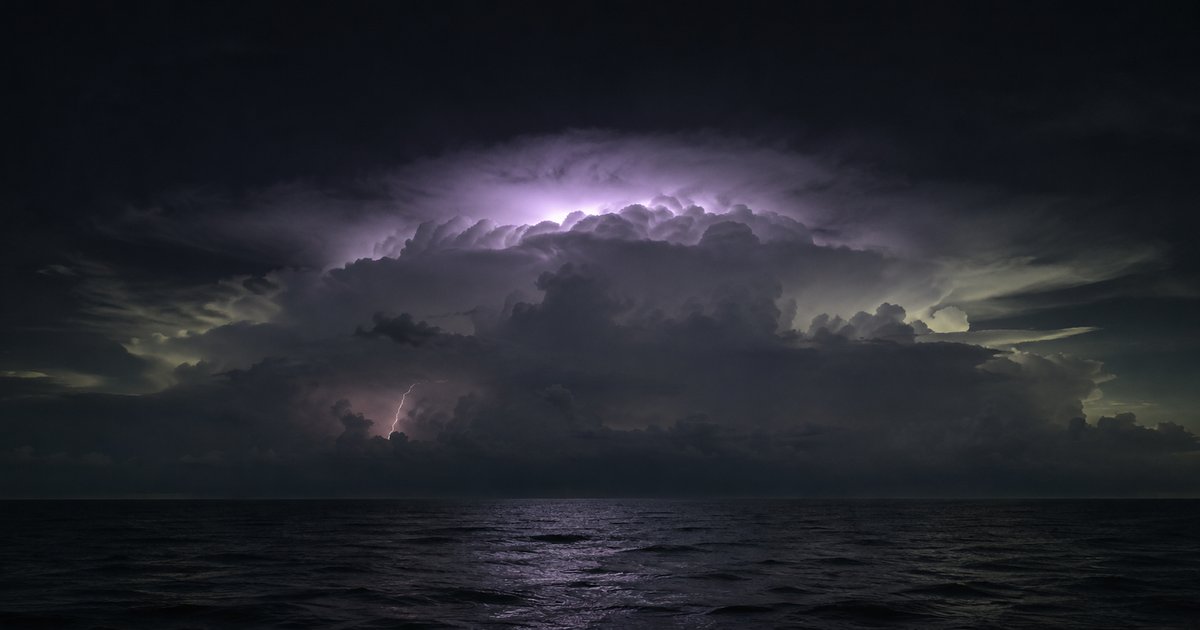
Terrestrial gamma-ray flashes are bursts of gamma rays, each shorter than a thousandth of a second, that active thunderstorms produce along with lightning. NASA’s Fermi team places their source well inside the thundercloud, and the only dose estimates in the sources opened for this page are modeled ones for aircraft in or near a storm’s high-field region.
A terrestrial gamma-ray flash is a sub-millisecond burst of gamma rays from a thunderstorm
NASA’s Fermi mission describes terrestrial gamma-ray flashes as intense sub-millisecond bursts of gamma rays, with energies in the millions of electronvolts (MeV), produced in active thunderstorm regions and linked in time to lightning events. A NASA science article from October 2, 2024, calls gamma rays the most energetic form of light and says thunderclouds can produce bursts of them lasting millionths of a second, as well as steady glows lasting seconds to minutes.
These flashes are not the cosmic gamma-ray bursts that astronomers study. Fermi’s mission page calls those bursts the most energetic explosions in the universe and says they originate in galaxies out to the edge of the visible universe. Fermi’s Gamma-ray Burst Monitor detects about 240 of the cosmic bursts a year, according to the same page, and it has detected terrestrial flashes too, which come from Earth’s own atmosphere.
How often the flashes occur is uncertain. Fermi’s terrestrial-flash page estimates about 500 per day worldwide, one for every thousand lightning events, says most go undetected, and adds that recent estimates are higher. That page was last updated on February 17, 2016, so the figure is a starting point, not a count.
Detectors built for astronomy recorded the first flashes in the early 1990s
Fishman and colleagues reported the discovery in the journal Science on May 27, 1994. Their abstract says detectors aboard NASA’s Compton Gamma Ray Observatory had seen brief, intense flashes of gamma rays, at least a dozen over the previous two years, and that the flashes had to start about 19 miles (30 kilometers) up to escape absorption by the atmosphere and reach the spacecraft. The authors called their most likely explanation, a rare high-altitude electrical discharge above thunderstorm regions, speculative. Physics World reported in April 2013 that the flashes were found by accident, by instruments designed to measure gamma rays from distant astrophysical sources.
Later work moved the source lower. Fermi’s page says radio imaging of a few events puts the source of the gamma rays at about 6 to 9 miles (10 to 15 kilometers) up, well within the thundercloud. Sources also differ on the year: Fermi’s page says the flashes were discovered in 1994, NASA’s 2024 article says 1992, and the paper that announced them appeared in 1994 and covers flashes seen over the two years before.
Strong electric fields in a thundercloud can start an avalanche of fast electrons
The Fermi team’s explanation starts with intense electric fields, above 100 kilovolts per meter, inside a thundercloud. Those fields can create an upward-moving runaway avalanche of electrons moving close to the speed of light, and when air molecules deflect the electrons they emit gamma rays. Some of the gamma rays knock more electrons loose, and others turn into an electron and positron pair; Fermi’s page says these particles can escape into space along Earth’s magnetic field lines. In December 2009, according to the page, Fermi’s Gamma-ray Burst Monitor detected a positron signature from a flash in southern Africa while the spacecraft flew over Egypt.
Many flashes coincide with a lightning event near the point beneath the satellite, which Fermi’s page reads as a sign that they are associated with lightning processes. A Science paper by Neubert and colleagues, published January 10, 2020, observed a flash from above with instruments on the International Space Station. High-speed photometry in optical, ultraviolet, x-ray and gamma-ray bands showed emission from an intracloud lightning leader, followed within a millisecond by the gamma-ray flash, and the authors concluded that the high electric fields within the leader produced it. The same lightning then made an electromagnetic pulse that lit an expanding ring of ultraviolet emission in the ionosphere, called an elve.
A ground-based observation points the same way. Wada and colleagues reported in Science Advances on May 23, 2025, a flash at television transmission towers in Kanazawa, Japan, that occurred as a downward negative leader collided with an upward positive leader from a tower. A cloud-to-ground discharge of −56 kiloamperes followed the flash by 30 microseconds, so the authors conclude that the flash started when the two leaders approached each other.
The mechanism is not settled. The Wada abstract says it is not yet understood how lightning produces so many relativistic electrons in dense air, and in 2013 physicist David Smith told Physics World that competing ideas for how the flashes are produced had not been ruled out. The introduction to a 2024 Nature paper adds that the flashes often show a close association with strong radio signals and optical pulses, and Dwyer, Liu and Rassoul wrote in Geophysical Research Letters in August 2013 that the discharges behind them produce some of the largest very-low- and low-frequency radio pulses from thunderstorms and were once misidentified as lightning.
Satellites, a space station, aircraft and ground towers have each recorded flashes
Terrestrial gamma-ray flashes have been recorded from spacecraft, a space station, a research aircraft and the ground.
| Platform | When | What the source says |
|---|---|---|
| Compton Gamma Ray Observatory | Reported May 1994 | At least a dozen flashes in two years (Fishman and colleagues, Science) |
| RHESSI, AGILE and Fermi | Fermi page, last updated February 17, 2016 | All three detected flashes; Fermi’s Gamma-ray Burst Monitor and Large Area Telescope both did |
| Fermi Gamma-ray Burst Monitor | First year of observation (Briggs and colleagues, 2010) | 12 intense flashes, typical maximum energies about 30 MeV, one photon at 38 MeV |
| ASIM on the space station | Launched April 2, 2018; mounted 11 days later | An x- and gamma-ray monitor (15 keV to 20 MeV), photometers and cameras, built within the European Space Agency framework |
| NASA ER-2 aircraft, ALOFT campaign | July 2023 | 10 flights from Tampa; the team saw 130 flashes, according to its principal investigator |
| Television towers, Kanazawa, Japan | Reported May 23, 2025 | A flash recorded from the ground as two lightning leaders approached |
The Atmosphere-Space Interactions Monitor, ASIM, is described in a 2019 paper in Space Science Reviews as the first space mission with a comprehensive suite of instruments designed to measure both terrestrial gamma-ray flashes and transient luminous events. A Birkeland Centre for Space Science page written before the 2018 launch says the instrument orbits about 250 miles (400 kilometers) up and that these gamma-ray emissions cannot be observed from the ground because of atmospheric absorption. It adds that the transient luminous events ASIM studies include red sprites, blue jets and elves, which are flashes above storms and not part of this topic.
NASA’s 2023 aircraft flights found a flash between the brief bursts and the long glows
NASA’s October 2, 2024, article says researchers using NASA airborne platforms found a new kind of gamma-ray emission, which they call a flickering gamma-ray flash, shorter than the steady glows and longer than the microsecond bursts. The University of Bergen in Norway led the study with NASA’s Marshall and Goddard centers, the U.S. Naval Research Laboratory and other universities, and the findings appeared in a pair of Nature papers published October 2, 2024. In July 2023 the ER-2 research aircraft flew 10 times from MacDill Air Force Base in Tampa, Florida, in figure-eight patterns a few miles above tropical thunderclouds in the Caribbean and Central America, carrying radars and sensors for gamma rays, lightning and microwave emissions.
The team had hoped for terrestrial gamma-ray flashes and, in the words of its principal investigator Nikolai Østgaard, saw 130. The new flashes were a surprise: NASA reports more than 25 of them, and co-investigator Martino Marisaldi said they are almost impossible to detect from space but visible from 12.5 miles (20 kilometers) up.
| Kind | Duration | What the abstract says |
|---|---|---|
| Gamma-ray glow | One to hundreds of seconds | Moderate intensity, from quasi-stationary thundercloud fields |
| Terrestrial gamma-ray flash | Tens to hundreds of microseconds | High intensity, often closely tied to strong radio signals and optical pulses |
| Flickering gamma-ray flash | 20 to 250 milliseconds | More pulses than an ordinary flash, each longer; radio and optically silent; starts as a glow, then rises exponentially |
The authors suggest that the flickering flashes could be the missing link between glows and the brief flashes, a gap that had puzzled researchers for two decades. The second paper, by Marisaldi and colleagues, reports that tropical thunderclouds over ocean and coastal regions commonly emit gamma rays for hours over areas up to a few thousand square kilometers (1,000 square kilometers is about 386 square miles), with timescales of 1 to 10 seconds and shorter, and compares the pattern to a “boiling pot.” NASA quotes Joseph Dwyer, who was not part of the study, saying the discovery could be among the most important thundercloud findings in a decade or more.
“Dark lightning” names lightning-like discharges that give off little visible light
The term comes from the same research. Dwyer, Liu and Rassoul calculated in 2013 that the lightning-like events responsible for terrestrial gamma-ray flashes emit relatively little visible light and so are inherently dark. The abstract adds that discharges caused by runaway electrons can carry currents that rival lightning and so could serve as an alternative discharge path for thunderclouds. Physics World, on April 17, 2013, described the Florida Tech work as a model of “dark lightning,” a discharge that is silent and invisible to the eye.
The name describes a model, not every flash. In the same Physics World report, David Smith said that in competing models the flash is never “dark,” because it requires an ordinary lightning flash that follows it closely. The 2020 space-station observation recorded optical and ultraviolet emission around a flash, and the 2024 Nature abstract says the brief flashes often come with optical pulses, while the flickering flashes are radio and optically silent. That abstract does not use the term dark lightning.
Dose estimates exist for aircraft inside or beside a storm, and the sources give none for the ground
Dwyer and colleagues estimated in the Journal of Geophysical Research in May 2010 that the fluence of high-energy electrons near a thundercloud’s high-field region can reach biologically significant levels at aircraft altitudes. If an aircraft were in or near that region during a lightning discharge or a gamma-ray flash, they wrote, the dose to passengers and crew could potentially approach 0.1 sievert (10 rem) in less than a millisecond. They noted that commercial aircraft are struck by lightning, on average, one to two times per year, and said the risk of such doses should be investigated further. The figure is a model estimate, not a dose measured on a flight.
Physics World reported in 2013 that the Florida Tech model put the dose near the top of a storm at about 10 chest X-rays, which the magazine equates to a year of natural background radiation, and nearer the center about 10 times larger, roughly a full-body CT scan. Dwyer told the magazine that a person would have to be inside the thunderstorm, in the worst part, at precisely the wrong time, and the magazine adds that pilots already do their utmost to avoid thunderstorms.
None of the sources opened for this page gives an exposure estimate for people on the ground, so this page offers none. The Birkeland Centre page says atmospheric absorption keeps these emissions from being observed from the ground, and the Kanazawa observation was made at a tower where two leaders met. NASA’s 2024 article says the new findings could lead to more accurate lightning risk estimates for people, aircraft and spacecraft. The National Weather Service’s guidance for any thunderstorm is unchanged by gamma rays: if you hear thunder, you are likely within striking distance of the storm, and you should wait 30 minutes after the last lightning or thunder before going back outside. Lightning Tracker, an iPhone app, shows recently detected strikes on a live map, with the distance and direction to the nearest one.
Not a substitute for official weather warnings.
If you hear thunder, seek shelter even if the app shows no nearby strike.
Sources
- NASA Fermi Gamma-ray Space Telescope, Spotting Terrestrial Gamma-Ray Flashes (page last updated February 17, 2016)
- NASA Fermi Gamma-ray Space Telescope, Investigating Gamma-Ray Bursts
- NASA Science, Via NASA Plane, Scientists Find New Gamma-ray Emission in Storm Clouds, October 2, 2024
- Østgaard et al., Flickering gamma-ray flashes, the missing link between gamma glows and TGFs, Nature, October 2, 2024
- Marisaldi et al., Highly dynamic gamma-ray emissions are common in tropical thunderclouds, Nature, October 2, 2024
- Fishman et al., Discovery of Intense Gamma-Ray Flashes of Atmospheric Origin, Science, May 27, 1994 (abstract)
- Briggs et al., First results on terrestrial gamma ray flashes from the Fermi Gamma-ray Burst Monitor, Journal of Geophysical Research: Space Physics, July 2010 (abstract)
- Neubert et al., A terrestrial gamma-ray flash and ionospheric ultraviolet emissions powered by lightning, Science, January 10, 2020 (abstract)
- Wada et al., Downward terrestrial gamma-ray flash associated with collision of lightning leaders, Science Advances, May 23, 2025 (abstract)
- Dwyer et al., Estimation of the fluence of high-energy electron bursts produced by thunderclouds and the resulting radiation doses received in aircraft, Journal of Geophysical Research: Atmospheres, May 2010 (abstract)
- Dwyer, Liu and Rassoul, Properties of the thundercloud discharges responsible for terrestrial gamma-ray flashes, Geophysical Research Letters, August 2013 (abstract)
- Physics World, Dark lightning sheds light on gamma-ray mystery, April 17, 2013
- Neubert et al., The ASIM Mission on the International Space Station, Space Science Reviews, March 2019
- Birkeland Centre for Space Science, University of Bergen, Atmosphere-Space Interactions Monitor (ASIM)
- National Weather Service, Overview: Lightning Safety