 Lightning Tracker
App Store
Storm basics
Could lightning have helped start life on Earth?
November 18, 2026 · 4 min read
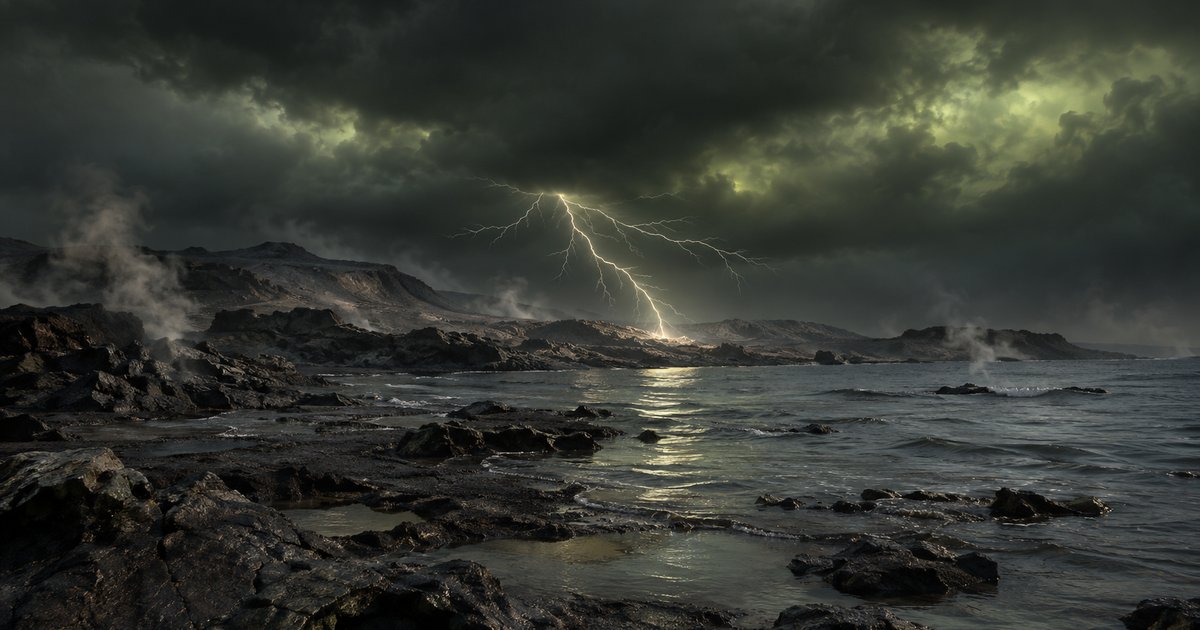
Lightning could have helped supply life’s chemical ingredients, but no experiment shows that it created life. A 2021 Nature Communications study estimated that early-Earth strikes might have made about 22 to 2,200 pounds (10 to 1,000 kilograms) of phosphide each year under its modeled conditions; the actual ancient supply is unknown.
Experiments show chemistry, not the birth of an organism
The University of Chicago’s origin-of-life explainer, reviewed in November 2025, says Stanley Miller’s 1952 experiment sent electrical sparks through an enclosed container of ammonia, methane and water vapor. Amino acids formed. The sparks simulated lightning, but the apparatus made molecules used by proteins, not a living cell. The university also says researchers now think the early atmosphere differed from the particular gas recipe Miller used. His result demonstrated a possible route from simple materials to organic compounds under those laboratory conditions.
A 2005 National Academies Press book on life’s origin describes many later variations with different gases, ultraviolet light and minerals. Those studies made basic building blocks, but the book points out another difficulty: high-energy lightning can break large molecules apart. Making small reactive pieces and assembling a stable system capable of reproduction are different steps. The electrical sparks made in laboratories are tools for testing chemistry, not replicas of a known first storm.
A lightning-made rock supplied a second clue
A 2021 Nature Communications paper by Benjamin Hess and colleagues studied a fulgurite, a rock melted by a ground strike. The team found schreibersite, an iron phosphide also known from some meteorites. Phosphorus matters to nucleic acids and other biomolecules, yet much phosphorus in ordinary rock is less accessible to prebiotic reactions. A strike that melts suitable phosphorus-bearing material can change its chemical form. The study’s measured fulgurite establishes that this change happens; it does not establish that the product entered a pathway to life.
Hess and colleagues then modeled ancient conditions. Their 2021 paper estimates that early-Earth strikes could have formed about 22 to 2,200 pounds (10 to 1,000 kilograms) of phosphide and about 220 to 22,000 pounds (100 to 10,000 kilograms) of phosphite and hypophosphite each year. Those are ranges from assumptions about exposed land, strike rates, fulgurite size and rock chemistry. They are not measurements of annual lightning on the ancient planet. The paper says its estimates depend on a substantial exposed landmass and a reactive water system; the amount of ancient land remains a key uncertainty.
The proposed route is local: a strike melts rock, reduced phosphorus forms in the glass, and water can carry useful compounds into nearby settings where other molecules may concentrate. Not every type of lightning discharge reaches ground, and not every struck material has the mix of phosphorus, iron and carbon needed for the same products. The 2021 authors identify carbon as a limiting ingredient for schreibersite in the fulgurites they discuss. A global supply estimate therefore cannot tell us that one specific pond had the right chemistry.
Newer experiments test carbon and nitrogen too
A 2024 Proceedings of the National Academy of Sciences experiment by Haihui Joy Jiang and colleagues placed an electrical discharge between gas and liquid to imitate a strike crossing an air-water boundary. Its abstract reports conversion of carbon dioxide into carbon monoxide and formic acid, and nitrogen into nitrate, nitrite and ammonium. The experiment tests a different route from Miller’s gas-only vessel and from the phosphorus-changing rock strike.
The 2024 authors report that interfaces involving air, water and ground increased yields compared with gas-phase-only reactions in their setup. They propose that cloud-to-ground lightning could have created high local concentrations of reactive molecules. “Could” is essential: the laboratory controls its gases, minerals and discharge, while ancient Earth’s exact combinations are not directly observed.
Other energy sources keep the origin open
NASA Goddard’s June 2023 research note says scientists have long considered lightning as energy for a “warm little pond” scenario, but questions whether early-Earth clouds produced enough lightning under a dimmer young Sun. The note describes research suggesting energetic particles from the young Sun could have produced prebiotic precursors more readily. Its comparison is a proposal, not a verdict that lightning played no part. The University of Chicago’s November 2025 explainer also mentions hydrothermal vents and life seeded by comets or meteorites as other possibilities.
The 2021 phosphorus paper compares lightning with meteorites because meteorites can also supply reduced phosphorus. A strike could keep producing it on land as impact deliveries waned, if the modeled conditions existed. That possibility widens the candidate supply routes. It does not distinguish which route supplied the particular molecules that eventually became the first living system. Similarly, the energy in a lightning flash is only one part of the question: chemistry also needs suitable materials, a setting where products persist, and subsequent reactions.
The University of Chicago’s explainer describes all proposed answers to life’s origin as unverified.
For a storm near you, Lightning Tracker, an iPhone app, shows recently detected strikes on a live map and the distance to the nearest one.
Not a substitute for official weather warnings.
If you hear thunder, seek shelter even if the app shows no nearby strike.
Sources
- Nature Communications, Lightning strikes as a major facilitator of prebiotic phosphorus reduction on early Earth
- Proceedings of the National Academy of Sciences, Mimicking lightning-induced electrochemistry on the early Earth
- University of Chicago, The origin of life on Earth, explained
- Harvard Gazette, How did life begin on Earth? Research zeroes in on lightning strikes
- NASA Goddard, A Stormy, Active Sun May Have Sparked Life on Earth
- National Academies Press, Stanley Miller’s Spark of Genius