 Lightning Tracker
App Store
Storm basics
Why do volcanoes make lightning?
November 16, 2026 · 7 min read
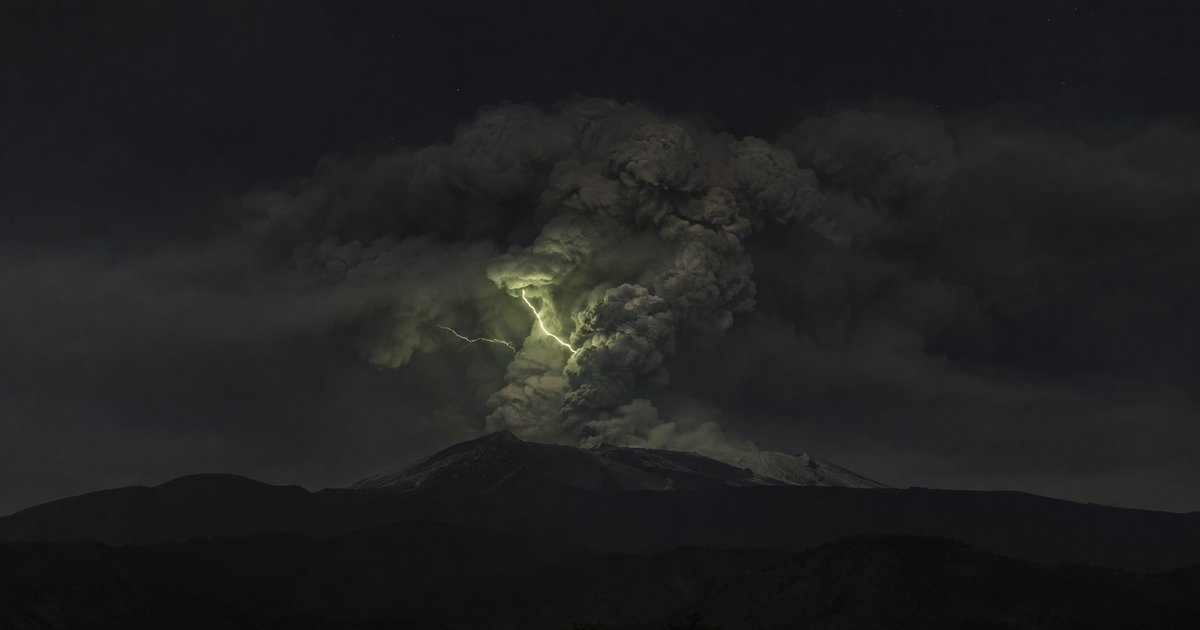
Volcanic lightning comes from electric charge built up by shattering magma and colliding ash near the vent and, higher in the plume, by ice, so it works partly like thunderstorm lightning and partly in ways a storm does not. Observatories treat the flashes as a signal: together with seismic data, lightning sensors can show that an eruption has put ash into the air when clouds or darkness hide the volcano.
Volcanic lightning has been reported at a minority of eruptions, more often at large ones
Researchers have documented volcanic lightning at a minority of eruptions. Stephen McNutt and Earle Williams assembled a global database for a 2010 paper in the Bulletin of Volcanology and report lightning at 80 volcanoes in association with 212 eruptions. For the 177 eruptions with a known Volcanic Explosivity Index (VEI), lightning was reported in 8% of those rated 3 to 5, in 10% of those rated 6 and in under 2% of those rated 1 to 2. The authors read this as consistent reporting for larger eruptions and either less lightning or under-reporting for small ones, so the shares describe what was reported, not a measured rate. They also note that reporting varied substantially from year to year.
The National Severe Storms Laboratory (NSSL) lists volcanic eruptions among the places lightning is seen, beside extremely intense forest fires (pyrocumulonimbus clouds), surface nuclear detonations, heavy snowstorms, large hurricanes and thunderstorms.
An ash plume can charge near the vent and again higher in the column
Researchers describe charging that starts at the vent and charging that needs ice higher up. A 2020 paper in Scientific Reports on the June 3, 2018 Fuego eruption in Guatemala summarizes both. In fractoemission, magma thrown from the vent shatters, and the brittle fragmentation creates ionized pieces of the earlier particles in the near-vent region. In triboelectrification, ash particles collide in the rising plume and trade charge. Higher up, in what the paper calls the mixed-phase region, supercooled liquid water freezes onto ash grains, and rebounding collisions between the growing ice particles can move charge through the non-inductive process, the same one NSSL describes for storms.
The heights of observed plumes point to the same split. In the McNutt and Williams database, 142 plume heights show a bimodal distribution with main peaks at about 4 to 7 miles (7 to 12 km) and 0.6 to 2.5 miles (1 to 4 km). The authors say the taller peak is similar to the heights of typical thunderstorms and suggests that water in its various forms is involved, while the lower peak suggests other factors closer to the vent.
Two field studies show each zone at work. A 2016 paper in Geophysical Research Letters on the April 22 to 23, 2015 Calbuco eruption in Chile concluded that electrical activity was enhanced both by ice formation in ash clouds more than 10 km (about 6 miles) above sea level and by a low-level charge layer from ground-hugging currents. A 2021 paper in the same journal followed 97 plumes lower than 3 km (1.9 miles) at Sakurajima volcano in Japan from June 1 to 7, 2015. It found that impulsive, fast plumes (above 55 meters per second, about 123 mph) were most likely to make vent discharges, the smallest electrical events, whereas full lightning flashes came from plumes with high volume flux. The authors conclude that plume dynamics govern the charging for lightning and the source explosion controls vent discharges.
These are explanations researchers propose and test, not a settled account. NSSL says the same about thunderstorms, where the exact physical mechanisms are not completely understood.
Volcanic lightning comes in three sizes, from vent sparks to plume flashes
The U.S. Geological Survey (USGS) Professional Paper 1769, published in 2010, sorted the lightning of the 2006 Augustine eruption in Alaska into three types. Thomas and colleagues also found two phases of activity: an explosive phase and a plume phase. Their classification comes from one eruption, and the Sakurajima result above shows that vent discharges and flashes can occur separately.
| Type | Size and duration | What the authors report |
|---|---|---|
| Vent discharges | Sparks of 10 to 100 m (33 to 330 ft) | Up to 10,000 per second at the mouth of the volcano during energetic explosions; seen six times |
| Near-vent lightning | 1 to 7 km (0.6 to 4.3 miles) long, 0.01 to 0.1 second | Develops upward from the cone into the developing column; its behavior indicates an overall positive charge in the ejecta |
| Plume lightning | More than 10 km (6 miles) long, more than 0.5 second | Often branched; resembled intracloud thunderstorm lightning |
Volcanic lightning differs from thunderstorm lightning in what charges the cloud
A thunderstorm charges through ice. NSSL says clouds become electrified when strong updrafts produce a mixture of graupel (larger ice particles), small ice crystals and supercooled liquid drops below freezing, and rebounding collisions between graupel and crystals transfer charge between them. Fractoemission and ash-to-ash collisions, two of the processes in the Fuego paper, involve rock and ash instead of ice.
Volcanic flashes can resemble storm flashes in some respects and differ in others. Plume lightning in the Augustine data resembled intracloud thunderstorm lightning, which NSSL says can stay completely within the cloud. Yet at Fuego the median length of flashes in the plume, measured from space by the Geostationary Lightning Mapper (GLM), was 12 km (7.5 miles), against 20 km (12 miles) for flashes in the surrounding thunderstorms on June 3, 2018. All 18 cloud-to-ground flashes were negative, which the authors say supports net negative charge within the plume. At Redoubt in 1990, Hoblitt found that early flashes in individual eruptions tended to be negative and late flashes positive, perhaps because coarse, fast-settling particles carried negative charge and fine, slow-settling ones positive. Read together, the sources point to no single polarity rule for volcanic lightning.
The extreme case is the January 15, 2022 Hunga eruption in Tonga. USGS reported on June 20, 2023 that it produced the most intense lightning ever recorded, from just over 192,000 flashes, which volcanologist Alexa Van Eaton tied to magma blasting through shallow ocean, vaporizing seawater that formed electrifying collisions between ash, supercooled water and hailstones. The researchers combined sensors that measure light and radio waves.
Observatories use volcanic lightning to confirm that ash is in the air
The case for monitoring by lightning began at Redoubt Volcano in Alaska. Hoblitt reported in 1994 that a commercial lightning-detection system temporarily deployed near Cook Inlet became operational on February 14, 1990, and detected lightning in 11 and located it in 9 of the 13 eruptions that followed. The flashes came from ash clouds rising from pyroclastic density currents after a lava dome collapsed. Hoblitt concluded that lightning detection is a useful adjunct to seismic monitoring, particularly when poor weather or darkness prevents visual observation. Lightning together with seismicity gives virtual certainty, he wrote, that an ash cloud is present, which matters for aircraft safety and for warning threatened communities. The paper adds that the Alaska Volcano Observatory (AVO) had by then deployed a permanent lightning-detection network around Cook Inlet.
During the 2009 Redoubt eruption, Sonja Behnke and McNutt compared three kinds of lightning detection instruments in a 2014 paper. Very low frequency instruments detect lightning at long ranges but tend to have low sensitivity, low and medium frequency instruments are more sensitive but work only at a regional scale, and very high frequency mapping instruments also cover a region but detect all lightning within range. All three picked up lightning from Redoubt’s plume. The very high frequency system detected lightning before the other two in every explosive event and recorded one or two orders of magnitude more. The authors conclude that lightning observations could confirm and, in some cases, detect explosive activity, and that the rapid response is valuable for identifying potentially hazardous ash clouds.
Lightning can also track change during an eruption. The Calbuco paper reported that volcanic lightning may be used with satellite detection to recognize and quantify changes in eruption style and intensity. That matters because the inputs to ash-dispersal forecasts are hard to pin down while an eruption evolves. In the Fuego study, the first of two periods of lightning coincided with rapid growth of the ash cloud and the second came near the time of a deadly pyroclastic density current and a thunderstorm.
AVO’s About page lists lightning data among its monitoring tools. Its July 17, 2026 weekly update says Mount Kupreanof, which has no real-time geophysical monitoring network, is also monitored by satellite data, regional infrasound and lightning networks, and visual observations from pilots and mariners.
Lightning data are one clue among several, with limits
Lightning is an adjunct, not a stand-alone alarm. Hoblitt called it an adjunct to seismic monitoring, and AVO lists it beside seismicity, infrasound, ground deformation, satellite imagery, gas emissions and webcams. Detection is not complete either: the Redoubt system located 9 of 13 eruptions, the 2020 Fuego study found that 91% of that event’s lightning was seen by only one of its lightning sensors, and McNutt and Williams say lightning at small eruptions may be under-reported. A flash near a volcano is also not proof of an eruption, because the Fuego authors discuss how the ash plume, a thunderstorm and the pyroclastic current may have interacted in the second period.
The sources do not measure the risk volcanic lightning poses to people on the ground. McNutt and Williams say lightning at volcanoes is a hazard in its own right. The Redoubt, Calbuco and Hunga sources frame the hazard they monitor as ash that can reach aircraft and communities downwind.
Volcano warnings come from observatories, not from a lightning map
AVO says its monitoring helps it provide timely warnings of volcanic activity. Lightning Tracker, an iPhone app that shows recently detected strikes on a live map, does not replace official warnings or local procedures.
Not a substitute for official weather warnings.
If you hear thunder, seek shelter even if the app shows no nearby strike.
Sources
- Stephen R. McNutt and Earle R. Williams, Volcanic lightning: global observations and constraints on source mechanisms, Bulletin of Volcanology, 2010
- Schultz et al., Observations of lightning in relation to transitions in volcanic activity during the 3 June 2018 Fuego Eruption, Scientific Reports, October 2020
- Van Eaton et al., Volcanic lightning and plume behavior reveal evolving hazards during the April 2015 eruption of Calbuco volcano, Chile, Geophysical Research Letters, April 2016
- Smith et al., Impulsive volcanic plumes generate volcanic lightning and vent discharges: A statistical analysis of Sakurajima volcano in 2015, Geophysical Research Letters, May 2021
- Thomas et al., U.S. Geological Survey, Lightning and electrical activity during the 2006 eruption of Augustine Volcano, Professional Paper 1769, 2010
- Robert P. Hoblitt, U.S. Geological Survey, An experiment to detect and locate lightning associated with eruptions of Redoubt Volcano, Journal of Volcanology and Geothermal Research, 1994
- Sonja A. Behnke and Stephen R. McNutt, Using lightning observations as a volcanic eruption monitoring tool, Bulletin of Volcanology, 2014
- U.S. Geological Survey, Tonga’s Hunga eruption produced the most intense lightning ever recorded, June 20, 2023
- NOAA National Severe Storms Laboratory, Severe Weather 101: Lightning FAQ
- Alaska Volcano Observatory, About AVO
- Alaska Volcano Observatory, Weekly Update, July 17, 2026