 Lightning Tracker
App Store
Storm basics
Hunga Tonga’s lightning: what the eruption revealed
November 11, 2026 · 7 min read
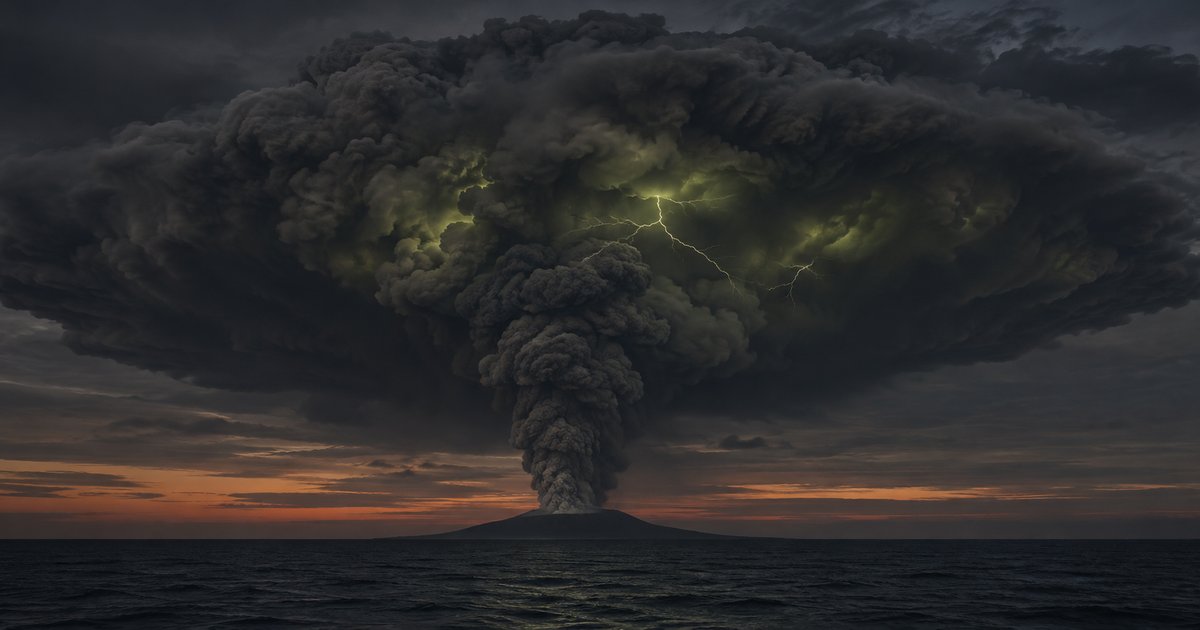
The January 15, 2022 eruption of Hunga volcano in Tonga produced the most intense lightning ever recorded, according to a 2023 study led by the U.S. Geological Survey: just over 192,000 flashes, at a peak of 2,615 flashes per minute. Ground radio networks and a weather satellite detected the storm from far away, and the flashes showed that the eruption lasted at least 11 hours.
The Hunga eruption of January 15, 2022 produced the most intense lightning ever recorded
The U.S. Geological Survey announced on June 20, 2023 that the January 15, 2022 eruption of Hunga volcano in Tonga had created a “supercharged” thunderstorm inside its plume. The announcement rests on a study led by USGS volcanologist Alexa Van Eaton and published in Geophysical Research Letters. USGS reports just over 192,000 flashes, made up of nearly 500,000 electrical pulses, with a peak of 2,615 flashes per minute. In the paper the peak falls at 04:53 UTC on January 15, and the authors call it the most intense electrical storm ever detected by global networks. The next most lightning-rich case in their comparison peaked at 993 flashes per minute.
The plume behind the storm was enormous. USGS describes a plume of ash, water and magmatic gas at least 36 miles (58 km) high, and the paper puts the maximum overshoot of the plume top at 58 km. The paper’s abstract calls the eruption the most violent of the modern satellite era.
The record is about how many flashes occurred per minute, not how far one flash reached. The World Meteorological Organization’s record for the longest single flash is 515 miles (829 km, give or take 5 miles), measured over the U.S. Great Plains in 2017.
Four data sets counted different things, so the published numbers differ
The Geophysical Research Letters paper draws on four lightning data sets: the Geostationary Lightning Mapper (GLM) on the GOES-17 satellite, and three ground-based networks, Vaisala’s Global Lightning Dataset (GLD360), the Earth Networks Total Lightning Network and the World Wide Lightning Location Network. The paper says GLM records the timing, location, area and optical brightness of lightning, while the ground networks detect the radio waves from pulses, the intermittent bursts of current inside a flash. The authors merged the radio pulses and grouped them into flashes. They kept GLM flashes within 155 miles (250 km) of the volcano, radio data within 186 miles (300 km), and all data between 00:00 and 15:12 UTC on January 15.
| Source | What it counted | Result |
|---|---|---|
| USGS summary of Van Eaton et al., 2023 | Flashes and electrical pulses, from light and radio sensors combined | Just over 192,000 flashes from nearly 500,000 pulses; peak of 2,615 flashes per minute |
| Jarvis et al., Bulletin of Volcanology, 2024 | “Strikes” recorded by GLD360 alone | Over 300,000 in a two-hour period |
| NOAA satellite service, January 26, 2022 | Flashes imaged by GLM on GOES-West | “Thousands” of flashes |
| Van Eaton et al., 2023, GLM detail | Optical flashes seen by GLM early in the eruption | 22 flashes from 04:14 to 04:25 UTC, then no optical detections until 08:32 UTC |
The unit matters, as lightning by the numbers shows for U.S. totals. A flash can contain several pulses, which is why nearly 500,000 pulses make about 192,000 flashes in USGS’s summary. The 2024 abstract counts GLD360 “strikes,” a third unit; it does not say how a strike relates to a flash. The time windows differ too, and no single figure from these sources can be read against another without checking what was counted.
Each system also had blind spots. The paper reports that the unusually high flash rates saturated the GLD360 sensors from 04:30 to 06:00 UTC. The system then favored higher-current lightning and lost many low-current pulses, which shows up as an apparent dip in flash rates within 12 miles (20 km) of the volcano. GLM went quiet as the plume rose above about 19 miles (30 km), a gap discussed below. Detection networks miss some strikes, especially weak ones, and Lightning Tracker, an iPhone app that shows detected strikes on a live map, labels delayed or missing data instead of treating it as quiet.
Ash, seawater and ice collisions charged the Hunga plume
The Hunga plume became electrified through collisions of particles, according to USGS. Van Eaton told USGS that the eruption happened to blast through shallow ocean, so molten rock vaporized seawater that rose into the plume and eventually formed electrifying collisions between volcanic ash, supercooled water and hailstones.
The paper separates two ways a volcanic plume can charge. In silicate charging, ash particles break up and collide. In ice charging, which the authors compare to ordinary thunderstorm electrification, strong updrafts carry liquid and frozen particles through a region where they coexist, and collisions there charge the plume much as ice collisions separate charge in a thunderstorm. The paper says ice charging is more likely in large plumes made where magma meets water, because the extra water raises the concentration of liquid and frozen particles. Hunga’s vent was under the sea, and the authors cite estimates that the eruption carried 50 to 150 teragrams of water vapor, or 50 to 150 million metric tons, into the stratosphere.
Water was not the only factor. The paper notes that volcanic flash rates scale with eruptive intensity, with taller plumes and broader umbrella clouds producing more flashes. Its authors calculate a mass eruption rate of at least 5 billion kilograms per second (roughly 11 billion pounds) between 04:15 and 04:57 UTC, and reason that the turbulence from such a flow increased collisions between particles and so the charge they generated.
Hunga’s lightning formed expanding rings, and flashes were detected 12 to 19 miles up
Concentric rings of lightning, centered on the volcano and expanding and contracting over time, puzzled the study’s authors. Van Eaton told USGS that nothing comparable exists in ordinary storms, where single rings have been seen but not multiple ones, and they are tiny by comparison. The paper puts the largest ring at about 87 miles (140 km) in radius, against about 6 miles (10 km) in severe storms. It counts at least four rings between 04:16 and 05:51 UTC and a final one between 08:38 and 08:48 UTC. The first and largest ring matched the leading edge of a gravity wave, a ripple in the stratospheric umbrella cloud that moved outward faster than 80 meters per second (about 180 mph).
The 2024 paper by Jarvis and colleagues used Himawari-8 satellite images with GLD360 data. It reports a ring of lightning about 31 miles (50 km) in radius that appeared about 20 minutes after the eruption began, grew with the front of the umbrella cloud to about 93 miles (150 km), then shrank back to about 31 miles. The authors attribute the ring to more frequent particle collisions caused by swirling motion in the head of the umbrella cloud. Both papers tie the rings to the moving edge of the cloud, and they differ in the mechanism they propose. The 2023 authors add that they have no satisfactory explanation for why lightning began refilling the empty center of the first ring two minutes after the wave passed.
The altitude of the flashes is the other open question. The paper reports optically bright lightning detected by GLM at 12 to 19 miles (20 to 30 km) above sea level, and says earlier studies had found lightning starting only up to about 11 miles (18 km) in overshooting cloud tops. The authors state that the height estimates carry large uncertainties, and that flashes this high would need an unconventional process, because higher in the atmosphere it is harder to form the hot plasma channels that characterize lightning. They also say some or all of the rings may be narrow bipolar events, bursts of cold plasma that give off mainly blue light that GLM cannot detect. That could explain why GLM saw nothing at the peak.
Lightning data showed the Hunga eruption lasted at least 11 hours
The lightning record gave scientists a timeline of an eruption that satellites could not fully see. USGS says the plume hid the vent from satellite view, which made changes harder to follow, and quotes Van Eaton saying the eruption lasted much longer than the hour or two first observed: plumes formed for at least 11 hours on January 15, a fact she said emerged only from the lightning data. The researchers identified four phases of activity from plume height and lightning rate.
The paper dates those phases in UTC. A plume was visible in satellite images by 02:57 and ground networks detected the first lightning at about 04:09. The most intense stage ran from 04:00 to 07:11, and renewed activity began at 07:46. The authors add that rates of lightning within 12 miles (20 km) of the volcano tracked the timing and intensity of the plume when an upper-level cloud hid the region for several hours, mainly between about 10:00 and 15:00. USGS says linking lightning to eruptive activity can improve monitoring and short-range forecasting of hazards to aircraft, such as ash cloud development and movement.
Lightning also left a mark on the ash. A 2026 paper in the Journal of Geophysical Research: Atmospheres by Kimberly Genareau and colleagues describes Hunga as producing the most lightning ever documented during an explosive eruption to date. The authors conclude that physical evidence of lightning in the ash may be limited, but that ash particles are still affected by the electromagnetic fields of the discharge. They calculate that just over a third (34.9%) of the airfall mass was exposed to magnetic flux densities above Earth’s ambient surface values. The fifth anniversary of the eruption falls on January 15, 2027. As of November 2026, the 2023 authors’ own expectation is that the eruption chronology will change as observations near the vent, geological deposits and eyewitness reports come to light.
Not a substitute for official weather warnings.
If you hear thunder, seek shelter even if the app shows no nearby strike.
Sources
- U.S. Geological Survey, Tonga’s Hunga eruption produced the most intense lightning ever recorded, June 20, 2023
- Van Eaton et al., Lightning rings and gravity waves: Insights into the giant eruption plume from Tonga’s Hunga Volcano on 15 January 2022, Geophysical Research Letters, June 2023
- Jarvis et al., Volcanic lightning reveals umbrella cloud dynamics of the 15 January 2022 Hunga volcano eruption, Tonga, Bulletin of Volcanology, 2024
- Genareau et al., Volcanic ash affected by lightning during the Hunga 2022 eruption, Journal of Geophysical Research: Atmospheres, 2026
- NOAA NESDIS, The Hunga Tonga-Hunga Ha’apai eruption: a multi-hazard event, January 26, 2022
- World Meteorological Organization, WMO certifies megaflash lightning record in USA, July 2025