 Lightning Tracker
App Store
Storm basics
Is lightning plasma? What the glowing channel is made of
November 19, 2026 · 7 min read
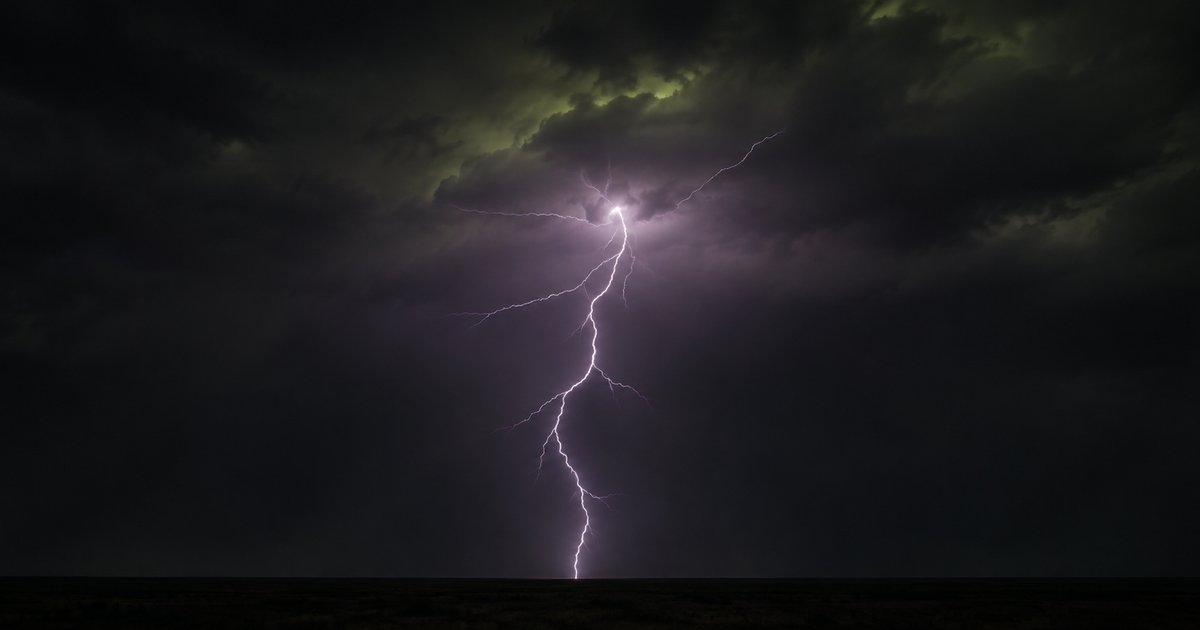
Yes: the channel of a lightning flash is plasma, air briefly broken into ions and free electrons that can carry current. The flash itself is a giant electrical discharge; electricity is the current and plasma is the state of the air it flows through, so the two words do not compete.
Lightning is an electrical discharge that turns the air in its path into plasma
The NOAA National Severe Storms Laboratory (NSSL) calls lightning a giant spark of electricity in the atmosphere between clouds, the air or the ground. Its lightning FAQ explains that air insulates the charges in a cloud until they build up enough for that insulation to break down, and that the breakdown creates ions and free electrons that travel down the conducting channel. Plasma physicists have a name for a gas in that condition. The Princeton Plasma Physics Laboratory, a U.S. Department of Energy lab, lists lightning first among its examples of plasmas and calls it one of the few naturally occurring plasmas found on Earth. A peer-reviewed paper from 2019 in the Journal of Geophysical Research: Atmospheres states in its abstract that lightning channels are made of plasma.
The National Academies of Sciences, Engineering, and Medicine also calls lightning a plasma, in its 2021 report Plasma Science: Enabling Technology, Sustainability, Security, and Exploration. NSSL describes the channel with ions and free electrons rather than with the word plasma, and the definition in the next section shows the two descriptions fit together.
Plasma is a gas in which some electrons have been freed from their atoms
Princeton Plasma Physics Laboratory describes plasma as a state of matter along with solids, liquids and gases. When a neutral gas is heated so that some electrons are freed from the atoms or molecules, the lab says, it becomes a plasma: a partially ionized gas containing ions, electrons and neutral atoms. Because the free electrons and positive ions can move, a plasma lets electric current flow through it. The Wisconsin Plasma Experience at the University of Wisconsin–Madison adds that matter counts as plasma only when a certain amount of its atoms are ionized, and its list of everyday examples includes lightning, made from the atmosphere being ionized by the electricity moving through it.
An older NASA Goddard question-and-answer page says the same in a line. In an answer dated November 2000, a NASA scientist called plasma just ionized gas and noted that lightning causes plasma to temporarily form. The label “fourth state of matter” is less settled than it sounds. In an answer dated October 2009 on the same page, another scientist answering for NASA wrote that plasma is widely accepted as a fourth state but not unanimously, partly because a gas shades into plasma gradually, with every mix from nearly neutral gas to fully ionized in between.
The light of a flash comes from ionized nitrogen and oxygen atoms
The first time-resolved spectrum of a return stroke between cloud and ground, reported by Richard Orville in the journal Science in January 1966, shows what the light is. The intense emission lines were attributed to singly ionized nitrogen atoms, which are nitrogen atoms missing one electron, and several faint lines that lasted about 150 microseconds to neutral nitrogen and oxygen atoms. Luminosity in a section of the channel rose from zero to its peak in 10 microseconds or less. The return stroke is the part NSSL says produces the visible flash of cloud-to-ground lightning, so the light you see is light from ionized air.
Measurements inside the plasma channel: temperature, electron density and resistance
How hot the channel gets depends on the stroke and on the instrument. NSSL says the energy of the return stroke heats the air in the channel to above 50,000 °F in only a few millionths of a second. In a 1968 analysis in the Journal of the Atmospheric Sciences, Orville examined ten return-stroke spectra of a roughly 33-foot (10-meter) section of channel. The peak temperature in five of them fell between 28,000 and 31,000 K (about 49,900 to 55,300 °F), the highest was 36,000 K (about 64,300 °F), and he put the errors at 10 to 25 percent. A 2026 paper in Scientific Reports measured an average peak temperature of 34,800 K (about 62,200 °F) across 23 return strokes. In one stroke followed by continuing current, the temperature held at 20,000 K (about 35,500 °F) for at least 10 milliseconds. That paper’s authors note that the peer-reviewed literature on the temperature of even the most energetic lightning sub-processes is scant.
Free electrons are what make the channel conduct, and one study counted them. In 2018, Cen and colleagues in AIP Advances used the Stark broadening of oxygen spectral lines at 777.4 and 844.6 nanometers in the spectrum of a stepped leader, the downward channel that advances in short steps ahead of the return stroke. They found an electron density on the order of 1018 per cubic centimeter, which decreased as the leader moved down toward the ground. That figure describes a leader, not a return stroke.
The channel does not behave like a copper wire. The 2019 paper by da Silva and colleagues explains that the driving current changes the channel’s resistance in a nonlinear fashion, and that the resistance depends on the history of Joule heating and cooling and on how electrons are produced and lost inside the channel. Their computer model tracks the channel’s electric field, temperature, plasma density, radius and resistance. The authors write that a number of unsolved puzzles in lightning physics are rooted in the plasma nature of the channel, such as why negative cloud-to-ground flashes transfer charge in a series of strokes that reuse the same channel while positive flashes mostly have a single stroke.
How lightning plasma compares with other plasmas
Princeton Plasma Physics Laboratory’s list of plasmas includes fluorescent light bulbs, which contain mercury plasma, stars such as the Sun, the auroras, fusion reactors and plasma displays. The National Academies’ 2021 report describes the range of plasma science as running from weakly ionized, low-temperature atmospheric-pressure plasmas through high-temperature, high-density plasmas to extreme conditions made with ultra-intense lasers.
| Plasma | Reported temperature | What the figure describes |
|---|---|---|
| Lightning return stroke | 28,000 to 36,000 K peak (about 49,900 to 64,300 °F) in 1968 spectra; 34,800 K average peak in 2026 | Temperature of a section of the channel, worked out from the brightness of spectral lines |
| The Sun’s visible surface | 10,000 °F (5,500 °C) | The photosphere, which NASA calls the layer we think of as the Sun’s surface |
| ST40 fusion experiment | More than 100 million °C (about 180 million °F) | Ion temperature; the plasma discharges lasted 150 milliseconds |
The three rows are not strictly like for like, because the lightning figures come from spectral lines and the ST40 figure is an ion temperature. They still show the scale: by these figures the peak temperature inside a lightning channel is roughly five to six times the Sun’s visible surface in kelvin (our arithmetic from 5,500 °C, or about 5,773 K) and a small fraction of the fusion experiment’s. Duration separates them as well. NSSL says the formation of the return stroke happens in a few thousandths of a second, and the longest hold in the 2026 data was at least 10 milliseconds, against 150 milliseconds for the ST40 discharges.
Electricity, plasma and fire answer different questions
The National Weather Service says that, technically, lightning is the movement of electrical charges and has no temperature of its own; resistance to that movement heats the material the charges pass through, and air, a very poor conductor, gets extremely hot. NSSL’s FAQ calls lightning an electrostatic discharge accompanied by visible light and other electromagnetic radiation. Read together, the sources give three words for three things: the discharge is the event, the electricity is the charge moving, and the plasma is the ionized air that the charge moves through.
Fire is a different case. A NASA Goddard educational FAQ, last updated August 7, 2007, answers the question of whether fire is a plasma with no: a flame is not hot enough to create a plasma, and its yellow glow comes from bits of burned material heated until they glow. Its author tested a gas-oven flame with an electric meter and detected no current through it. Educational sources do not all agree: NASA’s older ISTP teaching page, which carries a notice that it is kept online for archival purposes and no longer updated, lists flames among unconfined plasmas along with lightning. By the FAQ’s test, whether the gas carries current, lightning’s channel qualifies: NSSL describes ions and free electrons traveling down a conducting channel.
The glowing spheres reported in storms are a murkier case. A page of the same FAQ, last updated November 9, 2003, says ball lightning remains a mystery whose appearances are too brief and unpredictable for any meaningful study, and its author thinks a plasma of the kind a reader asked about would need an external pressure to keep it from dispersing, so it might not be a good model.
The plasma label does not change the National Weather Service’s advice
The National Weather Service’s lightning safety guidance does not depend on what the channel is made of: if you hear thunder, you are likely within striking distance of the storm, and you wait 30 minutes after the last lightning or thunder before going back outside. Lightning Tracker, an iPhone app, shows recently detected strikes on a live map with the distance and direction to the nearest one and how many minutes ago it was detected; it does not replace official warnings.
Not a substitute for official weather warnings.
If you hear thunder, seek shelter even if the app shows no nearby strike.
Sources
- NOAA National Severe Storms Laboratory, Severe Weather 101: Lightning FAQ
- National Weather Service, How Hot Is Lightning?
- National Weather Service, Overview: Lightning Safety
- Princeton Plasma Physics Laboratory (U.S. Department of Energy), About Plasmas and Fusion
- University of Wisconsin–Madison, Wisconsin Plasma Experience, What is a Plasma?
- National Academies of Sciences, Engineering, and Medicine, Plasma Science: Enabling Technology, Sustainability, Security, and Exploration (2021)
- NASA Goddard Space Flight Center, Cosmicopia, Ask Us: Cosmic Rays, Energetic Particles, and Plasma
- NASA Goddard Space Flight Center, Exploration of the Earth’s Magnetosphere, FAQ: Is fire a plasma? (page last updated August 7, 2007)
- NASA Goddard Space Flight Center, Exploration of the Earth’s Magnetosphere, FAQ: Can plasma physics explain ball lightning? (page last updated November 9, 2003)
- NASA ISTP historical pages (archival), Day 11: Introduction to Plasma
- NASA, Sun Facts
- U.S. Department of Energy Office of Science, Small Fusion Experiment Hits Temperatures Hotter than the Sun’s Core (2023)
- da Silva et al., Journal of Geophysical Research: Atmospheres, August 2019, The Plasma Nature of Lightning Channels and the Resulting Nonlinear Resistance
- Orville, Science, January 1966, High-Speed, Time-Resolved Spectrum of a Lightning Stroke
- Orville, Journal of the Atmospheric Sciences, September 1968, A High-Speed Time-Resolved Spectroscopic Study of the Lightning Return Stroke: Part II. A Quantitative Analysis
- Cen et al., AIP Advances, August 2018, Electron density measurement of a lightning stepped leader by oxygen spectral lines
- Wemhoner et al., Scientific Reports, January 2026, Atomic oxygen photometric temperature of lightning and its sub-processes with SOPAPILLA