 Lightning Tracker
App Store
Places and activities
Tree stands, blinds and lightning: what hunters can do
November 10, 2026 · 9 min read
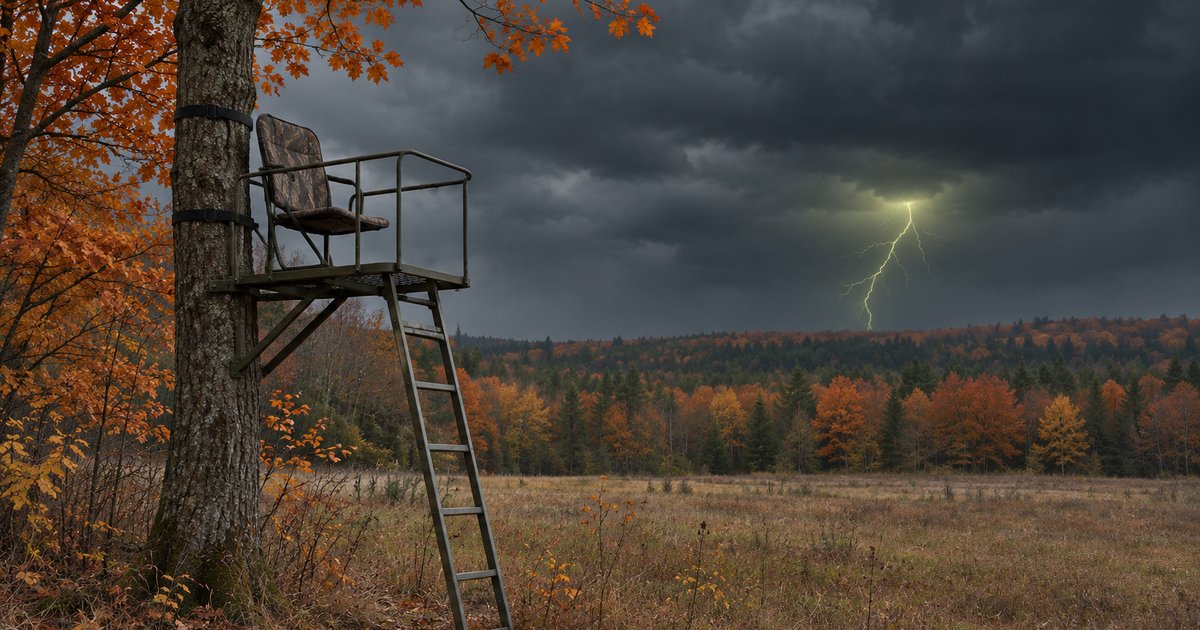
A tree stand or ground blind does not protect a hunter from lightning. The National Weather Service says nothing outdoors does when a thunderstorm is in the area, and a seat high in a tree adds height to the problem. None of the NWS pages read for this article mentions tree stands or blinds, so what follows applies its general guidance and marks where the reading is ours. The practical answer is to decide before the climb and to leave at the first thunder, because climbing down carries a risk of its own.
A tree stand puts a hunter high in a tree
The National Weather Service names height, a pointed shape and isolation as the dominant factors in where lightning strikes, and notes that tall, isolated natural objects such as trees and mountains are hit many times a year. The National Severe Storms Laboratory (NSSL) explains the mechanism: the tallest object is the one most likely to send up the short upward streamer that meets the descending lightning channel. A Missouri Department of Conservation staff member told a Springfield, Missouri, television station in October 2025 that a hunter in a stand is elevated and in a tree, and that both make a strike more likely.
Steel is not the reason. According to the NWS, the presence of metal makes no difference to where lightning lands, so a steel tower stand at the edge of a field is a risk because it is tall and alone, not because it is steel. Metal does conduct current once lightning reaches it, which is why the NWS tells people to keep away from metal fences and railings in a storm.
A strike does not have to hit a person to hurt them. The NWS describes two routes that matter in the woods. In a side flash, part of the current jumps from a struck tree to someone within a foot or two of it. In ground current, much of the energy spreads outward along the ground surface from the struck tree, and the NWS says it causes the most lightning deaths and injuries. A 2013 American Meteorological Society paper by R. L. Holle gathered 444 tree-related lightning events from news reports and other sources. Its common theme was that any arrangement of trees, a single tree or a whole woods, can give lightning a path to a person. Five ways lightning strikes people covers all of the routes.
In September 2025 a Colorado coroner told ABC News that two elk hunters had been killed when lightning struck a tree they were standing near. They were not hit directly, he said; the electricity traveled down the tree and then struck them. They were not in a stand, which is the point: standing near a tree was enough.
How often lightning kills hunters, and what is not known
The National Lightning Safety Council (NLSC) keeps the most detailed public analysis of U.S. lightning deaths. Its March 2026 report covers 2006 through 2025. Leisure activities account for 63% of the deaths, and hunting is 2% of those leisure deaths, the same share as children’s play and a little less than tourism (3%). Fishing, by comparison, accounts for 48 deaths over the period. The report’s list of unusual activities also includes building a deer blind. Who gets struck by lightning? has the wider pattern.
Two fall 2025 cases show what a hunting death can look like. In October 2025 authorities in Union Parish, Louisiana, said a 17-year-old who had been hunting deer alone was found in an elevated deer stand after thunderstorms moved through just before sunset. The sheriff’s office said investigators believed lightning killed him, and when ABC News reported the case on October 20, 2025, the investigation was still open. The NLSC counted it as the 20th U.S. lightning death of 2025. Together with the Colorado case, it shows that deaths in the field have happened in early fall.
Some things are not known. As of November 2026 we found no national count that separates lightning deaths or injuries in tree stands from other hunting cases, and the NLSC report does not break hunting deaths down by month. Its overall pattern is clear: more than 72% of deaths occurred in June, July and August. The National Park Service adds that lightning can strike at any time of year. Most recorded deaths were in summer, but a fall strike remains possible.
Blinds, huts and trucks: what counts as shelter
The NWS recognizes two kinds of shelter: a substantial building with electricity or plumbing, and an enclosed, metal-topped vehicle with the windows up. It says rain shelters, small sheds and open vehicles do not protect you, and that a tent offers no protection. None of the NWS pages read for this article names hunting structures, so the table sets its statements beside the structures a hunter is likely to use. The last column says whether the rating is the NWS’s or our reading of it.
| Where you are | What the NWS statement says | Whose rating |
|---|---|---|
| Truck or car with a hard top, windows up | Counts as shelter when no substantial building is close | NWS |
| Substantial cabin with wiring or plumbing | Fits the description of a substantial building; hunting cabins are not discussed | Our reading |
| Pop-up ground blind | A fabric shell on a frame, like a tent; a tent offers no protection | Our reading |
| Small box blind or shooting house without wiring or plumbing | A small outdoor building, like the sheds the NWS says do not protect | Our reading |
| Tree stand: hang-on, ladder or climbing | An elevated seat in or against a tree; the NWS says never to shelter under an isolated tree | Our reading |
| Tower stand in the open | Tall and isolated, the combination the NWS calls dominant in where lightning strikes | Our reading |
| ATV or other open vehicle | Open vehicles are listed as not protecting you | NWS |
The same logic applies to cover that only hides you. Where to shelter from lightning explains why a roof, a tent or a tree can feel like cover without giving any. A hunting trailer needs a closer look: RVs and campers in a thunderstorm compares metal shells with pop-ups.
Climbing down is a risk too
Leaving a stand in a storm trades one hazard for another. In a 2016 paper in the journal Injury, researchers from Marshfield Clinic and the Wisconsin Department of Natural Resources wrote that tree stand falls are the most common injury to hunters in the United States. They counted medically attended falls in one rural Wisconsin area over the 2009 to 2013 deer seasons and found 39, including two deaths and one case of paralysis. Most falls were by archery hunters, in the evening, and while descending. The study did not look at storms, and we found no source that compares the risk of climbing down during lightning with the risk of staying put, so no one can rank the two honestly.
What the lightning record does show is that timing is the lever. The NLSC found that many victims were headed to shelter when they were struck or were only steps away, and the NWS says too many people wait far too long to get to shelter. Both point to the same habit: decide early. If the climb down takes minutes and the walk to the truck takes more, those minutes have to fit inside the warning.
Timber can also delay the first cue. The NWS says thunder can usually be heard about 10 miles away when there is no background noise, but traffic, wind and rain can cut that distance, and trees and mountains can block the view of lightning. The NLSC makes the same point about trees hiding the horizon. A hunter in a stand under a canopy, in wind, may get the cue later than someone in the open. Flash to bang explains why thunder is the cue to move rather than to count.
A plan for the hunt
The steps below follow NWS and National Park Service guidance; applying them to stands and blinds is our reading.
- Before the hunt. Check the forecast. The NWS says to have a lightning safety plan and to cancel or postpone activities early when thunderstorms are expected. Pick where the group will go, a hard-topped vehicle or a building, and time the trip from the stand. The National Park Service asks outdoor visitors to know how long it takes to reach shelter.
- In the stand. Treat thunder as the signal to leave. The NWS says that if you hear thunder you are likely within striking distance of the storm. Go to the vehicle or building, and stay there until 30 minutes have passed since the last lightning or thunder; why the wait restarts with every strike.
- If you are caught away from a vehicle. The NWS says there is little you can do to substantially reduce your risk outside. It lists measures that only lower it a little: avoid open fields and the tops of hills and ridges, stay away from tall, isolated trees, do not lie flat because that raises your exposure to ground current, and spread out if you are in a group so current does not pass between people. Keep moving toward a building or vehicle. The NWS stopped recommending the crouch in 2008.
- Do not wait for a warning from your body. The NWS says that promoting the crouch as a last resort when your hair stands on end gives people the impression that they will get a warning sign, and that this could keep them from seeking shelter before the threat becomes significant.
- If someone is struck. The NWS says to call 911, start CPR and use an AED if one is needed. What to do in the first minutes has the detail.
NWS pages disagree about what to do in a forest. One national page says to stay near a lower stand of trees; another says to put as much distance as you can between you and any tree. An undated tips page from the NWS Marquette, Michigan, office tells people to take shelter under a thick growth of small trees and says that staying twice the height of a tall object away keeps you clear of it. None of the national pages read for this article repeats that twice-the-height rule. We follow the national pages: keep away from tall or isolated trees, and keep heading for a vehicle or building.
Getting an earlier warning in the woods
Lightning Tracker is an iPhone app that shows recently detected lightning strikes on a live map, with the distance and direction to the nearest one and how many minutes ago it landed. You set an alert radius for each place you watch; the default is 10 miles (16 km). The app alerts you when a strike is detected inside the radius and when strikes are clearly getting closer. A hunter with Premium could save the stand as a saved place and size the radius by how long it takes to climb down and reach the truck; how to choose an alert radius shows the arithmetic.
The app has limits. Detection networks miss some strikes, especially weak ones, and data can arrive late; the app labels a delay or a gap instead of treating it as quiet. In the background, iOS decides when the app may check for data, so a closed app may only see the latest strikes when you open it. Alerts are local notifications, and iOS settings such as Focus and Background App Refresh affect whether they arrive; five iPhone settings that decide when a storm alert arrives lists what to check before the season. Lightning Tracker does not replace official warnings or your own judgment, and what it cannot tell you is whether your hunting ground has a signal. Check that before you rely on any alert.
Not a substitute for official weather warnings.
If you hear thunder, seek shelter even if the app shows no nearby strike.
Sources
- National Weather Service, Overview: Lightning Safety
- National Weather Service, Lightning Tips
- National Weather Service, Lightning Safety Outdoors
- National Weather Service, Lightning Safety and Outdoor Sports Activities
- National Weather Service, Lightning Myths
- National Weather Service, Lightning Science: Five Ways Lightning Strikes People
- National Weather Service, The NWS stopped recommending the crouch in 2008
- National Weather Service Marquette, MI, Lightning Safety Messages (undated)
- NOAA National Severe Storms Laboratory, Lightning FAQ
- National Park Service, When Thunder Roars, Go Indoors
- National Lightning Safety Council, J. Jensenius, A Detailed Analysis of Lightning Deaths in the United States from 2006 through 2025 (PDF, March 2026)
- R. L. Holle, Lightning-Caused Deaths and Injuries in the Vicinity of Trees (PDF), American Meteorological Society 93rd Annual Meeting, 2013
- VanWormer et al., Epidemiologic trends in medically-attended tree stand fall injuries among Wisconsin deer hunters, Injury, 2016
- ABC News, Missing elk hunters were killed by lightning that struck nearby tree: Official, September 23, 2025
- ABC News, Teen killed in apparent lightning strike while hunting deer in Louisiana: Sheriff, October 20, 2025
- KY3, Springfield, Missouri, First Alert Weather: Lightning poses a risk to hunters even in fall, October 24, 2025