 Lightning Tracker
App Store
Storm basics
Hail size chart: coins, balls and inches
November 15, 2026 · 5 min read
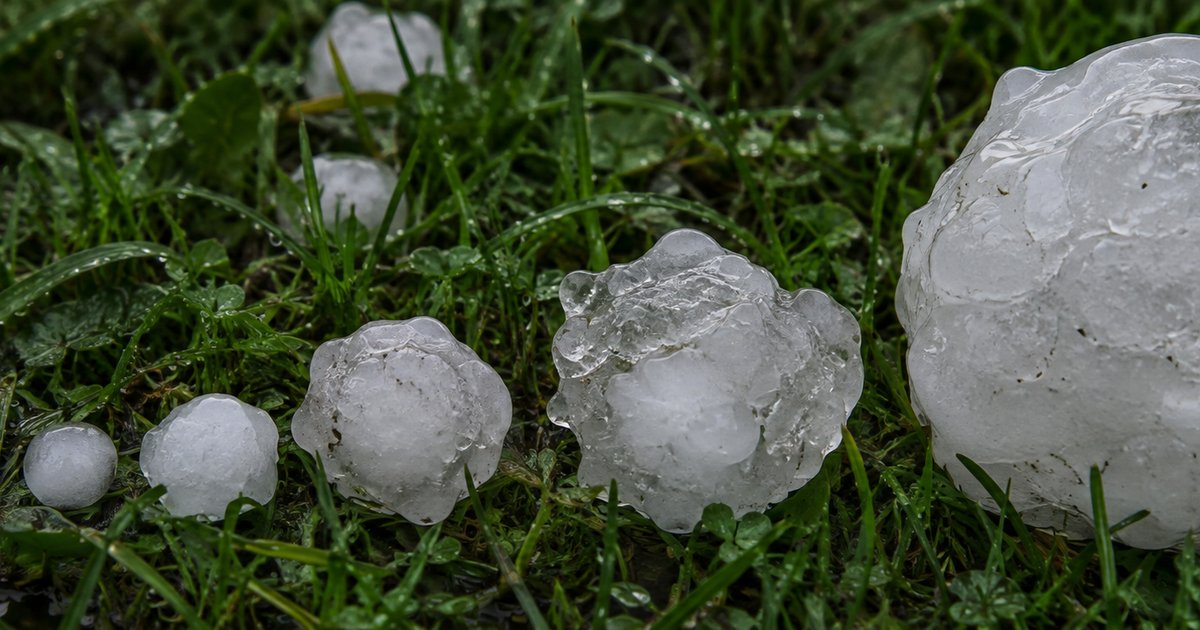
Hail size means the diameter of a stone: on the National Weather Service Northern Indiana chart, quarter-size hail is 1 inch across and golf-ball-size hail is 1.75 inches. The NWS counts hail of 1 inch or larger as meeting the hail criterion for a severe thunderstorm. Use the chart below to translate an object name or a measured width; stay indoors while hail falls.
Hail size is the diameter of the hailstone. On the National Weather Service chart, a quarter is 1 inch and a golf ball is 1 3/4 inches.
Hail one inch or larger is the National Weather Service threshold for a severe thunderstorm. Stay indoors while it falls.
What this lookup tells you
The result is a size comparison, not a forecast of the next hailstone, an estimate of property damage, or a reason to remain outdoors. The National Weather Service (NWS) says hail size refers to a stone’s diameter, its width across. Choose the largest stone you can observe from shelter, and use a ruler after the hail has stopped if conditions allow. A coin or ball name is a convenient label for an approximate diameter; it is not a measurement of every stone in the shower.
The widget uses the NWS Northern Indiana Hail Size Comparison Chart. Picking an object returns its listed width in inches and centimeters. Typing a measured diameter returns centimeters and the nearest named object on that same chart. The nearest label can be slightly smaller or larger than the number you entered, so include the actual measurement when you report it. The input accepts values greater than zero through 10 inches; blank entries, zero, negative numbers, and values above 10 show a prompt instead. It rounds displayed inches to at most two decimal places and converted centimeters to one decimal place. Selecting an object clears a typed diameter; typing clears an object selection. With JavaScript unavailable, the widget shows the quarter and golf-ball reference sizes and the severe threshold, but its controls stay hidden.
Coins and balls on the Northern Indiana chart
The NWS Northern Indiana chart pairs each familiar object with a diameter, and the lookup follows those pairs as published. “Quarter-size” means about 1 inch across; “golf-ball-size” means about 1.75 inches. The table below uses the chart’s centimeter figures, which are rounded independently of the widget’s conversion of a number you type.
| Object | Diameter | Metric |
|---|---|---|
| Pea | 0.25 inch | 0.64 cm |
| Dime | 0.7 inch | 1.8 cm |
| Penny | 0.75 inch | 1.9 cm |
| Nickel | 0.875 inch | 2.2 cm |
| Quarter | 1 inch | 2.5 cm |
| Half dollar | 1.25 inches | 3.2 cm |
| Golf ball | 1.75 inches | 4.4 cm |
| Billiard ball | 2.125 inches | 5.4 cm |
| Tennis ball | 2.5 inches | 6.4 cm |
| Baseball | 2.75 inches | 7.0 cm |
| Softball | 3.8 inches | 9.7 cm |
| Compact disc / DVD | 4.75 inches | 12.1 cm |
Not every NWS reference list uses the same objects or figures. The NWS glossary groups penny and dime at 0.75 inch and lists softball at 4.5 inches, while Northern Indiana lists dime at 0.7 inch and softball at 3.8 inches. That difference is why a measured width is more useful than a nickname when one is available. Use the widget as a translation of the named Northern Indiana chart, not as a claim that its names are exact physical sizes.
How the conversion works
For a number typed in inches, the widget multiplies the diameter by 2.54 centimeters per inch and rounds the result to one decimal place. It then compares the entered number with each chart diameter and picks the smallest absolute difference. If two objects are equally close, the earlier, smaller chart entry wins. The NWS Northern Indiana chart supplies the object values, while NIST defines 1 inch as exactly 2.54 centimeters.
For example, choose “Golf ball” and the widget says approximately 1.75 inches (4.4 cm) across and at or above the NWS severe line. Enter 0.9 inch instead and it shows 2.3 cm, identifies nickel size as the closest reference at 0.88 inch, and says the measurement is below that line. A 0.1-inch entry is accepted and maps to pea as the closest listed object, with an added “Smaller than a pea” note. Measurements above the chart’s 4.75-inch last entry still return that last entry as the closest reference until the widget’s 10-inch input limit; that label does not mean the stone was only 4.75 inches wide.
What the one-inch line means
The NWS defines a severe thunderstorm as capable of producing hail at least 1 inch in diameter or wind gusts over 58 mph. One inch is quarter size on the Northern Indiana chart. A 0.9-inch measurement is below the hail criterion; a 1-inch measurement meets it. The widget compares only hail diameter with this line. It does not issue a severe thunderstorm warning or evaluate the wind criterion. NWS says thunderstorm hazards also include lightning, so a sub-inch result is not permission to remain outside. If thunder is audible, follow the NWS guidance on where to shelter from lightning.
NOAA’s JetStream education page says hailstones grow by collision with supercooled water drops. The size chart describes a stone that has already fallen; it cannot tell you how much hail will fall next. A lightning map and weather radar show storm observations; neither measures a stone.
Measure and report the largest stone
The Northern Indiana NWS spotter handout asks observers to report the size of the largest stone and to include time, event, and location. NWS Boston’s Skywarn instructions likewise ask for the largest hailstone; local offices may set different reporting criteria. The NWS Baltimore/Washington 2026 spotter training says to pick the largest stone and measure it with a ruler. When hail has stopped and it is reasonable to inspect a stone, place it beside a ruler and record its greatest width in inches. If you can only estimate, say so and name the chart object you used. Do not go outside into falling hail to collect a sample.
A concise report might read: “Hail, largest measured stone 1.25 inches across, at 3:20 p.m. near the town center.” The half-dollar label is optional because the measurement states the diameter directly. If the size was estimated from sight, “estimated quarter size” tells the forecaster how the number was obtained. NWS Northern Indiana asks for reports of hail of any size; NWS Boston lists pea size or larger for its spotters. Use your local NWS office’s reporting channel and its criteria, and give the event’s location and time rather than only the time you sent the report.
If hail is falling near you, Lightning Tracker, an iPhone app, shows recently detected lightning strikes on a live map, with the distance to the nearest one.
Not a substitute for official weather warnings.
If you hear thunder, seek shelter even if the app shows no nearby strike.
Sources
- National Weather Service Northern Indiana, Hail Size Comparison Chart
- National Weather Service, Severe Thunderstorm Resources
- National Weather Service Northern Indiana, Severe Thunderstorm Reporting Criteria
- National Weather Service Boston, Skywarn
- National Weather Service, Hail Size
- NOAA JetStream, Thunderstorm Hazards - Hail
- NIST, SI Units – Length
- National Weather Service Baltimore/Washington, Basic Spotter Training 2026