 Lightning Tracker
App Store
Storm basics
Is there lightning on Mars? What Perseverance recorded
November 19, 2026 · 8 min read
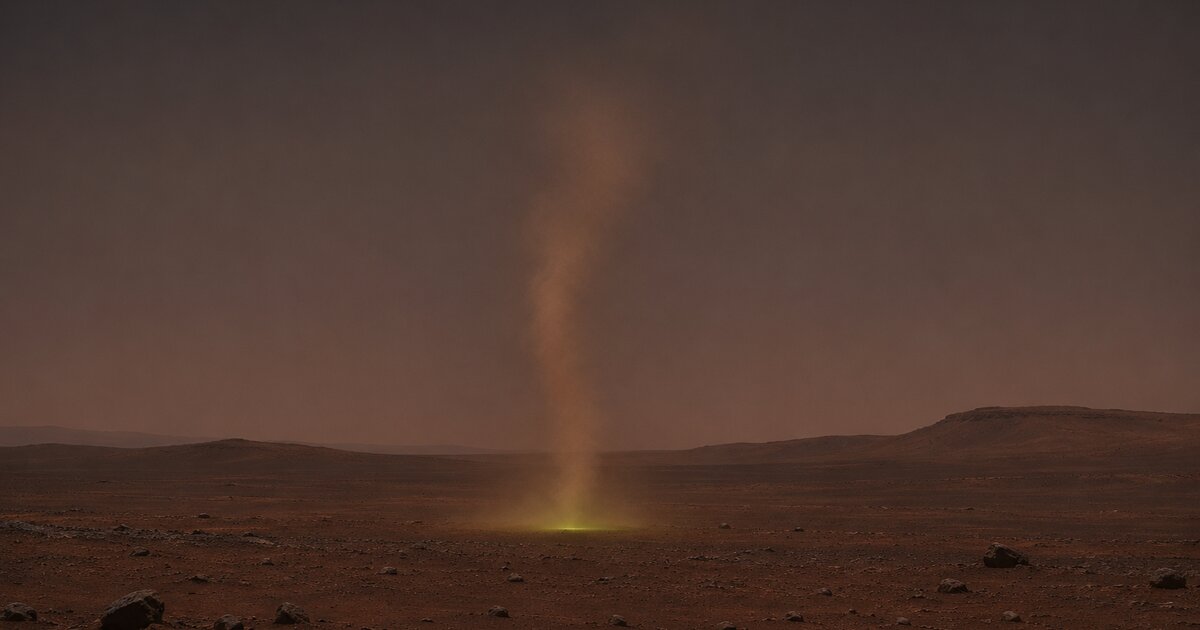
Mars has electrical discharges, according to a November 2025 paper in Nature: NASA's Perseverance rover recorded 55 of them in dust devils and dust storms. They are small sparks roughly an inch or two (a few centimeters) long, closer to a static shock than to an Earth bolt, and researchers still debate whether the word lightning fits.
Perseverance's microphone recorded 55 electrical events over two Martian years
Perseverance's SuperCam microphone picked up the sound and electrical interference of discharges, an international team reported in Nature on November 26, 2025. The paper's abstract counts 55 events over two Martian years, usually tied to dust devils and the convective fronts of dust storms. NASA's Jet Propulsion Laboratory (JPL) said on December 3, 2025 that SuperCam has logged them since the 215th Martian day of the mission in 2021: 16 as dust devils passed directly over the rover, and 35 more with convective fronts during regional dust storms. The BBC reported on November 28, 2025 that the recordings span 1,374 Earth days.
A dust devil, JPL explains, forms from rising and rotating columns of warm air that pick up dust. The Nature abstract sizes Martian dust devils from about 3 feet to about 330 feet (1 to 100 meters) across, and dust storms on a scale of about 620 miles (1,000 km).
The detection was an accident. NPR reported on November 26, 2025 that planetary scientist Ralph Lorenz of the Johns Hopkins Applied Physics Laboratory said the team first assumed a snap in a dust devil recording was a grain of sand or gravel hitting the rover. Baptiste Chide, the paper's lead author according to the BBC, then tested a microphone with an electrostatic generator on Earth and saw the same pattern: a brief burst of electrical interference followed by the sound of a shock wave. The French research agency CNRS adds that SuperCam's microphone was the first to operate on Mars and had collected over 30 hours of sound by the time of the paper.
Friction between dust grains builds the charge, not ice
Triboelectric charging is the process behind the Martian sparks, and JPL compares it to walking over a carpet in socks and then touching a metal doorknob. Dust grains rub together, swap electrons and separate, and the charge they carry eventually jumps as a spark. On Earth, a thundercloud works differently: the National Severe Storms Laboratory (NSSL) says clouds become electrified when strong updrafts produce a mixture of graupel, small ice crystals and supercooled water drops, so the charge separation in a storm runs on ice.
The thin Martian atmosphere helps the dust. Chide told JPL that sand and snow grains also charge on Earth, in deserts especially, but rarely discharge; on Mars the charge needed for a spark is much lower than in Earth's near-surface air. CNRS notes the atmosphere there is mostly carbon dioxide. The Nature abstract says the electric field needed for breakdown near the Martian surface is predicted to be on the order of several tens of kilovolts per meter. JPL adds that discharges did not seem to rise in the seasons when dust storms are common, which suggests local, turbulent lifting of dust matters more than a high dust count alone.
A Martian spark is about the size of a static shock, not a storm bolt
The sparks Perseverance recorded are electric arcs roughly an inch or two (a few centimeters) long, accompanied by audible shock waves, according to CNRS and NPR. CNRS compares them to the small shock felt when touching a door handle in dry weather, and JPL says a static spark is about the same level of discharge as a Martian dust devil might produce. Earth lightning is a different scale: the National Weather Service (NWS) office in Melbourne, Florida, lists an average cloud-to-ground channel at 2 to 10 miles (3 to 16 km) long and about 1 inch (2.5 cm) wide, and the NWS says a typical flash is about 300 million volts and about 30,000 amps.
| Feature | Earth thunderstorm lightning | Martian discharges recorded by Perseverance |
|---|---|---|
| What builds the charge | Graupel, ice crystals and supercooled drops in a cloud (NSSL) | Dust grains rubbing together (JPL) |
| Where | Thunderstorms | Dust devils and dust storm fronts (Nature, 2025) |
| Length | Average cloud-to-ground channel 2 to 10 miles (NWS) | Roughly an inch or two, a few centimeters (CNRS, NPR) |
| Electrical size | About 300 million volts, 30,000 amps in a typical flash (NWS) | Comparable to a static shock (JPL, CNRS); no volts, amps or joules in these sources |
| How it was recorded | A visible flash and thunder (NSSL) | Heard, and picked up as electrical interference; not seen (BBC, NPR, 2025) |
The NASA, CNRS and Nature texts used here give no figure in joules for a Martian spark, so this page states none. Both CNRS and NPR say the arcs come with audible shock waves. On Earth, NOAA's National Severe Storms Laboratory says the disturbance from a lightning channel is a shock wave for the first 10 yards (9 m) and then becomes an ordinary sound wave, which is thunder.
Earlier searches found hints, then a non-detection
Researchers had looked for Martian electricity for decades before Perseverance, and the results pointed both ways. NPR reports that experimenters in the 1970s did lab work suggesting lightning should exist on Mars; in one example Lorenz described, swirling volcanic sand in a flask pumped down to Martian pressures made a glow visible in the dark. The table lists the later steps, each from the source named.
| Date | Method | What the source reports |
|---|---|---|
| July 2009 | Radio telescope on Earth, May 22 to June 16, 2006 | Non-thermal radiation detected for a few hours on June 8, 2006, with a 22-mile (35 km) deep dust storm in view; the authors judged it probably caused by electric discharge |
| September 2010 | Mars Express orbiter radar receiver, nearly five years | No credible detections of radio signals from lightning, despite two major dust storms |
| November 2025 | Perseverance rover microphone, two Martian years | 55 discharge events heard in dust devils and dust storm fronts |
| February 2026 | MAVEN orbiter radio data, snapshots reviewed by eye | One whistler candidate, from June 2015 |
NASA's Earth Science Technology Office headlined its June 2009 page about the University of Michigan result "First Direct Measurements of Lightning on Mars." The 2025 Nature abstract, by contrast, describes electrical activity on Mars as long suspected but never directly demonstrated. The 2009 paper's spectrum also peaked near the lowest three modes of the Martian Schumann resonance, electromagnetic standing waves between the surface and the ionosphere that large-scale discharges force, according to its abstract. The 2010 Mars Express search, which covered 4.0 to 5.5 MHz, found no credible detections.
A 2026 orbiter report adds a radio signal that fits a discharge
The MAVEN orbiter's data produced a second kind of evidence, published in Science Advances on February 27, 2026. František Němec and colleagues at Charles University in Prague reported a whistler, a frequency-dispersed radio signal, in the Martian ionosphere. Scientific American, in a story published the same day, explained that lightning heats and ionizes surrounding air, which can act as a natural antenna that sends lightning-generated radio waves out of a planet's atmosphere, and that on a receiver they sound like a whistle.
The search was hard. According to Scientific American, the team looked through 108,418 MAVEN snapshots by eye and found only one candidate, from June 2015. The paper's abstract says the observation is direct evidence of electromagnetic waves from an impulsive source on Mars, suggesting that electric discharges may indeed occur in the Martian atmosphere. It shows that the dispersion matches theory and that only the low-frequency part of the whistler is seen because higher frequencies fade faster.
Researchers disagree on whether the sparks count as lightning
Daniel Mitchard, a lightning researcher at Cardiff University who was not on the team, wrote the commentary in Nature, and NPR quoted him saying lightning on Mars is probably one of the biggest mysteries about the planet. The BBC reported that he wrote the recordings would provide persuasive evidence of dust-induced discharges, but that because the discharges were only heard and not seen, "some doubt will inevitably remain as to whether this really was Martian lightning." He added that the debate is likely to continue for some time.
The two Mars results may not describe the same thing, either. Karen Aplin of the University of Bristol told Scientific American the two sets of observations are not contradictory but likely do not represent quite identical phenomena, and compared the case with Earth, where thunderstorm lightning differs greatly from the glow of Saint Elmo's fire. Ondřej Santolík, a coauthor of the MAVEN paper, said Martian lightning cannot be described as a lightning bolt like Earth's, though the principle is similar, and that nobody has taken a picture yet. Chide told NPR small discharges are hard to see in strong sunshine, and the sunniest times of day have the most dust devils, although some events came at night.
For other worlds, the 2026 paper's abstract says wave detections have confirmed lightning on Jupiter, Saturn and Neptune, while its occurrence on Venus and Mars remains unclear.
The sparks matter for Martian chemistry and for spacecraft
JPL says the discharges show the Martian atmosphere can become charged enough to drive reactions that create strongly oxidizing compounds such as chlorates and perchlorates, which can destroy organic molecules at the surface. JPL adds that the finding could help explain why Martian methane vanishes quickly, and that charges built by rubbing particles would seem likely to influence how dust moves on the planet. Charged dust has a parallel on Earth: Lorenz noted to NPR that even on Earth, lightning can occur in turbulent clouds of volcanic ash.
The hardware question is open. JPL notes that no adverse electrostatic discharge effects have been reported in several decades of Mars surface operations, which may reflect careful spacecraft grounding. NPR recalls that the Soviet Mars 3 lander operated only about 20 seconds after landing during a dust storm; Lorenz said an electrical discharge cannot be ruled out, which is a possibility, not a finding.
For thunderstorms here on Earth, Lightning Tracker, an iPhone app, maps recent detected lightning strikes and shows the distance and direction to the nearest one.
Not a substitute for official weather warnings.
If you hear thunder, seek shelter even if the app shows no nearby strike.
Sources
- Chide et al., Detection of triboelectric discharges during dust events on Mars, Nature, November 26, 2025 (abstract)
- NASA Jet Propulsion Laboratory, NASA Rover Detects Electric Sparks in Mars Dust Devils, Storms, December 3, 2025
- CNRS, Electric discharges detected on Mars for the first time (press release), November 26, 2025
- NPR, At long last, the mystery of lightning on Mars is solved, November 26, 2025
- BBC News, Lightning detected on Mars for the first time, scientists say, November 28, 2025
- Němec et al., Lightning-generated waves detected at Mars, Science Advances, February 27, 2026 (abstract)
- Scientific American, Is there lightning on Mars? New evidence suggests it's there, just hard to see, February 27, 2026
- Ruf et al., Emission of non-thermal microwave radiation by a Martian dust storm, Geophysical Research Letters, July 2009 (abstract)
- NASA Earth Science Technology Office, First Direct Measurements of Lightning on Mars, June 2009
- Gurnett et al., Non-detection of impulsive radio signals from lightning in Martian dust storms using the radar receiver on the Mars Express spacecraft, Geophysical Research Letters, September 2010 (abstract)
- National Weather Service, How Powerful Is Lightning?
- National Weather Service Melbourne, Lightning Rules and Facts
- NOAA National Severe Storms Laboratory, Severe Weather 101: Lightning FAQ