 Lightning Tracker
App Store
Storm basics
Lightning on other planets: what spacecraft have found
November 19, 2026 · 10 min read
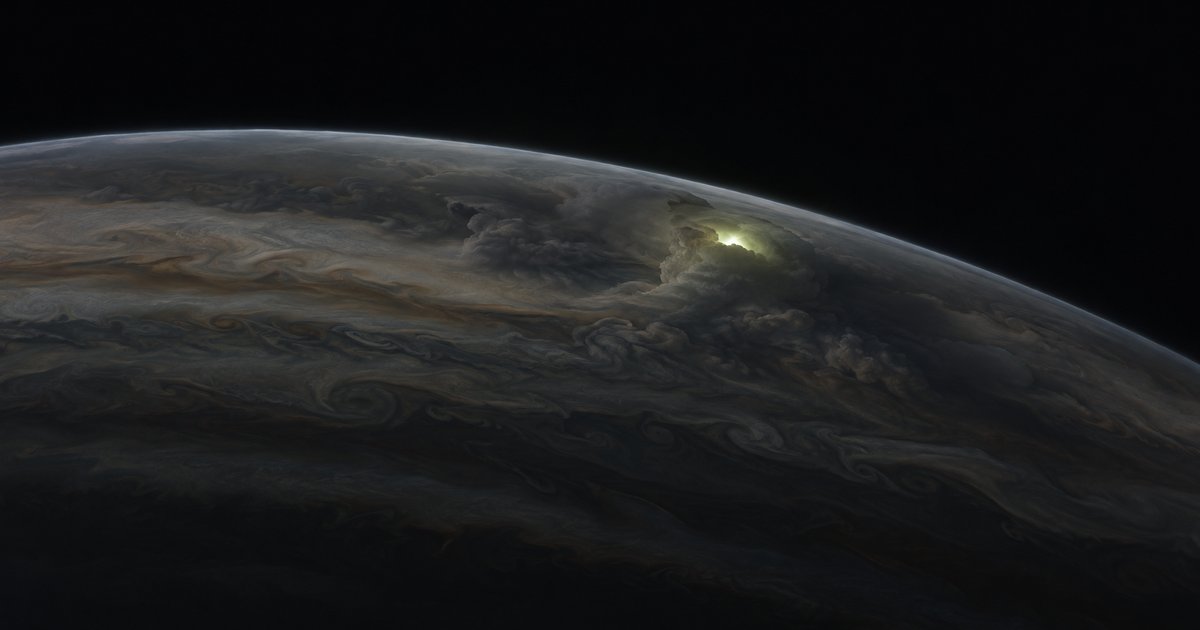
Spacecraft have recorded lightning on Jupiter and Saturn with both cameras and radio receivers, Voyager 2 radio data from Uranus and Neptune are read as lightning, and Venus is still disputed. On every planet the observations are firmer than the explanations of how its storms charge up.
Spacecraft recognize lightning by its flashes, its radio static and its whistlers
Spacecraft cannot hear thunder, so planetary scientists look for three other signs. NASA’s 2018 overview of lightning across the solar system names two radio signs: high-frequency radio static called “sferics”, which NASA says an AM car radio picks up near a storm on Earth, and “whistlers.” A 2020 review of the ice giants adds that whistlers are electromagnetic waves guided along magnetic field lines, which lets a spacecraft detect them from outside a planet’s ionosphere, while high-frequency sferics pass straight through the ionosphere to an orbiting spacecraft. The third sign is a flash of light on the planet’s night side, where, the University of California, Berkeley says, flashes stand out like a lightning bug in the dark.
Each sign has a blind spot. Berkeley notes that clouds can block the view of a flash and make its true optical power hard to pin down. The table lists what each planet’s record rests on as of November 2026.
| Planet | Signs recorded | Spacecraft and years | How the sources describe it |
|---|---|---|---|
| Jupiter | Camera flashes, radio sferics, whistlers | Voyager 1 (1979), Juno (orbiting since 2016) | Detected by every visiting spacecraft |
| Saturn | Radio sferics, then camera flashes | Voyager 1 and 2 (1980–81), Cassini (flashes imaged August 2009) | Detected by radio and by camera |
| Uranus | Radio bursts | Voyager 2 (January 1986) | Read as lightning; no flashes or whistlers seen |
| Neptune | Whistler-like waves, four weak sferics | Voyager 2 (August 1989) | Tentative; one reading ties the waves to another source |
| Venus | Whistler-mode waves; radio and camera searches that found nothing | Cassini flybys (1998–99), Venus Express (2007), Parker Solar Probe (2021) | Disputed |
Jupiter’s lightning gathers near the poles, where Earth’s favors the equator
NASA says that when Voyager 1 flew past Jupiter in 1979, its imager captured areas nearly as big as the U.S. lit up by lightning in the planet’s clouds. NASA’s 2018 overview adds that Juno, which has orbited closer to Jupiter than any earlier mission, found most of the planet’s lightning at higher latitudes, whereas on Earth lightning strikes mainly over land and most intensely at the equator. NASA reports peak rates of four strikes per second, similar to rates on Earth.
A June 2018 paper in Nature reported what Juno’s microwave radiometer picked up in the mission’s first eight orbits: 377 lightning sferics at 600 megahertz, prevalent near the poles, absent near the equator and most frequent north of 40 degrees north latitude. The authors say that earlier radio detections at Jupiter were only at kilohertz frequencies, and that the new detections imply Jovian lightning is not distinct from terrestrial lightning, as had been thought.
On Earth, lightning forms because colliding ice crystals and water drops develop opposite charges, NASA explains, and Berkeley says Jupiter’s lightning is likely generated in a similar way, from rising water vapor that condenses into droplets and ice crystals. Berkeley’s Michael Wong adds that Jupiter’s hydrogen-dominated atmosphere makes moist air heavier and harder to lift, and that its storms are more than 60 miles (100 km) tall, compared with about 6 miles (10 km) on Earth.
Juno recorded some small flashes that start too high for liquid water
A paper in Nature in August 2020 reported flashes recorded by Juno’s Stellar Reference Unit, which Cornell University describes as a camera designed to detect dim light. The flashes had optical energies of about 100,000 to 100 million joules and durations as short as 5.4 milliseconds, “with typical terrestrial energies,” in the paper’s words. Earlier flashes seen by other spacecraft had optical energies comparable to Earth’s “superbolts,” the paper says, but earlier observations were limited by camera sensitivity, distance from Jupiter and long exposures. Several of Juno’s flashes were so small that, the authors conclude, they must start above the 2-bar pressure level, where there is no liquid water.
The paper also names the brightest line in the spectrum of Jovian lightning: the 656.3-nanometer hydrogen-alpha line of atomic hydrogen. Earth’s lightning, by comparison, can appear in many different colors depending on what the light travels through, according to the National Severe Storms Laboratory.
The ammonia-water idea is a proposed mechanism, not an observation
The ammonia-water explanation for Jupiter’s shallow lightning comes from reasoning and modeling, and the sources present it that way. NASA’s 2020 description of the discovery says that at those altitudes it is too cold for pure liquid water, and that ammonia gas acts as an antifreeze, melting water-ice crystals flung up by the storms into an ammonia-water cloud that can electrify the sky. Cornell adds that the collision of falling droplets of mixed ammonia and water with suspended water-ice particles is a way to separate charge, that doctoral work there on how lightning is generated under these conditions is continuing, and that the models are “starting to confirm” the role of ammonia, in the words of Cornell astronomer Jonathan Lunine. In March 2026, Berkeley described one theory in which water and ammonia combine into “mushballs” that fall like slushy hail, and quoted Wong saying that the details of how Jupiter’s lightning is generated, compared with Earth’s, remain a mystery.
What Juno recorded is the flashes and how high they start. The sources describe the charging process itself as modeled or theorized.
A 2026 radio study put Jupiter’s lightning at roughly Earth’s power to 100 times more
A study led by Wong, published in AGU Advances in 2026, used the Juno microwave radiometer to measure the power of lightning pulses. It worked because in 2021 and 2022 Jupiter’s North Equatorial Belt had a lull in storms, so each pulse could be tied to one isolated storm that the researchers call a “stealth superstorm.” Berkeley says Juno made 12 passes over such storms and was close enough on four of them to measure the pulses: 613 in total, arriving at an average of three per second. The study put their power at about that of an Earth bolt up to 100 times that or more.
The comparison carries uncertainty. Berkeley says Earth’s lightning emissions were compared at one radio wavelength and Jupiter’s at another, and that, based on one study of Earth’s lightning radio emissions, Jupiter’s bolts could be a million times more powerful. The paper’s abstract gives median pulse powers of 27 to 214 watts over the radiometer’s band and says the instrument measures typical pulses in these storms, not rare outliers. It adds that future studies may show whether pulses in stealth superstorms are typical of Jupiter’s lightning in general, and Berkeley notes that the pulses came from four stealth superstorms between 2021 and 2022. Wong estimates the total energy of a Jupiter bolt at up to 500 times, and perhaps 10,000 times, that of an Earth bolt, which Berkeley puts at about 1 gigajoule.
The 2026 result and the 2020 camera result do not contradict each other. Berkeley says earlier night-side imaging could detect only super-powerful flashes, which gave Jupiter its reputation for extreme lightning, until Juno’s sensitive star-tracking camera recorded many weaker, Earth-like flashes.
Saturn’s lightning was detected by radio in 1980–81 and photographed in 2009
Voyager detected the radio signals called sferics at Saturn in 1980–81, NASA says, and Cassini’s radio instrument later showed that strong storms produced lightning as many as ten times per second. Cassini’s cameras could not catch a flash at first. NASA’s Jet Propulsion Laboratory said in April 2010 that the planet is very bright and reflective, and that sunlight off the rings made its night side as bright as a full-moon night on Earth, until the equinox around August 2009 lit the rings edge-on and brought the necessary darkness. Cassini then captured the first lightning flashes on Saturn on August 17, 2009, from a storm that lasted from January to October 2009, which NASA called the longest-lasting lightning storm known in the solar system as of that release.
A bigger storm followed. A July 2011 paper in Nature reported a thunderstorm that began in early December 2010 at 35 degrees north latitude and reached about 6,200 miles (10,000 kilometers) in latitude in about three weeks. Its flash rate was about an order of magnitude higher than earlier storms, peaking above ten per second, and the authors say Saturn’s lightning radio waves are about 10,000 times more intense than their counterparts on Earth.
Uranus and Neptune have only Voyager 2’s radio data, read with different confidence
Voyager 2 is the only spacecraft to have visited Uranus and Neptune, and a 2020 review in Space Science Reviews, written by researchers from several countries, collects what it saw. At Uranus in January 1986, the craft’s planetary radio astronomy instrument detected 140 impulsive bursts between 0.9 and 40 megahertz, within about 373,000 miles (600,000 km) of the planet on January 24 and 25. The review says neither whistlers nor optical flashes were seen on Uranus’s night side.
Neptune’s case is thinner. On August 25, 1989, Voyager 2’s plasma wave instrument recorded 16 whistler-like events in about 20 minutes, at 1.3 to 2 Neptune radii from the planet’s center (roughly 20,000 to 31,000 miles, or 32,000 to 50,000 km). The review adds that a 1996 analysis read the signals as another kind of wave whose source could be lightning or the planet’s magnetosphere, and that four weak high-frequency sferics detected at Neptune somewhat support the lightning reading. No optical lightning was seen. The review’s summary is that Voyager 2 detected lightning at all four giant planets, “albeit tentatively at Neptune.”
Venus is the planet where the evidence points both ways
NASA’s 2001 account of the Venus debate says discussion began in 1978, when the Venera lander found low-frequency signals that some scientists called lightning and others doubted. William Taylor reported what he took as evidence in 1979 from NASA’s Pioneer Venus, and in 1990 the Galileo spacecraft detected small impulses read at the time as lightning, though NASA says Galileo was about 60 times farther from Venus than Cassini later was and its results were less significant.
Cassini then searched on two flybys, on April 26, 1998, and June 24, 1999, for high-frequency radio signals from 0.125 to 16 megahertz, the kind terrestrial lightning always produces. It found none, though the same instrument easily detected lightning when Cassini flew by Earth on August 18, 1999. Physicist Donald Gurnett concluded in the January 2001 Nature paper that any lightning at Venus is either extremely rare or very different from Earth’s. NASA notes that he could not rule out low-frequency electrical activity, because radio signals below about 1 megahertz cannot get through the ionosphere, and Gurnett noted that Venus’s clouds sit 25 miles (40 km) or higher, so any lightning there is likely mostly cloud-to-cloud, the weaker variety.
In November 2007, a paper reporting Venus Express results described bursts of circularly polarized waves near 100 hertz in Venus’s ionosphere, each lasting 0.25 to 0.5 second, with the expected properties of whistler-mode signals from lightning in the clouds. The same abstract recalls that some earlier searches were negative and that the existence of lightning had remained controversial.
A September 2023 paper in Geophysical Research Letters, led by Harriet George of the University of Colorado Boulder, put a limit on the whistler evidence. Its abstract says whistlers recorded during a Parker Solar Probe flyby of Venus were seen on the night side at an altitude of 0.39 Venus radii, traveled toward the planet and occurred at the same time as Langmuir waves, which lets the authors eliminate lightning as the source of those waves and suggests that whistler-based lightning rates may be overestimated. The abstract also notes that optical flashes on Venus are exceedingly rare and that several spacecraft have not detected lightning there.
Eos, the news magazine of the American Geophysical Union, reported in December 2023 that the flyby came in February 2021, passed within about 1,500 miles (2,400 km) of Venus’s surface and recorded several whistlers but no other obvious lightning signals. George told Eos the team was not trying to say that lightning does not exist on Venus, and the team suggested that a reconnection of magnetic field lines could have generated the whistler. Eos also reported that Cassini and Japan’s Akatsuki, in orbit at Venus since 2015, carried instruments built to detect lightning and found none. An Arizona State University planetary scientist told Eos that the few flashes seen by cameras are so infrequent they could be meteors, while Christopher Russell of the University of California, Los Angeles, who supports lightning on Venus, maintains that optical flashes detected from the planet’s surface are incontrovertible proof of it.
Mars has inch-scale electrical sparks in its dust, not storm lightning
NASA’s 2018 overview says Gurnett used Mars Express’s radar receiver in a five-year search for lightning from dust storms and did not find any. A paper in Nature on November 26, 2025 then reported 55 electrical events recorded over two Martian years by the SuperCam microphone aboard NASA’s Perseverance rover, usually during dust devils and dust storm fronts, and the French research agency CNRS describes them as electric arcs roughly an inch or two (a few centimeters) long.
For lightning here on Earth, Lightning Tracker, an iPhone app, maps recent detected strikes and shows the distance and direction to the nearest one.
Not a substitute for official weather warnings.
If you hear thunder, seek shelter even if the app shows no nearby strike.
Sources
- NASA Science, Lightning Across the Solar System (October 2018)
- Chide et al., Detection of triboelectric discharges during dust events on Mars, Nature, November 26, 2025 (abstract)
- CNRS, Electric discharges detected on Mars for the first time (press release), November 26, 2025
- NASA Science, Shallow Lightning on Jupiter (September 2020)
- NASA Science, First Lightning Flashes on Saturn (Jet Propulsion Laboratory, April 2010)
- NASA Science, Cassini Scientists See No Sign of Lightning on Venus (January 2001)
- Brown et al., Prevalent lightning sferics at 600 megahertz near Jupiter’s poles, Nature, June 2018
- Becker et al., Small lightning flashes from shallow electrical storms on Jupiter, Nature, August 2020
- Cornell Department of Astronomy, Ammonia sparks unexpected, exotic lightning on Jupiter (August 2020)
- UC Berkeley News, Lightning bolts on Jupiter pack more than 100 times the power of Earth’s flashes (March 2026)
- Wong et al., Radio Pulse Power Distribution of Lightning in Jupiter’s 2021–2022 Stealth Superstorms, AGU Advances, March 2026
- Fischer et al., A giant thunderstorm on Saturn, Nature, July 2011
- Aplin et al., Atmospheric Electricity at the Ice Giants, Space Science Reviews, 2020 (author’s open copy)
- Gurnett et al., Non-detection at Venus of high-frequency radio signals characteristic of terrestrial lightning, Nature, January 2001
- Russell et al., Lightning on Venus inferred from whistler-mode waves in the ionosphere, Nature, November 2007
- George et al., Non-Lightning-Generated Whistler Waves in Near-Venus Space, Geophysical Research Letters, September 2023
- Eos (American Geophysical Union), Lightning Struck Down as Source of a Venus Whistler (December 2023)
- NOAA National Severe Storms Laboratory, Severe Weather 101: Lightning FAQ