 Lightning Tracker
App Store
Lightning safety
What does it feel like to be struck by lightning?
November 19, 2026 · 5 min read
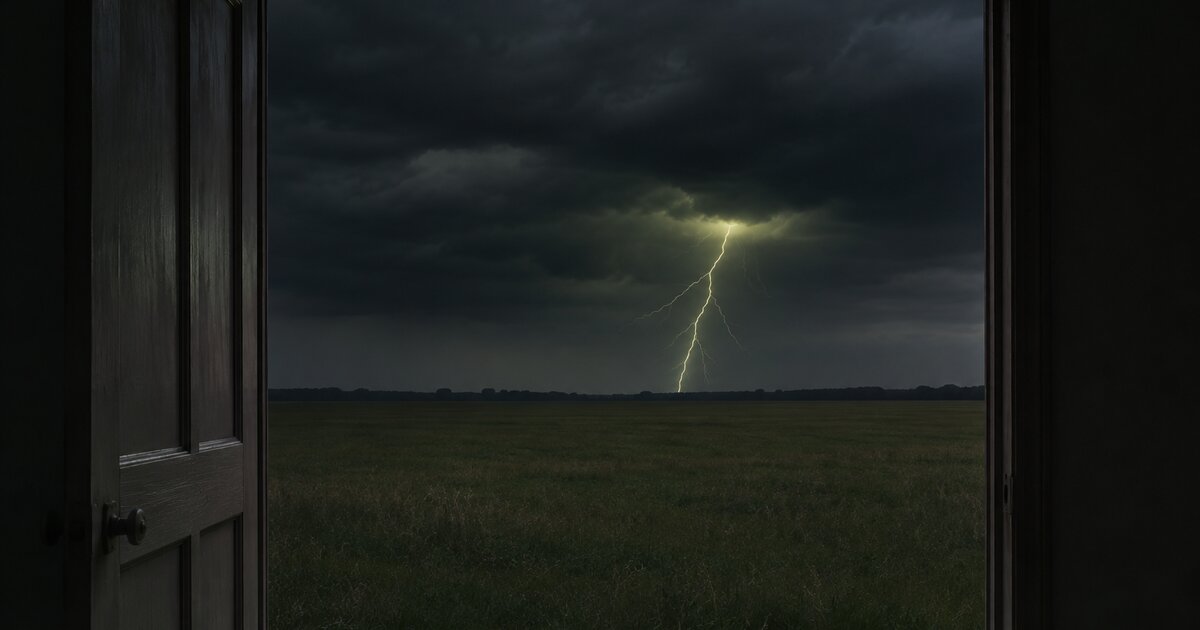
People struck by lightning describe it very differently: a flash and a loud bang, a force passing through the body, or nothing at all. Loss of consciousness and amnesia are among the immediate effects medical sources list. The CDC says almost 90% of lightning strike victims survive (page dated July 10, 2026).
What survivors say it felt like
The National Weather Service publishes survivors’ own accounts on its site and states that the stories are “submitted by lightning victims and are NOT corroborated by NOAA.” The six below are short extracts from that collection, each one person’s recollection of a different strike.
- A flash and a bang. A man at a ranch in the Texas Hill Country, under a sky with hardly any clouds, says “we heard the loudest bang and saw the brightest light,” and that it took him a while to realize anything.
- Colors and a force. A 19-year-old unlocking her bike in Copenhagen remembers “a power going through me” and being “surrounded by intense white and purple colors.” Her arm then began to tingle and tense, and she called an ambulance herself.
- Dazzled, then a path through the body. On a New Jersey beach in 2012, a man holding an umbrella says the bolt “blinded us like a flashbulb” and that he “felt the lightning travel through my left arm into my chest.” He was sore for a few days.
- A shock like broken bones. A swimmer in a Sierra Nevada lake, where a bolt hit a boulder on the shore and the current went through the water, writes that “it felt like all my bones broke.” The swimmer’s sister compared it to having all of her joints dislocated, and the account says “thankfully we were fine.”
- A warning, then a gap. A man at his Florida home, reaching for a metal window frame on a screened porch, first noticed “all the little hairs were standing up on my wrist.” He writes “The next thing I know I’m back in the living room!” and says he was flat on his back and could not talk until he managed to ask what had happened.
- No memory in between. A teenager walking home in the United Kingdom, where lightning hit a power line ahead on the road, writes: “The next thing I remember we were both getting up off the ground.”
The accounts agree on little beyond a sudden event: light and sound in some, a force or a blow in others, and in two of them a stretch with no memory.
Lightning reaches people in different ways
The National Weather Service says it “is not always possible to know exactly how a victim has been struck,” and lists five ways lightning reaches people. It says direct strikes “are not as common as the other ways people are struck by lightning,” and that ground current causes the most lightning deaths and injuries because it affects a much larger area than the other routes. Only some of the accounts name a route: the Copenhagen account describes conduction, with the lightning traveling “through the pylon, my bike and then me,” and the lake account describes current through water.
Loss of consciousness and amnesia are listed as immediate effects
A 2012 review in the Journal of Craniovertebral Junction and Spine cites a classification by Cherington in which the first group of injuries is the immediate and transient one. It lists “loss of consciousness, confusion, amnesia, weakness, or keraunoparalysis” in that group. Keraunoparalysis is a temporary weakness. The National Weather Service describes lightning as “primarily an injury to the nervous system, often with brain injury and nerve injury.”
One account in the NWS collection dates from July 1965: an 11-year-old at a baseball game on his grandfather’s farm was knocked unconscious and “remained unconscious till several hours later in the hospital.”
What medical sources list in the first hours and days
Two papers and the National Weather Service list these immediate effects, and the table sets them side by side.
| Effect | What the source says | Source |
|---|---|---|
| Loss of consciousness, confusion, amnesia | Listed among the immediate and transient deficits | Kumar, Srinivas and Sahu, 2012 |
| Keraunoparalysis (temporary weakness, more often in the legs) | Reverses automatically within a few hours; the limb in the line of the current becomes cold, blanched, numb and pulseless | Kumar and colleagues, 2012; Andrews and Reisner, 2017 |
| Mild confusion, memory slowness, mental clouding | Often clear over a few days in people who did not have cardiac arrest | National Weather Service, Medical Aspects of Lightning |
| Headache, nausea, stomach upset, dizziness, balance problems, muscle soreness | Same group of lesser symptoms, which often clear over a few days | National Weather Service, Medical Aspects of Lightning |
| Cardiac arrest | Cardio-pulmonary effects are the most common cause of lightning-related deaths; the review says cardiac arrest can be the primary cause and also calls respiratory arrest the chief cause of mortality | Kumar and colleagues, 2012 |
| Burns | Serious burns seldom occur | National Weather Service, Medical Aspects of Lightning |
How many people survive
The CDC says “almost 90% of all lightning strike victims survive” (page dated July 10, 2026). The same page puts the yearly odds of being struck at less than one in a million and counts 517 lightning-related deaths in the United States from 2006 through 2025. The National Weather Service adds that “the ability to survive any lightning strike is related to immediate medical attention,” and that the amount of current moving through the body is also a factor.
The CDC figure counts survival, not recovery. The National Weather Service says “most survivors experience only some of the symptoms” on its longer list of lasting problems.
If you are with someone who is struck
The National Weather Service lists calling 911, starting CPR and using an AED as steps that “may be critically important to keep the person alive” until more advanced medical care arrives.
Before a strike
One account above notes hair standing on end just before the strike. Explaining why it stopped recommending the crouch in 2008, the National Weather Service says that promoting it even as a last resort when a person’s hair stands on end “gives people the impression that they will get a warning sign.” Its overview page says: “If you hear thunder, you are likely within striking distance of the storm.”
Lightning Tracker, an iPhone app, alerts you when a strike is detected inside the radius you set for each place, 10 miles by default, and it does not replace official warnings.
Not a substitute for official weather warnings.
If you hear thunder, seek shelter even if the app shows no nearby strike.
Sources
- Centers for Disease Control and Prevention, Lightning Strike Victim Data
- National Weather Service, Lightning Strike Survivor Stories
- National Weather Service, Survivor story, Texas Hill Country
- National Weather Service, Survivor story, unlocking a bike, Copenhagen
- National Weather Service, Survivor story, Long Beach Island, New Jersey
- National Weather Service, Survivor story, swimming in Donner Lake
- National Weather Service, Survivor story, closing a metal-framed door
- National Weather Service, Survivor story, struck twice, walking outside
- National Weather Service, Survivor story, hit while under a tree
- National Weather Service, Medical Aspects of Lightning
- National Weather Service, Lightning Science: Five Ways Lightning Strikes People
- National Weather Service, The National Weather Service (NWS) stopped recommending the crouch in 2008.
- National Weather Service, Overview: Lightning Safety
- Kumar, Srinivas and Sahu, Journal of Craniovertebral Junction and Spine, 2012, Keraunoparalysis: What a neurosurgeon should know about it?
- Andrews and Reisner, Neural Regeneration Research, 2017, Neurological and neuropsychological consequences of electrical and lightning shock: review and theories of causation