 Lightning Tracker
App Store
Storm basics
Why is lightning more common in summer?
November 19, 2026 · 4 min read
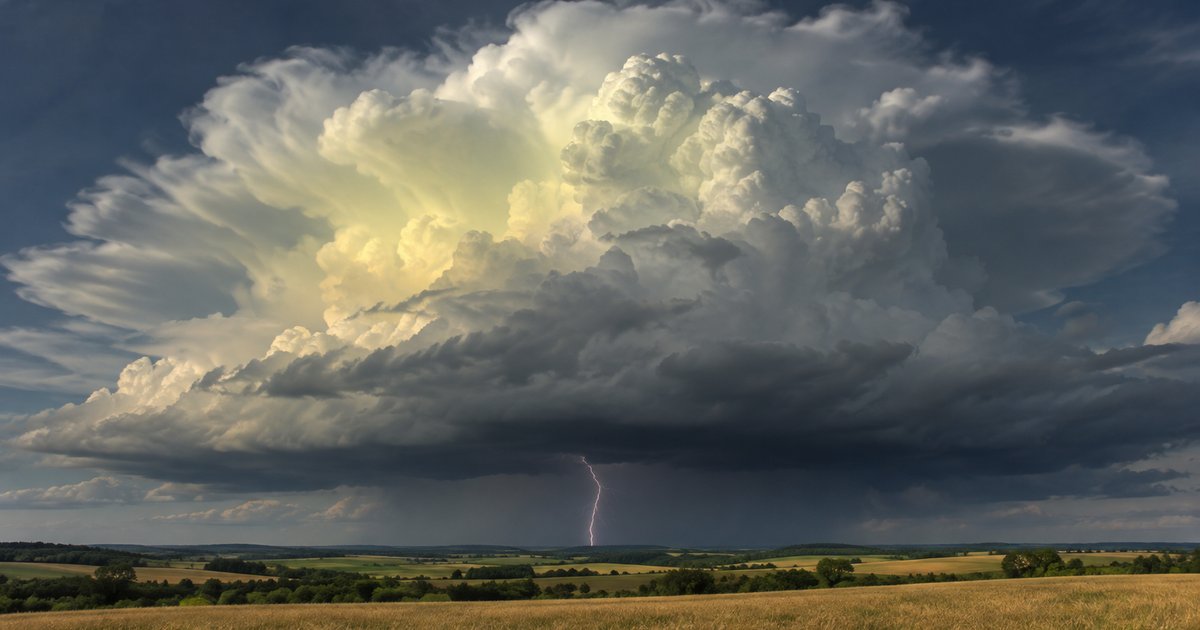
Summer lightning is common because warmth and moisture make deep, rising thunderstorms easier to build, but summer is not the peak season everywhere. In a 2016 analysis of detected cloud-to-ground flashes from 2005–2014, Holle, Cummins and Brooks found that 64% of the year’s flashes in their U.S.-and-adjacent study area occurred in June, July and August. Their maps also show places where spring or winter contributes more than summer.
The 64% number counts ground flashes, not every flash
The 2016 Holle, Cummins and Brooks study used the National Lightning Detection Network to count cloud-to-ground flashes over the contiguous United States and adjacent areas during 2005–2014. Researchers sorted detections into meteorological seasons: June through August is summer. The 64% share means nearly two-thirds of the detected annual ground flashes in that study area occurred in those three months. It does not apply to every kind of lightning on Earth or to every U.S. location.
The authors grouped flashes into roughly 12-mile by 12-mile (20-kilometer by 20-kilometer) grid cells and mapped each season's portion of each cell's annual total. They noted that detector upgrades affected reported densities across years. The U.S. lightning pattern by place also differs sharply: a national share cannot be assigned to an individual town.
Warmth helps when moisture and lift are present
NOAA's National Severe Storms Laboratory says a thunderstorm needs moisture, rising unstable air and a lifting mechanism. Instability means a parcel of air can keep rising after an initial push. Summer sun heats the ground and the air just above it; warm, humid lower air can then rise through cooler air aloft. The National Weather Service says most U.S. regions have enough moisture for storms in summer if those other ingredients are present. Heat alone does not create lightning: hot but dry or stable air may lack a deep thundercloud.
Lifting starts the ascent. NOAA lists hills, mountains and boundaries between warm and cold or wet and dry air as triggers. Sun-heated ground can also initiate rising air. As the air rises and cools, water vapor condenses and releases heat, helping the cloud grow upward. The afternoon thunderstorm pattern follows this daily rise in surface heating.
NOAA explains that a growing storm cloud reaches freezing levels, where collisions among different ice particles help separate electric charge. Enough separation can produce a flash. Summer's role is to make the deep, moist updraft environment more frequent in many places; the charge separation inside a storm still requires cloud ice and vigorous motion. A warm surface thermometer reading alone cannot tell whether a cloud will electrify.
Regional maps break the summer rule
The 2016 seasonal analysis found less than 40% of annual cloud-to-ground lightning in summer across southeastern Texas and Oklahoma. Its authors associated the smaller summer share with a persistent high-pressure ridge there; spring supplies a larger part of the year's activity. Their study also says California's Central Valley lightning occurs mainly in winter. The point concerns the share of a local annual total: the Pacific coast has low lightning density overall, so a winter majority there does not mean winter lightning is frequent in absolute terms.
The same study found more than 60% of annual flashes over the Florida Peninsula in summer and nearly all of Arizona's flashes in summer. The National Weather Service's Florida climatology attributes high June and later summer flash rates on the peninsula to interacting sea breezes from its two coasts. The 2016 analysis also shows summer accounts for more than 90% of detected lightning strokes across much of Canada, while southern U.S. areas receive a larger share outside summer.
Winter lightning and Southern Hemisphere summer change the calendar
The National Weather Service says thunderstorms can occur at any time of year over most of the United States. In winter, southern areas more often retain the needed moisture, and strong storm systems can carry moist air north. NOAA's lightning FAQ says winter air usually has less moisture and instability, but lightning can still occur in a snowstorm. That rarer combination is lightning inside a snowstorm.
A 2014 satellite climatology by Cecil, Buechler and Blakeslee measured total lightning, including flashes that never reach the ground, using observations gathered from 1995 through 2010. In that historical dataset, estimated global flash rate was about 35 per second in February, the Southern Hemisphere's summer, and 60 per second in August, the Northern Hemisphere's summer. These older measurements show why “summer” needs a hemisphere and why a worldwide monthly average differs from the U.S. ground-flash share.
Seasonal likelihood is not a forecast for today
The NOAA ingredient rule still applies in July: moisture, instability and lift have to coincide. A spring front or winter storm can also bring them together. Lightning Tracker's Premium iPhone forecast shows daily thunderstorm probabilities over several days, which can help plan an outdoor day when the seasonal average is too broad. The National Weather Service says to move to a substantial building or an enclosed metal-topped vehicle when thunder is heard, whatever the month.
Not a substitute for official weather warnings.
If you hear thunder, seek shelter even if the app shows no nearby strike.
Sources
- Vaisala, Seasonal Lightning Distributions over North America
- NOAA National Severe Storms Laboratory, Thunderstorm Basics
- National Weather Service, Thunderstorm Development
- NOAA National Severe Storms Laboratory, Lightning FAQ
- National Weather Service Melbourne, Florida Lightning Climatology
- Atmospheric Research, Gridded lightning climatology from TRMM-LIS and OTD
- National Weather Service, Lightning Tips