 Lightning Tracker
App Store
Storm basics
Was the First Lightning Photo Taken in 1882?
November 19, 2026 · 3 min read
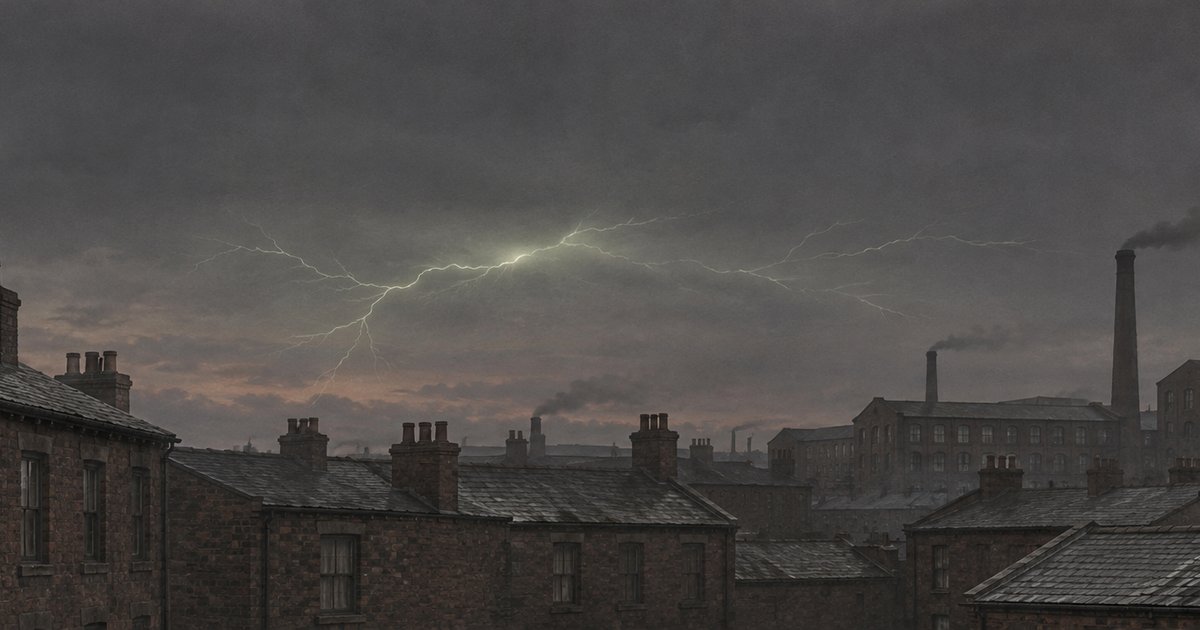
The Franklin Institute’s historical committee report dates William Nicholson Jennings’s first successful lightning photograph to September 2, 1882. But “the first photograph of lightning” is not an uncontested world record: the Institute later said it could not verify Jennings’s priority, and a 2016 art-history study points to an 1847 daguerreotype by Thomas Martin Easterly.
The dated event is Jennings’s successful 1882 exposure
The Franklin Institute’s committee report says Jennings had tried to photograph lightning in the summer of 1881, but his plates could not register such a short burst of light. In late summer 1882, plate maker John Carbutt supplied him with more sensitive “Rapid Eclipse” plates. The report dates the successful exposure to the evening of September 2, 1882. Its description of the image is specific: a main flash, three branches toward the ground, and an irregular path rather than a tidy zigzag.
The original committee document also calls the 1882 image Plate I and dates Jennings’s next successful photograph to August 1, 1885. The second image and a letter appeared in Scientific American on September 5, 1885, according to the report. The 2016 Panorama study by art historian Laura Turner Igoe notes that news coverage after the 1885 publication quickly called Jennings the first photographer to capture lightning.
The Franklin Institute did not certify world priority
The Franklin Institute’s case-file article explains that its awards committee debated whether Jennings had truly been first. Its final report said the Institute could not find a photograph before his 1882 image, yet the case-file account says the committee was unable to verify that Jennings was the first photographer of lightning. That finding describes the committee’s inquiry; it does not establish a world record.
Igoe’s 2016 study makes the competing claim explicit: it identifies a lightning daguerreotype made by St. Louis photographer Thomas Martin Easterly in 1847 as a more likely earlier image. A 2018 peer-reviewed comparison of lightning paintings and photographs likewise says Easterly made a daguerreotype on June 18, 1847, while noting that Jennings is often credited for 1882. A daguerreotype is a photograph made on a prepared metal plate, so an earlier surviving or documented daguerreotype matters to the word “first.”
The image tested an artistic claim about lightning’s shape
The Franklin Institute report says Jennings began the project to test whether the zigzag path commonly drawn by artists matched lightning. Its description of the 1882 plate found branches and an irregular course, but no regular zigzag. The Institute’s later case-file account says Jennings gathered many forms of lightning and used his images in lectures and articles. He was not merely preserving a dramatic instant: he treated the photograph as evidence about the path of an electrical discharge.
A modern flash still has bends and branches. The old conclusion was about a repeated, geometric zigzag motif, not a claim that every channel is straight. The 2018 research paper compared 100 paintings with 400 photographs of real lightning; its authors found that branching patterns differed between the two groups. Their study did not prove what Jennings saw in a particular 1882 storm, but it shows why photographs remain useful in checking a drawing against an observed phenomenon. Jennings’s plates recorded the visible result of leaders and return strokes.
Other nineteenth-century photographs broaden the record
The Metropolitan Museum of Art dates Charles Moussette’s Spiral of Lightning in a Thunderstorm to May 12, 1886. Its object record says he recorded two bolts on one glass-plate negative from his laboratory near Paris, then enlarged part of the negative to show an irregular spiral. The museum says Moussette published the image in 1886 and exhibited lightning photographs in 1888.
A single photograph can show a channel’s visible geometry, but by itself it does not identify every electrical feature of different types of lightning. A drawing or one frame can also omit faint branches. Jennings’s 1882 plate documented one visible flash path.
Lightning in a photograph should also not be treated as a cue to stand outdoors and watch a storm. The National Weather Service’s lightning myths page says to seek a substantial building or hard-topped vehicle as soon as thunder is heard.
For a storm you are observing today, Lightning Tracker, an iPhone app, shows recently detected strikes on a live map and the distance to the nearest one.
Not a substitute for official weather warnings.
If you hear thunder, seek shelter even if the app shows no nearby strike.
Sources
- Franklin Institute, The Work of William N. Jennings in the Photography of Lightning
- Franklin Institute, Case Files: William Jennings
- Panorama, Capturing Jove’s Autograph
- Metropolitan Museum of Art, Spiral of Lightning in a Thunderstorm
- Proceedings of the Royal Society A, How realistic are painted lightnings?
- National Weather Service, Lightning Myths