 Lightning Tracker
App Store
Places and activities
How to photograph lightning without standing in the storm
November 13, 2026 · 9 min read
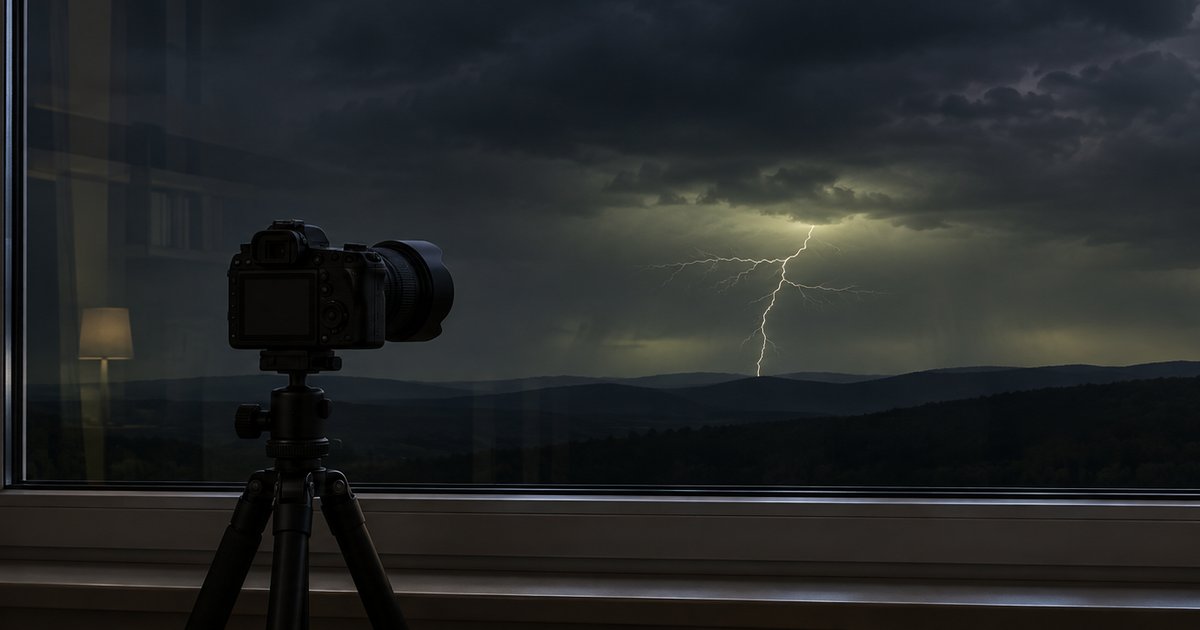
Photograph lightning from inside a substantial building or a hard-topped car with the windows closed, with the camera on a tripod, a remote release in your hand and focus set by hand, so that nothing requires you to stand beside it. The National Weather Service says no place outdoors protects you when thunderstorms are in the area, so the only outdoor case this page covers is a storm far enough away that you cannot hear its thunder, and the first rumble ends the shoot.
The National Weather Service gives photographers no outdoor exception
The National Weather Service (NWS) lightning safety overview says there is no protected place outdoors when thunderstorms are in the area, and that hearing thunder means you are likely within striking distance of the storm. Its working options are substantial buildings and hard-topped vehicles; rain shelters, small sheds and open vehicles are not among them. The same page tells people to plan ahead and to cancel or postpone activities early when thunderstorms are expected, which for a photographer means the camera is aimed and ready before the storm arrives.
Photography guidance points the same way. The National Park Service’s Grand Canyon photography page, last updated May 5, 2026, says photographers are more at risk from lightning because of the conductive metal in cameras and tripods, and tells visitors who see lightning or hear thunder to leave the rim and seek shelter immediately. The NWS lightning myths page says metal does not change where lightning strikes but does conduct it. Read together, the point is to stay away from the tripod, not to expect it to draw the bolt. The NWS storm spotter guide lists standing close to camera tripods among the ways spotters put themselves at risk, and reminds readers that the first strike they see may be the last.
The photographers’ own guides carry the same warning. Nikon USA’s guide by storm chaser Jim Reed says that anyone who can hear thunder is vulnerable to being struck. Mike Olbinski’s guide on Digital Photography School says a strike has hit within 75 feet of him. Gary Hart’s 2016 guide on Sony’s Alpha Universe site says no way of photographing lightning removes the risk, and then lists steps for someone caught outdoors, including crouching with feet together. The NWS says crouching does not make you any safer outdoors, so that list is not a substitute for shelter.
A building and a hard-topped car fit the rule; a storm you cannot hear is an exception with no margin
Photographers shoot from a building, from a hard-topped car, or from a distance, and the table shows what the sources leave open for each.
| Place | What the sources say | What they leave open |
|---|---|---|
| Substantial building | NWS: a working option if you avoid contact with corded phones, electrical equipment, plumbing, windows and doors | How far from the glass a camera operator should stay |
| Hard-topped car, windows closed | NWS: the outer metal shell protects the people inside; Nikon and Digital Photography School describe shooting from a vehicle | Whether Nikon’s window mount means an open window |
| Storm too far to hear | NWS: thunder is heard only about 10 miles from a flash; bolts from the blue strike 10 to 15 miles from the storm. Hart tries to stay within a quick sprint of his car, and the first thunder ends the shoot | The NWS names no distance outdoors that protects you |
A building is the first option the NWS names, but its conditions collide with the shot. The overview says that once inside you should avoid contact with corded phones, electrical equipment, plumbing, and windows and doors, and should keep away from outside doors and windows. The camera guides cited here do not say how close to the glass is acceptable, so the NWS wording remains the rule: keep yourself and anything you touch away from windows and doors, and run the camera by remote. Canon’s guide notes that if you have no remote trigger, its camera app can release the shutter from a smartphone.
A hard-topped car is the second option. The NWS says the outer metal shell of such a vehicle protects the people inside when the windows are closed, and that the vehicle itself does not always fare well: damage to the antenna, electrical system, rear windshield and tires is common. Nikon’s guide suggests staying in a hard-topped vehicle and shooting with a window mount, but it does not say where the window sits, and the NWS statement covers closed windows. The version that matches the NWS wording is a camera looking through closed glass; Canon’s guide recommends an anti-reflection lens hood for shooting through windows. Olbinski prefers a wireless intervalometer because it lets him control the camera from inside the car.
The third place is a storm you cannot hear. The NWS defines heat lightning as lightning from a storm too far away to see the flash or hear the thunder, and says thunder can be heard only about 10 miles from a flash. That is no promise of distance: the NWS also says bolts from the blue can strike 10 to 15 miles from the thunderstorm, and it names no distance at which standing outdoors protects you. Hart’s 2016 Sony article says his goal is to photograph lightning that is happening somewhere else, and that if he is in the storm he is too close. His blog says he tries never to shoot more than a quick sprint from his car, puts the umbrella down and runs for cover once lightning is within 10 miles, and treats hearing thunder as being too close. The blog says most strikes land within a ten-mile radius of the previous one, while the Sony article says six miles, so no radius here should be treated as a margin. The NWS says dividing the seconds between flash and thunder by five gives the distance in miles, but any thunder at all is the signal to go in.
Camera makers and storm photographers agree on a slow shutter and low ISO but not on the numbers
Canon, Nikon, Sony’s Alpha Universe site and two storm photographers all start from manual exposure, and their starting points differ, as the table shows.
| Guide | Shutter | Aperture | ISO |
|---|---|---|---|
| Canon, Chris Ambler (updated January 29, 2026) | Daylight 1/60 second; sunrise or sunset 1 to 2 seconds; night 3 to 6 seconds | Not wider than f/4, even at night | Raised when more brightness is needed |
| Nikon USA, Jim Reed (undated) | Bulb, closed after the flash; with a trigger, 1/4 second in shutter priority | f/5.6 | 400; 250 with the trigger |
| Sony Alpha Universe, Gary Hart (2016) | Daylight 1/15 to 1/4 second | f/16 or smaller, with a polarizer | Often 50 |
| Digital Photography School, Mike Olbinski (undated) | Daylight: the slowest you can; city night 10 to 15 seconds; very dark 20 to 30 seconds | Daylight f/16 to f/22; dark f/5.6 to f/8; city f/10 to f/16 | 100 after dark away from lights |
| Stu Short (page titled 2024) | Set after the aperture, to suit the ambient light | Daylight f/7.1 to f/16; night opened all the way | Almost always 100 |
The guides explain their choices differently. Canon says the key is a slow shutter speed, because a fast one may miss the entire strike, and that a large strike can blow out the frame, so its author shoots RAW and underexposes by one to two stops. Short argues that the flash lasts about a thousandth of a second, so the aperture, not the shutter speed, decides how bright it looks. Hart says that in daylight a shutter slower than 1/4 second washes the lightning out, so a neutral density filter is not a way to dial in a long exposure, while Olbinski says he tried filters and found they tend to wash out the lightning a little. Nikon’s guide adds that the less time the shutter is open, the sharper the bolt, unless you want several bolts in one frame. Canon says the settings have to keep changing as the storm moves, and Reed’s advice is to review the first few frames and then change the ISO up or down.
Manual focus, a heavy tripod and a remote release matter more than the camera body
Canon’s minimum kit for lightning photography is a camera with manual settings, a sturdy tripod or clamp, a way to release the shutter remotely, and rain covers. Olbinski says basic DSLRs and entry-level mirrorless cameras are a good starting point, and wind can knock over a light tripod. Focus is the usual failure: Olbinski calls out-of-focus frames the most common mistake and suggests focusing on distant lights, or zooming in Live View on a single distant light and focusing by hand, with the lens’s infinity mark as a last resort. Canon and Nikon both say to switch to manual focus, and Nikon adds that setting the lens to infinity will not always give the sharpest image.
Timing is the other problem. Olbinski uses a wireless intervalometer, and in daylight he shoots every second or two in the hope of catching a bolt. Canon’s author sets the interval to his shutter time plus one second. A lightning trigger fires the shutter when it senses a flash. Hart’s guide says a good one detects lightning at least 20 miles away and, by his estimate, fired at least 95 percent of the time when lightning appeared in his frame, though many clicks come from lightning he cannot see. Olbinski says cheaper triggers often miss strikes, and Short, who does not own one, says he has watched triggers fire empty shots in daylight and miss strikes, and that bolts at the July 2019 Hagerman supercell came too fast for one. Hart says a camera’s shutter lag should be no slower than 60 milliseconds, with 120 milliseconds still workable.
Apple’s iPhone support pages describe Live Photos and Night mode but do not mention lightning
Apple’s support page on Live Photos says the iPhone records what happens 1.5 seconds before and after you take a picture, and that you can add an effect named Loop, Bounce or Long Exposure afterward; the page does not describe how Long Exposure works. Apple’s Night mode page says the iPhone turns it on in low light, that a photo can take several seconds depending on how dark the scene is, and that a solid surface or a tripod helps. Neither page mentions lightning. Short says motion photos on some phones capture a few seconds before and after the press, so a bolt may appear in the earlier frames; the Live Photo recording window is the Apple counterpart. Short adds that a phone can take lightning photos if it lets you control the exposure by hand.
Gear left outdoors has to wait for the 30 minutes
A tripod camera set up before the storm and triggered from inside is an outdoor arrangement Nikon’s guide offers, and it puts the camera at risk instead of you. It also creates a retrieval problem. The NWS says to wait 30 minutes after the last lightning or thunder before going back outside, and that many people go out too soon, waiting only for the rain to lighten or end. Hart advises getting everything ready before the first bolt if the sky looks even a little promising, which fits the NWS advice to plan ahead; the camera outdoors is a decision made early, not a reason to step out at the first rumble.
What Lightning Tracker adds, and what it does not
Lightning Tracker is an iPhone app, free on the App Store, that shows recently detected strikes on a live map, with the distance and direction to the nearest one and how many minutes ago it was detected. It alerts you when a strike is detected inside a radius you set for each place, 10 miles (16 km) by default. For a photographer that is one more input for deciding to stop shooting and go inside; it does not make any outdoor spot protected. Detection networks miss some strikes, especially weak ones, and data can arrive late, so thunder overrides the map. The app does not replace official warnings or local procedures.
Not a substitute for official weather warnings.
If you hear thunder, seek shelter even if the app shows no nearby strike.
Sources
- National Weather Service, Overview: Lightning Safety
- National Weather Service, Lightning Myths
- National Weather Service, Heat Lightning
- National Weather Service, Vehicles and Lightning
- National Weather Service, Understanding Lightning: Thunder
- National Weather Service Norman, Storm Spotting
- National Park Service, Grand Canyon National Park, Photography 101
- Canon Singapore, Lightning Photography 101, Canon Snapshot
- Nikon USA, How to Photograph Lightning
- Sony Alpha Universe, The Definitive Guide To Photographing Lightning, Gary Hart, 2016
- Gary Hart, Lightning, Eloquent Images
- Digital Photography School, How to Photograph Lightning: The Ultimate Guide, Mike Olbinski
- Stu Short Photography, Lightning Photography Guide (2024)
- Apple Support, Take and edit Live Photos
- Apple Support, Use Night mode on your iPhone