 Lightning Tracker
App Store
Storm basics
Can lightning shatter or melt rock?
November 19, 2026 · 4 min read
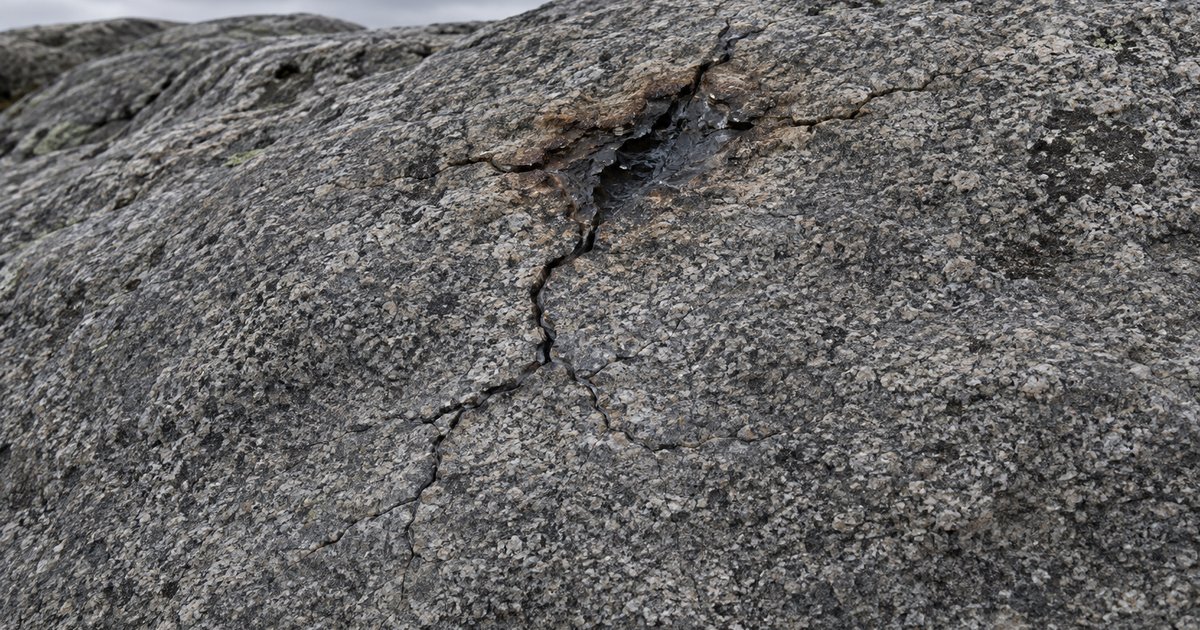
Yes. In a 2012 laboratory study of three rock types, lightning-like impulses broke tuff and rhyolite, and left the tested granite unbroken; field studies also document thin glassy melt on struck granite. The outcome depends on the rock and the discharge, and published model values are estimates for particular assumptions.
Breakage depends on the rock being hit
Wakasa and colleagues reported the clearest direct comparison in a 2012 Geomorphology experiment. Their impulse generator struck samples of tuff, rhyolite, and granite. The tuff and rhyolite samples broke, while the stronger granite sample did not break under those tests. The generator reached up to 20,000 amperes, but its voltage was much lower than natural lightning voltage. The researchers explicitly described their artificial impulses as different from natural lightning. The comparison demonstrates a possible fracture process, not a prediction that a particular outdoor boulder will explode.
Rock strength is only one part of the result of a ground discharge. A natural strike may take a path along a surface or through an existing fracture, and the 2021 Scientific Reports study of granitic gneiss found both a surface glass layer and glass inside a shallow fracture. The authors recovered heavily fractured quartz and feldspar enclosed by glass in the fracture sample. They observed the altered material down to about 6.6 feet (2 meters) below the top of their outcrop. That was a measured site depth; the paper's separate modeling of deeper possible current paths does not establish how deeply every strike reaches.
Heat can melt a thin surface without melting a whole boulder
Elmi and colleagues examined lightning-altered granite from Mount Mottarone, Italy, in a 2017 American Mineralogist study. They found a brown-black, glassy, porous coating rather than a boulder turned to glass. The coating contained glass with quartz and cristobalite crystals. Its mineral assemblage suggested that the altered surface exceeded about 3,092 °F (1,700 °C), under the authors' equilibrium assumption. Their microscopy and chemical analysis tie the glass to abrupt electrical heating followed by cooling. That is direct material evidence, not a temperature reading taken during the strike.
NOAA's National Severe Storms Laboratory also describes a ground strike fusing dirt and clay into a glassy product called a fulgurite. Rock fulgurites can appear as a surface crust rather than the hollow tube often pictured in sand. The form of the glass is a narrower question than whether solid rock can crack or melt. The 2017 granite sample shows that heat from a lightning channel can melt the target locally where the current acts, while nearby rock remains recognizable.
Shock and electrical heating act together
Chen and colleagues published an idealized model in Geophysical Research Letters in 2017. They modeled a lightning channel above granite and current spreading through the rock. In that setup, a rapid shock wave loads the surface while electrical resistance heats material near the current path. Their model produced pressures above about 1 million pounds per square inch (7 gigapascals) near the strike, a melted region with an estimated radius of about 3.5 inches (9 centimeters), and a larger scorched region. Those values are model outputs for chosen geometry and energy, not universal field measurements or dimensions to expect after a strike.
The 2017 model was motivated partly by earlier observations of planar deformation features in quartz from rock fulgurites. Such microscopic features record intense shock, and the paper argues that lightning can produce them as well as melting. The 2021 granitic-gneiss study adds a more complicated field case: the authors measured high residual stress in feldspar, found glass along a fracture, and interpreted a rapid rise in temperature and pressure in a fluid-filled crack as a possible cause of simultaneous melting and breakage. They cautioned that the absolute pressure and temperature of that natural event could not be determined from the preserved material.
What should a rock strike leave behind?
The published examples do not support one standard appearance. The 2012 laboratory test produced very different fracture outcomes across three materials. The 2017 granite work documented a thin dark crust; the 2021 field work documented both crust and fractured, glass-infiltrated material below the surface. A lightning strike may leave local burn marks or glass while much of the rock remains solid, just as a struck tree can show damage localized along the current path. It can also fracture material when current and pressure concentrate in favorable paths. These observations say what can happen, not that every scar, crack, or dark patch was made by lightning.
If you are looking at a storm rather than an old strike mark, Lightning Tracker, an iPhone app, maps recent detected lightning strikes and shows the distance and direction to the nearest one.
Not a substitute for official weather warnings.
If you hear thunder, seek shelter even if the app shows no nearby strike.
Sources
- Elsevier, Does Lightning Destroy Rocks?
- American Geophysical Union, Generation of Shock Lamellae and Melting in Rocks
- Mineralogical Society of America, Mineralogical and Compositional Features of Rock Fulgurites
- Nature Portfolio, Lightning-Induced High Temperature and Pressure Microstructures
- NOAA National Severe Storms Laboratory, Lightning FAQ