 Lightning Tracker
App Store
Using the app
Phone lightning alert app versus a handheld detector
November 16, 2026 · 5 min read
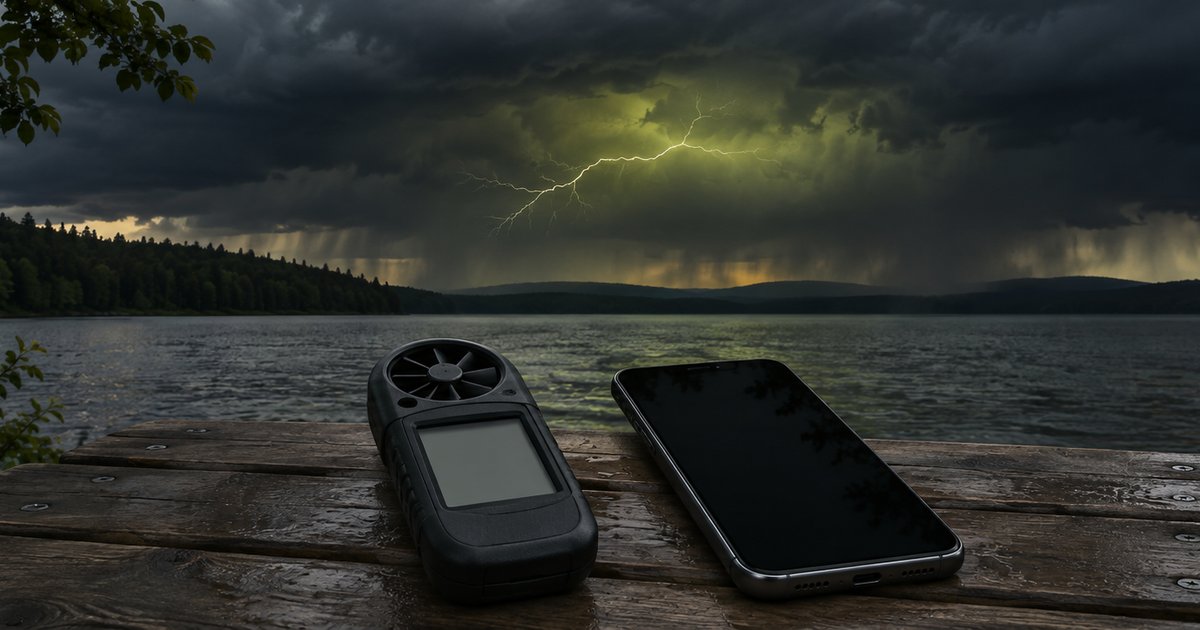
Choose a phone lightning alert app when mapped detections and alerts for several places matter; consider a handheld detector when you need a local receiver without a phone data connection. The June 2021 OSHA/NOAA lightning fact sheet says handhelds estimate distance from a received electromagnetic pulse, while commercial detection services can map strikes and send range alerts. Neither tool detects every strike or replaces a plan for thunder, shelter and stopping activity.
What each tool actually receives
A handheld detector listens at its own antenna. The June 2021 OSHA/NOAA fact sheet says portable detectors receive the electromagnetic signal from a nearby strike and process it to estimate distance. It also says they typically miss some strikes and cannot place a strike on a map. The detailed workings of individual models belong in how handheld lightning detectors work; the choice here is whether a local receiver suits the places and people you watch.
A phone alert app instead displays results produced elsewhere. Blitzortung's undated network documentation explains that several radio receiver sites send the arrival time of a lightning impulse and their positions to a central server, which calculates the discharge position. Earth Networks' undated account of its own system similarly says multiple stations compare arrival times to locate a strike. A phone can display those mapped results; that does not mean the phone itself detects radio impulses. Different networks and satellite feeds can produce different maps, as the sources behind lightning maps illustrate.
The useful tradeoffs
The comparison is about what must be working when you need the information. A self-contained handheld receiver can keep listening without a cellular data connection, provided its batteries and sensor work. A network-based app needs the remote detection, a path to the phone, a data check, and notification delivery. Neither chain is flawless. The OSHA/NOAA fact sheet says handhelds typically miss strikes; the Lightning Tracker app's documented limits say networks can miss some too, especially weak strikes, and data can arrive late.
| Question | Phone alert app | Handheld detector |
|---|---|---|
| Where does the observation start? | At a remote detection network; the phone receives its reported result. | At the detector's own antenna, where it is carried or placed. |
| What does distance mean? | Distance from a location to a reported, mapped detection. | An estimated distance from the signal picked up locally. |
| What has to keep working? | Data service, app checks, phone settings and notification delivery. | Battery, sensor and a position without disruptive interference. |
| What can go wrong? | Missed or delayed network detections and delayed phone checks. | Missed strikes and no mapped strike location; interference can also cause false alarms in some sensors. |
These are system differences, not a tested accuracy ranking. The June 2021 OSHA/NOAA fact sheet compares handheld detectors with commercial detection and notification services, saying handhelds are less accurate and cannot report a strike's location. That statement does not measure every consumer app or handheld model. It is a reason to inspect the data source, delay, radius controls and delivery behavior of any particular app, the questions in choosing a lightning alert app.
When a handheld helps, and where it can fail
A handheld is useful to consider where a phone's data path may be unavailable, but its antenna must be able to hear the strike amid local electrical noise. Ambient Weather's 2020 WH31L manual says interference from appliances, fluorescent lights and engines can produce false alarms or missed strikes in that sensor. The same manual warns that personal detectors cannot give the exact strike location. That particular WH31L also requires a compatible weather-station console to view its readings, so a buyer should verify that a proposed device really works on its own.
The OSHA/NOAA fact sheet adds a harder limit: no detection system can detect the first strike in a developing storm before it happens. It recommends monitoring forecasts and radar when advance notice matters and watching the sky for nearby development. A quiet handheld is therefore not permission to wait outdoors for its first alarm. If thunder is audible, the National Weather Service says you are likely within striking distance; go to a substantial building or hard-topped vehicle.
When a phone helps, and where alerts can fail
A phone is useful when a mapped detection and alerts for specific places matter. Lightning Tracker is an iPhone app that shows recently detected strikes on a live map, the distance and direction to the nearest one, and how many minutes ago it was detected. It alerts when a strike is detected inside a radius set for each place, 10 miles (16 km) by default. Those features serve a coach watching a field and a person checking a saved location, without asking either to interpret a handheld's distance estimate. Choosing an alert radius is a separate decision about how long your group needs to reach shelter.
The app's documented limits matter as much as its map. Detection data may arrive late, and the app labels delays or gaps. iOS decides when a closed app can check in the background; Focus, background refresh and Low Power Mode can affect delivery. Its alerts are local notifications after a check, so a phone left in a bag should never be the only way conditions are watched. Lightning Tracker does not replace official warnings or local procedures.
A checklist before anyone goes outside
The June 2021 OSHA/NOAA guidance asks outdoor employers to identify shelters, the time people need to reach them, how warnings are communicated, and when activity stops and resumes. A coach or event lead can use the same questions without treating a purchase as a complete procedure:
- Choose the shelter first. Identify a substantial building or hard-topped vehicle and measure the time for everyone to get there. A tent, open pavilion or dugout is not the shelter named by the NWS.
- Assign a watcher and a stop signal. Decide who checks forecasts, sky and thunder, who can stop activity, and how everyone hears that decision. An outdoor lightning plan sets out these duties for a worksite.
- Test the actual tool at the actual place. For an app, check data reception, notification permissions, delivery settings and the selected radius. For a handheld, check power, display, placement and interference. These checks test operation, not detection accuracy.
- Write the override. NWS guidance says to move inside at a threatening sky or thunder even when no device reports a nearby strike. The NWS also says to wait 30 minutes after the last lightning or thunder before going back outside.
For a single person away from cellular service, a working handheld may provide extra local observations. For a lead watching several places, a mapped phone alert may be easier to coordinate. Either way, the NWS's thunder and shelter rules decide the action, and no silent screen or detector establishes an all-clear.
Not a substitute for official weather warnings.
If you hear thunder, seek shelter even if the app shows no nearby strike.
Sources
- OSHA and NOAA, Lightning Safety When Working Outdoors
- National Weather Service, Overview: Lightning Safety
- Blitzortung/LightningMaps, General
- Earth Networks, Lightning Detection: Everything You Need to Know
- Ambient Weather, WH31L Lightning Detector Manual